2026 Retirement Planning Guide: Limits, Brackets, SECURE 2.0
Updated contribution limits, federal tax brackets, IRMAA thresholds, and SECURE 2.0 changes — and how each one shifts your retirement strategy.
📋Key Takeaways
- $7,500 (under 50)
- $8,600 (50+)
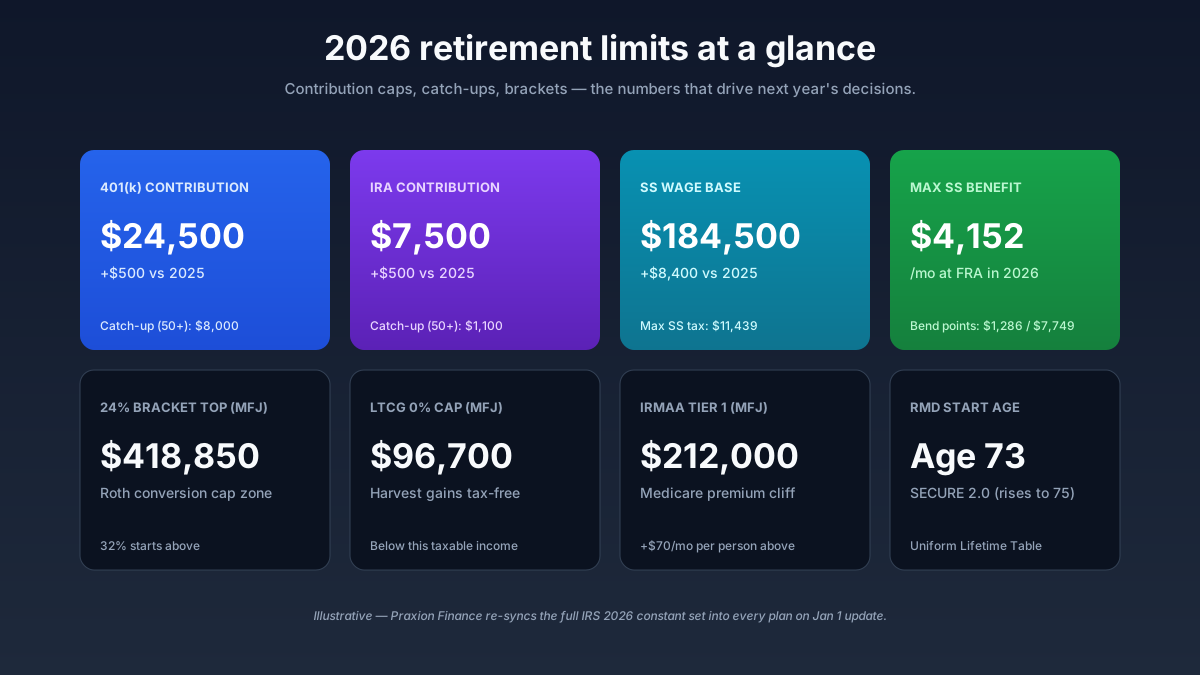
- $24,500 base
- +$8,000 catch-up (50+)
- +$11,250 super catch-up (60-63)
- Single/HoH: $153,000-$168,000
- Married: $242,000-$252,000
- HSA: $4,400/$8,750
- FSA: $3,400
Introduction: Why 2026 Retirement Contribution Limits Matter
The 2026 retirement contribution limits bring significant changes to your financial planning strategy. This year, the IRS has updated 2026 401(k) and IRA limits, adjusted tax bracket changes for 2026, and the SECURE 2.0 catch-up rule takes full effect. Understanding these updates is essential for anyone building a retirement tax strategy for 2026 — whether you're actively saving or transitioning into retirement.
For 2026, the changes create meaningful opportunities to:
- Save more in tax-advantaged accounts
- Reduce taxable income
- Improve long-term retirement outcomes
This article breaks down the 2026 updates in plain English and explains how thoughtful planning can turn regulatory changes into financial advantages.
Understanding Inflation Adjustments and IRS Changes
The IRS applies inflation indexing to tax brackets and contribution limits to prevent "bracket creep" — a situation where rising wages push taxpayers into higher tax brackets without an actual increase in purchasing power. IRS Revenue Procedure 2025-32 | IRS Notice 2025-67 | IRS News Release IR-2025-103
In 2026:
- Contribution limits increased across major retirement accounts
- Tax bracket thresholds shifted upward
- Standard deductions increased
These adjustments help protect your income — but only if your financial plan evolves alongside them.
2026 Retirement Contribution Limits: 401(k) and IRA Updates
One of the most impactful updates for 2026 is the increase in retirement savings limits.
2026 401(k) Contribution Limits: 401(k), 403(b), and 457 Plans
This means individuals in their peak earning years can potentially contribute over $35,000 annually to tax-advantaged retirement accounts. The super catch-up applies specifically to 401(k) plans for participants ages 60-63, per IRS Notice 2025-67.
2026 IRA Contribution Limits
Under 50: $7,500 maximum contribution. Age 50+: $7,500 base + $1,100 catch-up = $8,600 total contribution. IRAs, though smaller than employer plans, remain critical for tax diversification and long-term retirement savings.
| Age | Base Limit | Catch-Up | Total Possible Contribution |
|---|---|---|---|
| Under 50 | $7,500 | – | $7,500 |
| 50+ | $7,500 | $1,100 | $8,600 |
Note: These contributions are separate from employer retirement plans and the catch-up is added on top of the base limit, not included within it. IRS Notice 2025-67 | IRS IRA Limits
⚠️ Income Phase-Outs for IRA Eligibility (2026)
Critical for tax planning: Income limits determine your eligibility for Roth IRA contributions and deductible Traditional IRA contributions. These phase-outs are adjusted annually for inflation.
Roth IRA Eligibility (2026)
- Single filers and Head of Household: Phase-out begins at $153,000, ends at $168,000
- Married filing jointly: Phase-out begins at $242,000, ends at $252,000
Traditional IRA Deduction (2026) — If you or your spouse are covered by a workplace retirement plan:
- Single: Phase-out $81,000 – $91,000
- Married filing jointly: Phase-out $129,000 – $149,000
For complete details and verification, refer to IRS Notice 2025-67 | IRS IRA Limits
SIMPLE IRA Contribution Limits 2026
SIMPLE (Savings Incentive Match Plan for Employees) IRAs are retirement plans for small businesses. For 2026, the contribution limits are:
Source: IRS Notice 2025-67 | IRS SIMPLE IRA Limits
Saver's Credit (Retirement Savings Contributions Credit) 2026
The Saver's Credit is a tax credit for low- and moderate-income taxpayers who contribute to retirement accounts. This credit can reduce your tax bill dollar-for-dollar, making it a valuable incentive to save for retirement.
2026 Saver's Credit Income Limits
The credit amount is based on your adjusted gross income (AGI) and filing status. Income limits are adjusted annually for inflation.
| Filing Status | 50% Credit | 20% Credit | 10% Credit |
|---|---|---|---|
| Married Filing Jointly | Up to $48,500 | $48,501 – $52,500 | $52,501 – $80,500 |
| Head of Household | Up to $36,375 | $36,376 – $39,375 | $39,376 – $60,375 |
| All Other Taxpayers | Up to $24,250 | $24,251 – $26,250 | $26,251 – $40,250 |
Source: IRS Notice 2025-67 | IRS Saver's Credit
SECURE 2.0 Retirement Rules: Roth vs Traditional in 2026
The decision between Roth and traditional contributions becomes more important as limits increase.
Traditional Contributions
- Reduce taxable income today
- Ideal for higher earners expecting lower retirement tax rates
- Tax-deferred growth
Roth Contributions
- Tax-free growth and withdrawals
- No required minimum distributions (RMDs) for Roth IRAs
- Required for certain high-income catch-up contributors beginning in 2026
⚠️ New Rule Alert
SECURE 2.0 Rule: If you earn over $150,000 (2026, indexed for inflation) and make catch-up contributions to employer plans, those contributions must now be Roth (after-tax). This rule change shifts tax planning from "tax deferral" to tax diversification and is worth a callout for high earners. IRS Notice 2025-67 | IRS Catch-up Rules
HSA & FSA Contribution Limits 2026
Health Savings Accounts (HSAs) and Flexible Spending Accounts (FSAs) are often overlooked but offer significant tax advantages. Adding these numbers makes your retirement planning more comprehensive.
HSA Contribution Limits 2026
| Coverage Type | Base Limit | Catch-Up (55+) | Total Possible |
|---|---|---|---|
| Self-only coverage | $4,400 | $1,000 | $5,400 |
| Family coverage | $8,750 | $1,000 | $9,750 |
Source: IRS Revenue Procedure 2025-32 (PDF) | IRS News Release IR-2025-103 | IRS Publication 969
FSA Contribution Limit 2026
$3,400 for health FSAs (Flexible Spending Accounts), up from $3,200 in 2025. For cafeteria plans that permit the carryover of unused amounts, the maximum carryover amount is $680. IRS Revenue Procedure 2025-32, Section 4.15 (PDF) | IRS News Release IR-2025-103
💎HSA Triple Tax Advantage
Tax-Deductible Contributions
Reduce your taxable income when you contribute
Tax-Free Growth
Investment earnings grow without tax drag
Tax-Free Withdrawals
Qualified medical expenses are tax-free
This triple advantage makes HSAs one of the most powerful retirement savings tools available
2026 Federal Tax Bracket Adjustments
⚠️ Important: Tax bracket thresholds and standard deduction amounts shown below are from IRS Revenue Procedure 2025-32 (Section 4.01 for tax brackets, Section 4.14 for standard deduction) as referenced in IRS News Release IR-2025-103.
Tax brackets increased roughly in line with inflation, meaning higher income thresholds before moving into the next bracket. This means you can earn more income in 2026 before being pushed into a higher tax bracket. IRS 2026 Tax Brackets & Standard Deduction
2026 Federal Income Tax Brackets
| Tax Rate | Single Filers | Married Filing Jointly | Head of Household |
|---|---|---|---|
| 10% | $0 – $12,400 | $0 – $24,800 | $0 – $17,700 |
| 12% | $12,401 – $50,400 | $24,801 – $100,800 | $17,701 – $67,450 |
| 22% | $50,401 – $105,700 | $100,801 – $211,400 | $67,451 – $105,700 |
| 24% | $105,701 – $201,775 | $211,401 – $403,550 | $105,701 – $201,750 |
| 32% | $201,776 – $256,225 | $403,551 – $512,450 | $201,776 – $256,200 |
| 35% | $256,226 – $640,600 | $512,451 – $768,700 | $256,201 – $640,600 |
| 37% | $640,601+ | $768,701+ | $640,601+ |
| Standard Deduction | $16,100 | $32,200 | $24,150 |
* These brackets apply to taxable income after deductions. The standard deduction for 2026 is $16,100 for single filers and $32,200 for married couples filing jointly. Tax bracket thresholds are from IRS Revenue Procedure 2025-32, Section 4.01 (PDF) and standard deduction amounts are from Section 4.14 (PDF) as referenced in IRS News Release IR-2025-103.
What This Means for Your Paycheck and Tax Liability
Understanding how these bracket adjustments affect you personally can help you make better financial decisions:
- More take-home pay: If you received a cost-of-living raise that matches inflation, you may actually see a slight increase in your take-home pay because more of your income falls into lower brackets.
- Lower effective tax rate: Even if your gross income increases, the higher bracket thresholds mean you might pay a lower effective tax rate on your total income compared to 2025.
- Bracket protection: A 3-4% raise that keeps pace with inflation won't push you into a higher bracket, so your marginal tax rate stays the same while your after-tax income increases.
- Tax planning opportunities: The expanded brackets create more "headroom" for strategic moves like Roth conversions, capital gains harvesting, or timing retirement account withdrawals to stay in lower brackets.
Strategic Planning Benefits:
- You may stay in a lower tax bracket even with a raise
- Roth conversions may be more attractive with expanded brackets
- Capital gains and retirement withdrawals can be timed more efficiently
- More flexibility for income smoothing strategies in retirement

Standard Deduction Increase
The standard deduction has also increased for 2026 under the One, Big, Beautiful Bill. Standard deduction amounts are from IRS Revenue Procedure 2025-32, Section 4.14 (PDF) as referenced in IRS News Release IR-2025-103.
- Single filers and married filing separately: $16,100
- Married filing jointly: $32,200
- Head of household: $24,150
- Shields more income from taxation
- Makes itemizing less necessary for many households
Retirement Tax Strategy 2026: Smart Planning Tips
1️⃣Maximize Employer Contributions
If you receive an employer match, ensure you're contributing enough to take advantage of 100% of the employer match — especially with higher limits. The matched amount compounds along with your contributions over time.
2️⃣Review Roth Conversion Opportunities
With adjusted brackets, some clients may find themselves in temporarily lower tax brackets — an ideal time for partial Roth conversions. This strategy can help you lock in today's rates and enjoy tax-free withdrawals in retirement.
3️⃣Coordinate Retirement and Tax Planning
Retirement planning isn't just about saving — it's about:
- When you withdraw
- From which accounts
- At what tax rate
This is where proactive planning adds significant value.
4️⃣Consider HSA Contributions
Health Savings Accounts offer a triple tax advantage — contributions are tax-deductible, growth is tax-free, and qualified withdrawals are tax-free.
For 2026, HSA limits are $4,400 (self-only) and $8,750 (family), with a $1,000 catch-up for ages 55+. FSA limits are $3,400 for health FSAs, with a maximum carryover of $680 for unused amounts. See the HSA and FSA section above for complete details.
💡 Practical Planning Tips for 2026
Catch-Up Contributions (Age 50+)
If you're 50+, maxing out your catch-up contributions can significantly boost your retirement savings. For IRAs, that's an extra $1,100 on top of the $7,500 base limit, bringing your total to $8,600.
High Earners & Roth IRA Phase-Outs
High earners should check Roth IRA phase-outs or consider a backdoor Roth. If you earn over $150,000 (2026, indexed for inflation) and make catch-up contributions, those must be Roth under SECURE 2.0.
Super Catch-Up (Ages 60-63)
Review your 401(k) plan to take advantage of the super catch-up if you're age 60-63. This allows up to $11,250 in additional contributions, potentially bringing your total to over $35,000 annually.
Planning for Pre-Retirees and Retirees
For those nearing or already in retirement:
- Higher limits may affect part-time work contributions
- Tax brackets impact Social Security taxation
- Withdrawal sequencing becomes critical
A well-coordinated plan can:
- Extend portfolio longevity
- Reduce lifetime taxes
- Increase predictable income
Final Thoughts: Turning IRS Changes into Opportunity
The 2026 updates aren't just administrative changes — they're planning opportunities. When aligned with a personalized financial strategy, higher limits and adjusted brackets can significantly improve long-term outcomes.
Whether you're accumulating wealth, preparing for retirement, or managing retirement income, staying proactive — not reactive — is the key to financial confidence.
Frequently Asked Questions (FAQs)
What are the 2026 401(k) contribution limits?
For 2026, the 401(k) employee contribution limit is $24,500. If you are age 50 or older, you can contribute an additional $8,000 catch-up contribution. Ages 60-63 qualify for a super catch-up of up to $11,250, allowing total contributions of over $35,000.
How do SECURE 2.0 changes affect catch-up contributions in 2026?
Under SECURE 2.0, if you earn over $150,000 (2026, indexed for inflation) and make catch-up contributions to employer retirement plans, those contributions must now be Roth (after-tax) starting in 2026. This shifts tax planning from tax deferral to tax diversification.
Should I consider Roth conversions in 2026?
With adjusted tax brackets in 2026, some individuals may find themselves in temporarily lower tax brackets—an ideal time for partial Roth conversions. This strategy locks in current tax rates and provides tax-free withdrawals in retirement.
What changed in the standard deduction for 2026?
The standard deduction increased for 2026 to $16,100 for single filers and $32,200 for married filing jointly. For head of household, the standard deduction is $24,150. This shields more income from taxation and makes itemizing less necessary for many households. Source: IRS Revenue Procedure 2025-32, Section 4.14.
What are the 2026 IRA contribution limits?
For 2026, the Traditional and Roth IRA contribution limit is $7,500 for individuals under age 50. If you are age 50 or older, you can contribute an additional $1,100 catch-up, bringing the total possible contribution to $8,600. The catch-up is added on top of the base limit, not included within it. These contributions are separate from employer retirement plans. IRAs, though smaller than employer plans, remain critical for tax diversification and long-term retirement savings.
How do income phase-outs affect my ability to contribute to a Roth or deduct a Traditional IRA?
Income phase-outs are critical for tax planning. For Roth IRA eligibility in 2026, single filers and head of household phase-out between $153,000-$168,000, and married filing jointly phase-out between $242,000-$252,000. For Traditional IRA deductions (if you or your spouse are covered by a workplace plan), single filers phase-out between $81,000-$91,000, and married filing jointly phase-out between $129,000-$149,000. If you exceed these limits, you may need to consider a backdoor Roth strategy or non-deductible Traditional IRA contributions. Always consult with a tax professional to determine your specific eligibility.
Get a Personalized Financial Review
Want to see how these 2026 changes impact your personal plan? Use Praxion Finance's free retirement planning tools to create a customized review that can help align your savings, taxes, and retirement goals.
Official Sources & References
All data and figures cited in this article are sourced directly from official IRS and Treasury Department publications:
- Retirement Contribution Limits (401(k), IRA, SIMPLE IRA, Saver's Credit): IRS Notice 2025-67 (PDF) | IRS 401(k) Limits | IRS IRA Limits
- Catch-up Contributions & SECURE 2.0 Rules: IRS Notice 2025-67 (PDF) | IRS Catch-up Rules
- Tax Brackets & Standard Deduction: IRS Revenue Procedure 2025-32 (PDF) (Section 4.01 for tax brackets, Section 4.14 for standard deduction) | IRS News Release IR-2025-103
- HSA & FSA Limits: IRS Revenue Procedure 2025-32 (PDF) (Section 4.15 for FSA limits, HSA limits also included) | IRS News Release IR-2025-103 | IRS Publication 969 (HSA Guide)
Note: Tax laws and contribution limits are subject to change. Always consult with a qualified tax professional or refer to the latest IRS publications for the most current information.
Images generated using AI tools.