Best Roth Conversion Calculator 2026: Multi-Year Strategy with BETR
Free multi-year modeling with BETR analysis, bracket fill, RMD pressure, and IRMAA awareness — 2026 IRS values.
Based on IRS publications and standard retirement tax modeling practices.
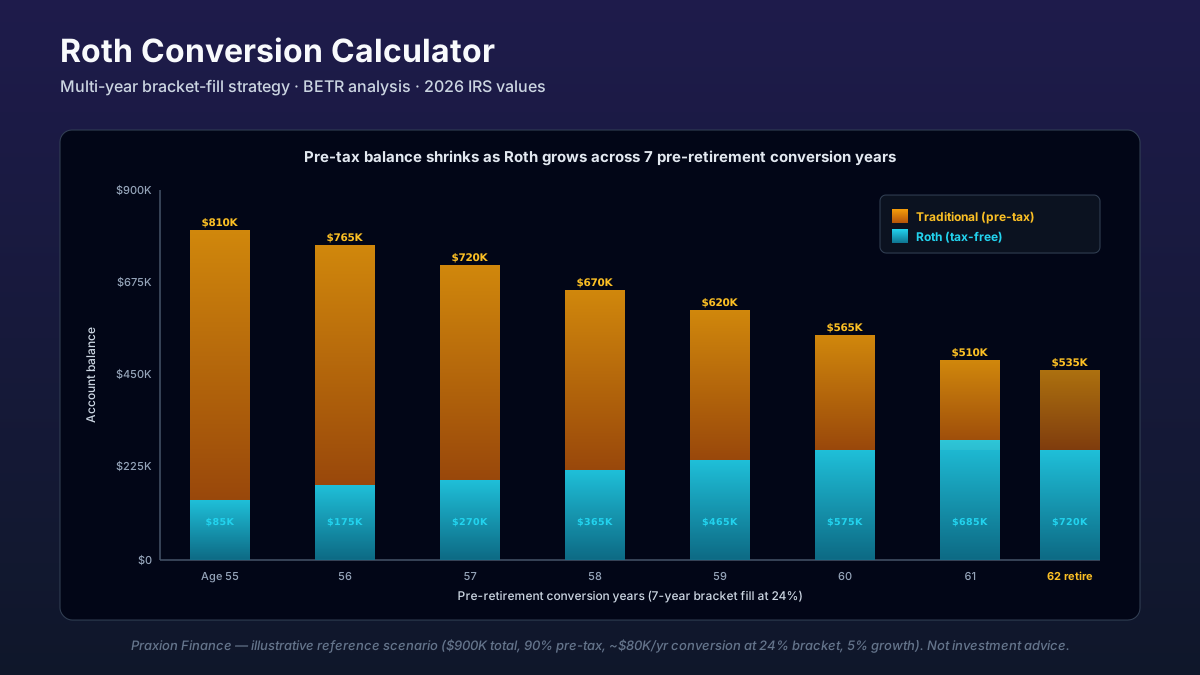
Calculate Your Modeled Roth Conversion Range
Illustrative example (same defaults as the calculator model): $810,000 pre-tax balance (90% of a $900,000 account), age 55, retire at 62, 7 pre-retirement conversion years, 24% federal bracket using 2026 IRS brackets. Excludes state tax and IRMAA.
Enter your details below to see your personalized modeled tax-difference range.
Paying conversion taxes with outside cash usually preserves more tax-free compounding.
Advanced BETR Inputs (optional)
Core outputs include: modeled annual conversion range, lifetime tax estimate before vs. after modeled tax strategies, suggested withdrawal sequencing for analysis, and modeled lifetime tax differences.
What is a Roth IRA Conversion?
A Roth IRA conversion moves money from a Traditional IRA or 401(k) into a Roth IRA. You pay taxes now on the converted amount, and future qualified withdrawals are tax-free.
- Move pre-tax retirement dollars into a Roth IRA
- Pay ordinary income tax in the conversion year
- Build future tax-free retirement withdrawals
How this calculator works
- Estimates current tax liability on the selected conversion amount
- Projects future tax-free growth in the Roth IRA
- Compares stay-traditional versus convert scenarios over time
Assumes constant tax rate and average investment returns.
When does a Roth conversion make sense?
- You expect higher tax rates in retirement
- You are in a temporarily low-income year
- You want to reduce future RMDs
- You want tax diversification
Contexts where models often show weaker Roth conversion value
- You are currently in a very high tax bracket
- You need to pay conversion taxes from the IRA itself
- You expect lower tax rates in retirement
- You are close to Medicare IRMAA thresholds
Three Worked Roth Conversion Scenarios
The same conversion math produces a different target bracket depending on what you're optimizing. Each scenario below maps to one of Praxion's five plan goals and reports its outcome in the metric that goal actually optimizes.
Scenario 1 — Mid-tier saver, minimize-taxes goal
Matches the calculator's default scenario abovePlan goal: minimize_taxes — optimize for the smallest total tax across the owner's lifetime plus what heirs pay.
Headline metric: Family lifetime tax reduction (Owner + Heirs).
Sensitivity: The same inputs with only 3 conversion years (compressed window) materially shrinks the savings; with 12 years (longer runway) it grows. See the sensitivity chart below.
Takeaway: For a mid-tier saver with similar pre- and post-retirement brackets, the value comes mostly from filling unused 24% bracket room in the gap before Social Security and RMDs. Earlier start, more headroom.
Scenario 2 — HNW household, maximize-legacy goal
Alternate scenario (different persona)Plan goal: maximize_legacy — optimize the after-tax estate at life expectancy for the heir, not the owner.
Headline metric: Net after-tax legacy at life expectancy — i.e., what the heir actually keeps after the SECURE Act 10-year drain.
Sensitivity: The legacy benefit grows with the spread between today's bracket and the projected heir bracket, and with the size of the inherited Traditional balance (because the 10-year drain concentrates the tax hit).
Takeaway: For legacy-oriented HNW households, “convert higher than feels comfortable today” can often pencil — the heir tax saved tends to exceed the conversion tax paid. The in-product Roth Analyzer evaluates this against a balance-sensitive heir-rate curve, not a flat number.
Scenario 3 — Mass-affluent saver, balanced goal
Alternate scenario (different persona)Plan goal: balanced — weight spendable retirement wealth alongside a bounded legacy component.
Headline metric: Spendable wealth @ 85 (TEW@RA) plus a bounded legacy delta — never enough legacy premium to push you across a hard liquidity cliff.
Sensitivity: Becomes materially more attractive if the future bracket rises (e.g., scheduled 2026 sunset reversion to higher brackets, or you relocate to a high-tax state).
Takeaway: For mass-affluent savers with no bracket spread, partial conversions still earn their keep on tax-diversification grounds — but the case is much weaker than for Scenarios 1 or 2. A “don't convert” recommendation can be the right answer here.
How Praxion Picks the Bracket — Intent-to-Metric Routing
Praxion's in-product Roth analyzer doesn't rank brackets in a vacuum. It first asks what are you optimizing for? The five plan goals each route to a different ranking metric — which is why two households with identical inputs can get different bracket recommendations.
The five plan goals
- maximize_legacy — optimize what heirs keep after the SECURE Act 10-year drain.
- minimize_taxes — optimize total family tax (owner lifetime + heir tax on inheritance).
- stable_income — optimize spendable retirement wealth with low withdrawal-rate volatility.
- balanced — spendable wealth + a bounded legacy component, with liquidity guardrails.
- maximize_spending — optimize spendable retirement wealth, with bounded legacy + IRMAA awareness.
Which metric drives the recommendation
| Plan goal | Primary ranking metric | What you actually see on the recommendation card |
|---|---|---|
maximize_legacy | Net after-tax legacy at life expectancy | “+$X net after-tax legacy for heirs” |
minimize_taxes | Family lifetime tax reduction | “−$X total family tax (Owner + Heirs)” |
stable_income | Spendable wealth @ 85 + bounded legacy | “+$X spendable @ 85 · +$Y legacy” |
balanced | Spendable wealth @ 85 + bounded legacy | “+$X spendable @ 85 · +$Y legacy” |
maximize_spending | Spendable retirement wealth @ 85 | “+$X spendable retirement wealth” |
Heir tax rate: a balance-sensitive curve, not a flat number
For legacy-oriented households, the “heir tax rate” assumption swings the answer more than almost any other input. Praxion uses a balance-sensitive curve(anchored in today's dollars, deflated to the death year) and supports a per-profile override when you have a defensible reason to disagree with the curve.
The reason: a non-spouse heir inheriting a $2M Traditional IRA is forced into a very different effective rate than one inheriting $150K. A single flat heir rate (sometimes quoted as “about a third”) papers over a real range. Where a flat rate appears anywhere in the codebase, it's a deprecated safety net — not the rate that should drive any recommendation.
SECURE Act 10-year drain
Non-spouse heirs (most adult children) must fully distribute an inherited Traditional IRA within 10 years of death. For an heir in their peak earning years, this concentrates a decade of withdrawals into their highest-bracket window. The Roth heir has no such forced distribution and no tax on qualified withdrawals — which is why the SECURE Act drain is the single largest tailwind for Roth conversion in legacy-oriented plans.
What this calculator does not model
- The exact IRMAA cliff — this public calculator flags the risk in pitfalls and contexts, but does not price the per-tier Medicare surcharge dollars for your inputs. The full Praxion plan does — start free.
- State estate taxes (some states impose an estate tax separate from federal)
- Tax-law changes after 2026 — projections assume current law continues
- Charitable-giving optimization (QCDs, charitable Roth conversion offset, donor-advised funds)
- Return-regime modeling beyond static assumed growth (no GARCH or regime-switching — see the Monte Carlo article for that side of the math)
- Per-state tax differential when relocating mid-retirement
Praxion is a software platform, not a registered investment adviser. Projections are illustrative, not advice. For binding tax guidance, consult a CFP or CPA.
Conversion Value vs Pre-Retirement Years
The length of the conversion window is one of the strongest levers in the model. Below: the relative lifetime tax savings for Scenario 1's inputs as the pre-retirement window shrinks (compressed window) or extends (longer runway).
Curve illustrative; numerical magnitudes depend on the household's specific inputs. The shape — diminishing returns after ~9 years — is the load-bearing point.
6 Common Roth Conversion Pitfalls (and How to Avoid Them)
- Filling the bracket without checking IRMAA. A clean 24%-bracket-fill conversion can quietly push your MAGI across a Medicare premium cliff that costs more than the bracket savings. The full Praxion plan prices the cliff per tier; this public calculator flags only the risk. Start a free plan to get the per-tier IRMAA dollar impact for your inputs. Also see early-retirement Roth conversions for the pre-Medicare window where this is most often avoidable.
- Paying conversion tax from inside the IRA. Funding the tax bill from the same IRA you're converting kills most of the long-term math — the dollars that left to pay tax never compound inside the Roth. Pay from liquid taxable cash whenever the option exists.
- Anchoring on a flat heir-rate guess. Using “about a third” as the heir-tax assumption ignores both the SECURE Act 10-year drain and the balance-sensitive curve. The Roth heir-side benefit can be over- or under-stated by a wide margin when you pick a single flat number.
- Single-year mega-conversion. Converting in one big chunk pushes the marginal dollar into 32% or 37%. Multi-year bracket-fill is typically the stronger structure outside of deathbed or terminal-illness cases. See the HNW Roth golden window for why this applies even to $5M+ households.
- Ignoring the state tax differential. Relocating to a no-income-tax state mid-retirement (FL, TX, NV, WA, TN, NH) changes the future-bracket assumption materially. The reverse — moving from a low-tax to a high-tax state — also changes the conversion math.
- Not pricing in the SECURE Act 10-year drain on heirs. For a non-spouse heir in their 40s–50s and already in a 32%+ bracket, the inherited Traditional balance gets distributed into their peak earning decade. Roth conversion essentially neutralizes this; ignoring the drain in your assumptions makes Roth look weaker than it is.
Roth conversion FAQ
Is a Roth conversion taxable?
Yes. Converted amounts are taxed as ordinary income in the year of conversion.
What timing does this model often emphasize for Roth conversions?
Often illustrated during lower-income years or after market declines reduce account balances in the model.
Does Roth conversion affect Medicare premiums?
Yes. Large conversions can increase MAGI and may trigger IRMAA surcharges.
Can I undo a Roth conversion?
No. Roth recharacterizations were eliminated after tax law changes.
How do models usually treat lump-sum vs. gradual conversions?
Many illustrations spread conversions over multiple years to stay within modeled bracket bands.
What makes this calculator different
- Models multi-year Roth conversion strategies across changing tax brackets
- Accounts for future tax bracket changes and retirement timing differences
- Models withdrawal sequencing across tax-deferred, Roth, and taxable flows
Underlying Assumptions
This calculator uses:
- IRS tax brackets (current law)
- Required Minimum Distribution (RMD) rules
- Standard retirement withdrawal sequencing logic
- Simplified investment growth assumptions
Research-Backed Rules Included in This Model
- RMD timing follows IRS retirement guidance, including SECURE 2.0 updates and required beginning dates.
- Roth conversion tax treatment is aligned to IRS IRA conversion reporting and distribution rules.
- Social Security taxation interactions are evaluated using IRS combined-income framing.
Primary sources: IRS RMD Guidance, IRS Publication 590-A, IRS Publication 590-B, IRS Publication 915.
Related reading
See Your Roth Conversion Strategy in Minutes
Start Free CalculationThis tool is for educational purposes only and does not constitute tax advice.