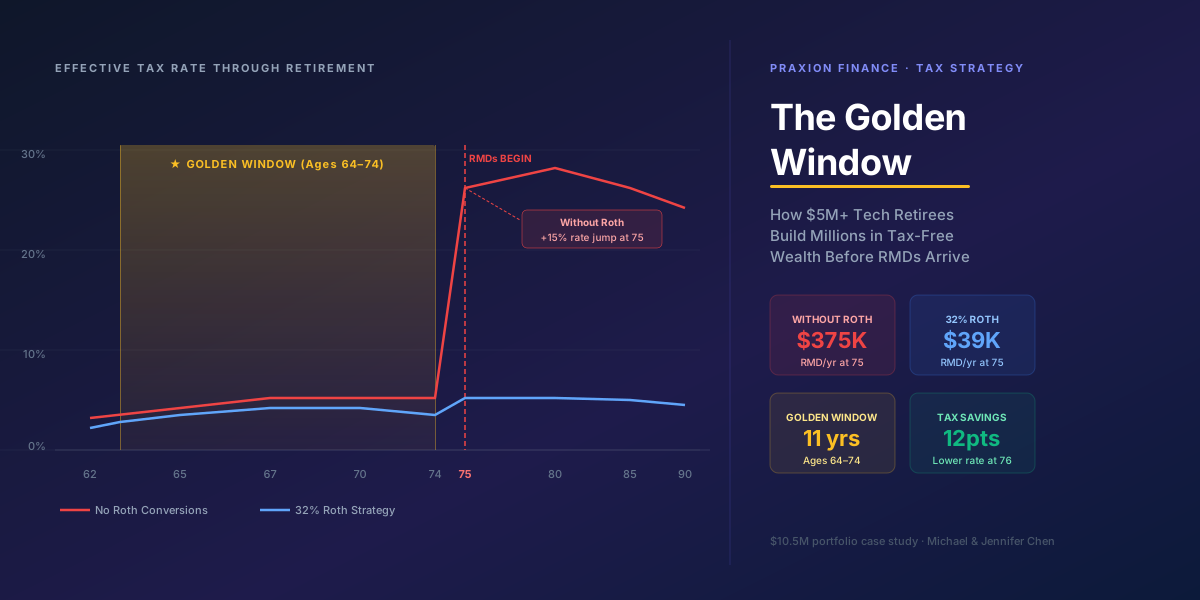
1. The $375,000 Surprise
“At 61, Michael Chen had done everything right: 25 years at a major tech company, $10.5 million saved across a 401k, his wife Jennifer's IRA rollover, and a brokerage account heavy with company stock. Then their financial planner ran the numbers. Without a plan, they'd face $375,000 per year in mandatory, fully taxable distributions starting at 75 — pushing their effective tax rate from 11% to 27% overnight.”
Many affluent retirees unknowingly drift from low-tax retirement years into some of the highest effective tax rates of their lifetime — not because they made bad investments, but because RMDs, Social Security taxation, IRMAA Medicare surcharges, and the surviving-spouse bracket compression all stack together at once. The result isn't just a higher tax bill. It's a long-term structural loss of flexibility over your own income.
The Chens' scenario isn't unusual. It's what the math can produce for nearly every high-income household with a large pre-tax retirement account and no conversion plan. The culprit: Required Minimum Distributions (RMDs) — mandatory withdrawals beginning at age 75 under SECURE 2.0 (or age 73 for those born 1951–1959), calculated as a percentage of your traditional 401k and IRA balances whether you need the money or not.
For a $4.5M pre-tax balance at age 75 (a conservative estimate after growth), the IRS Uniform Lifetime Table requires a ~3.7% distribution — roughly $166,000 in year one, rising with age. Stack that on Social Security ($69,600/yr for the Chens) and brokerage dividends, and you may face $270,000+ of ordinary taxable income annually, automatically, for the rest of your life — including years you're in a nursing home or simply don't need the money.
The Real Risk: Loss of Control
Most HNW retirees aren't worried about running out of money. They're worried about: forced taxation on income they don't need, IRMAA Medicare surcharges that punish success, estate plans complicated by a large pre-tax IRA, and a surviving spouse inheriting a bracket problem they can't solve alone.
Once RMDs begin, you lose the ability to engineer low-income years. You can't defer them, time them to a down market, or reinvest them tax-free. The only path is to shrink the pre-tax balance before age 75 — which is exactly what the Golden Window is designed to do.
2. How the Golden Window Works
The “Golden Window” is the period between retirement and RMD onset — typically ages 62 to 74 — when a specific set of tax advantages lines up perfectly for Roth conversions:
During this window, taxable income drops sharply from working years — no salary, no RSU vesting, potentially no Social Security for the first few years. This creates a rare opportunity to convert pre-tax savings at a low effective rate, even if the marginal rate looks high on paper.
Income Gap
No salary or RSU income. Total taxable income may drop from $760K to $80K–$120K in the first retirement year.
Low Effective Rate
Even converting at the 32% marginal rate, the effective rate is often 12–18% because deductions and lower-bracket income stack favorably.
Time to Grow
Money moved to Roth at age 64 has 26+ years to compound completely tax-free before age 90.
3. Case Study: Michael & Jennifer Chen ($10.5M)
Profile Overview
Three Scenarios, Modeled to Age 90
No Roth Conversion
22% Bracket Conversions
32% Bracket Conversions
Effective Tax Rate Through Retirement
$10.5M portfolio — No Conversion vs. 32% Roth Strategy (Michael & Jennifer Chen)
Year-by-Year: 32% Bracket Strategy (Ages 62–78)
| Age | Annual Conversion | RMD | Gross Income | Eff. Tax Rate | Note |
|---|---|---|---|---|---|
| 62 | $233,000 | — | $383,000 | 16% | Retirement — golden window opens |
| 63 | $243,000 | — | $393,000 | 16% | |
| 64 | $248,000 | — | $400,000 | 16% | |
| 65 | $253,000 | — | $408,000 | 15% | Medicare starts |
| 66 | $258,000 | — | $410,000 | 15% | |
| 67 | $263,000 | — | $478,000 | 17% | SS starts ($69.6K) |
| 68 | $258,000 | — | $475,000 | 17% | |
| 69 | $253,000 | — | $471,000 | 17% | |
| 70 | $248,000 | — | $466,000 | 16% | |
| 71 | $243,000 | — | $461,000 | 16% | |
| 72 | $238,000 | — | $456,000 | 14% | |
| 73 | $233,000 | — | $451,000 | 13% | |
| 74 | $125,000 | — | $340,000 | 12% | Final conversion year |
| 75 | — | $39,000 | $207,000 | 14% | ⚡ RMDs begin (controlled) |
| 76 | — | $43,000 | $211,000 | 15% | |
| 78 | — | $51,000 | $219,000 | 16% | |
| Total Roth Conversions (ages 62–74) | ~$3.1M — avg. $238K/yr over 13-year window | ||||
Why Does 32% Beat 22% for Michael & Jennifer?
Their $5.7M brokerage generates ~$57,000/year in dividends. Combined with 85% of their Social Security ($59,160 taxable), they have ~$116,000 of ordinary income before any conversion — already consuming most of the 22% bracket space. To move meaningful pre-tax balances into Roth, they need to reach into the 32% bracket. And the math works: paying 32% marginal today on a $200K+ conversion beats paying 32%+ effective on $375K of mandatory RMDs every year for 15+ years.
4. The Bracket Math: Why 32% Wins for HNW
For a household with $500K in savings, the 22% bracket usually has plenty of room for meaningful Roth conversions — SS and dividends don't fill it. For a $5M+ household, it's a different calculation:
| Income Source | Amount (annual) | Bracket Consumed |
|---|---|---|
| SS — Michael (85% taxable) | $38,760 | 10–12% bracket range |
| SS — Jennifer (85% taxable) | $20,400 | 12–22% bracket range |
| Brokerage dividends (1% yield on $5.7M) | $57,000 | Upper 22% bracket |
| Cash interest (4.5% on $300K) | $13,500 | Into 24% bracket |
| Subtotal before conversion | $129,660 | → Only ~$30K left in 24% bracket |
| Available at 22% for conversion | ~$0–$30K | ⚠ Not enough to matter |
| Available at 32% for conversion | $200K–$250K/yr | ✅ Where conversions go |
Three Scenarios: What the Numbers Say
$10.5M portfolio — Michael & Jennifer Chen
5. The RMD Time Bomb
Under SECURE 2.0 Act (H.R. 2954), RMDs start at age 75. The IRS requires you to withdraw a percentage of your combined traditional 401k and IRA balance each year, calculated using their Uniform Lifetime Table (Publication 590-B). At age 75, the factor is roughly 3.7%. By age 85, it rises to 6.25%.
The RMD Time Bomb: Annual Required Distributions (Ages 75–90)
Mandatory taxable withdrawals by Roth strategy — $10.5M portfolio
The RMD isn't just a large withdrawal — it's a cascade effect:
This pushes more of your Social Security from 50% taxable to 85% taxable — adding another $10K–$20K of unexpected taxable income.
Medicare Part B premiums jump when MAGI exceeds $218,000 (MFJ, 2026). RMDs can push HNW couples into the highest IRMAA tier ($578/person/month extra vs ~$185 base) — over $13,800/yr in combined Part B + Part D surcharges per couple. Source: 2026 IRS / CMS IRMAA schedule.
You must take the RMD. You can't defer it, invest it back into a tax-advantaged account, or time it to a down-market year. It's automatic, annual, and fully taxable as ordinary income.
“This isn't just a tax problem — it's a bracket-lock.” Once RMDs start, you lose control of your income level. You can no longer engineer low-income years for Roth conversions. The only path is to shrink the pre-tax balance before age 75. That's the window.
6. Case Study 2: David & Lisa Patel ($5M)
You don't need $10M for this to matter. The Patels — a physician couple in their late 50s — illustrate the same bracket-lock risk at $5M, and show that the optimal strategy shifts at lower wealth levels.
Profile — David & Lisa Patel
22% Bracket
Adequate — lower dividend income leaves more 22% room than Chen profile
24% Bracket
Better balance — captures more without excessive IRMAA exposure
32% Bracket
Optimal if aggressive — larger total conversions, smaller RMDs
Key difference: At $5M with lower brokerage dividends, the Patels have more 22%–24% bracket space available for conversions — so they don't need to reach 32% to move meaningful amounts. Their optimal bracket is 24% (not 22%, not 32%). Praxion's recommender automatically detects this and suggests 24% for their profile. The right bracket is profile-specific, not one-size-fits-all.
7. The Widow/Widower Tax Trap
This is the most underappreciated Roth conversion argument — and the one that most financial articles overlook entirely. For married HNW couples, one of the most powerful reasons to convert now is to protect the surviving spouse from a brutal tax situation that compounds every problem described in this article.
What Changes When One Spouse Dies
Here's the critical insight: a surviving spouse cannot do Roth conversions on the deceased spouse's IRA. If the IRA passes as an inherited account to a non-spouse beneficiary (such as adult children), the 10-year rule under the SECURE Act requires full distribution within a decade — often at high tax rates. The only way to protect a surviving spouse is to convert pre-tax assets while both spouses are alive.
Without Roth Conversions
Surviving spouse inherits $4M+ traditional IRA. RMDs at single rates may push effective rate to 30%+. IRMAA surcharges apply immediately. Estate potentially forced through 10-year liquidation at peak bracket.
With 32% Roth Strategy
Surviving spouse inherits mostly Roth accounts — zero RMDs, zero ordinary income, no IRMAA pressure. They can control their taxable income entirely. Estate transfers tax-free to heirs within 10 years.
The Roth conversion you do today isn't just for you — it's insurance for your spouse. Every dollar moved to Roth now is a dollar that will never force a widowed spouse into a bracket they can't control, and never create an estate complication for your children.
8. The California (and High-Tax State) Multiplier
California taxes Roth conversions as ordinary income at rates up to 13.3%. That adds a real cost to each conversion — but critically, California also taxes RMDs at the same rates. The question isn't whether to pay California tax, it's when and on how much.
Staying in California
Convert at 32% federal + 9.3% CA = 41.3% combined. But future RMDs will also be taxed at 32% federal + 9.3% CA. Converting now still wins if your pre-tax balance keeps growing and RMDs would be larger later.
Relocating to a No-Tax State
Nevada, Florida, Texas, and Washington have 0% state income tax. Converting in the year you relocate eliminates California's 9.3%+ on that conversion — potentially $90,000+ in state tax savings on a $1M conversion.
ACA cliff + IRMAA 2-year lookback: California HNW retirees ages 62–64 also face a potential ACA marketplace insurance cliff (~$82K MAGI for a 2-person household triggers loss of all subsidies) and IRMAA surcharges that use 2-year-old income. A $400K conversion at age 63 means higher Medicare premiums at 65. Professional projection modeling is essential for timing decisions in high-tax states.
9. Common Mistakes — and When Roth Conversions May Not Be Optimal
Roth conversions are not universally right for every HNW household. The strategy works best when pre-tax balances are large relative to expected withdrawals, the golden window is long, and estate simplification matters. Here are both the common execution errors and the scenarios where a more limited or different approach may be warranted.
Common Execution Mistakes
| Mistake | What Happens | The Fix |
|---|---|---|
| Converting in final working year | Conversion stacks on $700K+ salary → 37% bracket, state tax, NIIT | Wait until first full retirement year (age 62 or 63) |
| Stopping at 22% for a $10M portfolio | Only $1.1M converted — $375K RMD still hits at 75 | Run the bracket math; for HNW, 32% is often the optimal ceiling |
| Ignoring IRMAA 2-year lookback | Medicare premiums spike 2 years after a large conversion year | Model IRMAA tiers in the projection; pace conversions across years |
| Paying conversion taxes from the IRA | Reduces converted amount + triggers 10% penalty before 59½ | Fund taxes from brokerage or cash — never from the IRA being converted |
| No liquidity buffer for conversion taxes | Down-market year forces brokerage sale at depressed prices to fund tax bill | Reserve 18–24 months of conversion tax cost in cash or short-term holdings |
| Treating the golden window as optional | Each year of delay at 6–7% growth = larger future RMD; compounding works against you | Start in year one of retirement — the window doesn't get wider |
When Roth Conversions May Not Be the Right Primary Strategy
Roth conversions require time for tax-free compounding to offset the upfront tax cost. If health conditions significantly limit expected longevity, the breakeven point (often 10–15 years) may not be reached. A charitable strategy or stepped-up basis planning may dominate.
Qualified Charitable Distributions (QCDs) allow taxpayers 70½+ to donate up to approximately $111,000/yr (2026, SECURE 2.0 indexed) directly from a traditional IRA tax-free — effectively achieving a 0% rate on those dollars. For households with significant philanthropic goals, QCDs may reduce the pre-tax balance more efficiently than conversions.
If a taxable brokerage holds heavily appreciated securities, the stepped-up basis at death can eliminate embedded gains entirely. Paying conversion taxes today while sitting on $5M+ in unrealized appreciation may be suboptimal — a coordinated review is essential.
If you genuinely expect lower future income (e.g., moving to a no-tax state, large charitable deductions, significant medical expenses), future RMD rates may be lower than current conversion rates. Conversions still reduce estate complexity, but the tax arbitrage narrows.
Conversions require accessible cash to pay the tax bill. If a down-market year or a major expense (second home, healthcare) depletes the liquidity buffer, conversions may need to pause rather than force a brokerage liquidation at depressed prices.
The right answer requires a full household projection — income sources, life expectancy, charitable intent, estate goals, and state tax exposure all interact. Praxion models all of these simultaneously.
See a plain-English breakdown of when a Roth conversion can cost your family money →
Coordinating Tax-Loss Harvesting With Conversion Years
A conversion year is also a year your overall income is elevated — and that means any capital losses you can realize in the same year offset higher-bracket gains and reduce the effective conversion cost.
- Harvest losses on long-held taxable positions before year-end if the conversion has pushed your bracket up. Realized losses offset realized gains dollar-for-dollar, then up to $3,000 of ordinary income per year, with the remainder carried forward indefinitely.
- Pair losses with appreciated-stock charitable giving. If you would have donated cash, donate appreciated stock instead and use the avoided gain to absorb a loss harvest on a different position — net effect: full charitable deduction, no realized gain, and the loss becomes a forward carry.
- Watch the wash-sale rule. If you sell a security at a loss and buy "substantially identical" shares within 30 days before or after, the loss is disallowed. Buy a similar-but-not-identical ETF (e.g., sell VTI, buy ITOT) or wait 31 days.
- Direct indexing accounts (separately managed accounts that hold individual stocks instead of a single index fund) systematically harvest losses on the underlying positions throughout the year — a structural advantage during conversion years for households with $500K+ in taxable assets.
The coordination matters most when conversions push you into the 32% or 35% bracket — that's where harvested losses also offset gains taxed at 18.8% (15% LTCG + 3.8% NIIT) or 23.8% (20% LTCG + 3.8% NIIT). State capital gains stack on top.
10. How to Find Your Golden Window
5-Step Back-of-Envelope Analysis
- Project your pre-tax balance at 75: Current balance × (1.069)^(75 − your age). Use 6.9% nominal growth for moderate allocation.
- Estimate year-1 RMD: Projected balance × 3.7% (IRS factor at 75). This is your mandatory taxable income floor starting at 75.
- Add RMD to projected SS + dividends: What bracket does that put you in? If it pushes you to 24%+, you have a problem worth solving now.
- Calculate conversion headroom: How much can you convert annually at 22%? At 24%? At 32%? Multiply by 10 years (the window). Is that enough to move the needle?
- Run the full projection: The spreadsheet gets complicated fast — IRMAA tiers, SS taxation phase-ins, ACA cliffs, state tax interactions. Use a tool that models all of these together.
Let Praxion Run This Analysis for Your Profile
Praxion models your Roth conversion strategy year-by-year — across all tax brackets — and automatically flags IRMAA, ACA cliff, and state-tax interactions for your specific household.
No credit card. No commitment. Results in under 2 minutes.
Frequently Asked Questions
Q: At what age should I start Roth conversions if I retire early?
Ideally the first full retirement year — typically age 62 or 63 — after your final W-2 income drops off. Converting at age 62 on top of a $700K+ final salary is costly; converting at 63 when income is $80–120K is dramatically cheaper. For most HNW couples, ages 64–74 are the sweet spot: Medicare has started, Social Security may not have yet, and you have 10+ full years to convert.
Q: Does the 32% bracket still make sense if I plan to move to a no-income-tax state?
Yes — often more so. If you're converting in California today at 32% + 9.3% state = 41.3% combined, and you relocate to Nevada or Florida before age 75, your future RMDs will only be taxed federally (no state tax). That changes the math in favor of the conversion. Coordinate the move with the conversion year if possible.
Q: What if I have a pension or annuity that already fills my tax brackets?
A large pension can push you into a situation where conversions make little sense — your income floor is already high, and there's no low-income window to exploit. Run a projection to see. Some households with pensions are better served by a targeted conversion strategy at the 22% margin only, rather than reaching into 32%.
Q: How do I pay the conversion taxes without dipping into the IRA?
Use taxable brokerage or cash savings. The ideal: liquidate long-term brokerage holdings with favorable capital gains rates to raise cash for the conversion tax bill. Avoid pulling conversion taxes from the IRA itself — that reduces the converted amount and, before age 59½, triggers a 10% early withdrawal penalty on the tax portion.
Q: What's the difference between a Roth conversion and a Roth contribution?
A Roth contribution is a new annual deposit into a Roth IRA (limited to $7,000–$8,000/year, income-capped at ~$246K MAGI for MFJ). A Roth conversion moves existing pre-tax money from a traditional 401k or IRA into a Roth account — with no dollar cap and no income limit. Conversions are the primary lever for HNW households who exceed the income cap for contributions.
Q: How does the widow/widower tax trap affect Roth conversion planning?
When one spouse dies, the survivor files as Single — cutting the 22% bracket threshold roughly in half (from ~$94K to ~$47K) and the IRMAA Medicare threshold from $218K to $109K. The same RMD income that was manageable for a couple can push a surviving spouse into the 32–35% bracket with significant Medicare surcharges. Roth conversions done while both spouses are alive are the only way to materially reduce this risk, since surviving spouses cannot convert an inherited IRA.
Q: What are Qualified Charitable Distributions (QCDs) and when do they make more sense than Roth conversions?
A QCD allows taxpayers 70½ or older to donate up to $105,000/year directly from a traditional IRA to a qualified charity — counting toward the RMD and excluded from taxable income entirely (effectively a 0% rate). For households with strong charitable intent, QCDs can reduce the pre-tax balance efficiently without a tax cost. However, QCDs do not protect a surviving spouse or heirs from future RMD income, whereas Roth conversions do. The optimal strategy often uses both: QCDs for charitable goals, conversions for estate and survivor protection.
Q: What happens to Roth accounts when I pass them to heirs?
Roth IRAs inherited by non-spouse beneficiaries (such as adult children) are subject to the SECURE Act 10-year distribution rule — all funds must be withdrawn within 10 years of the original owner's death. However, those withdrawals remain tax-free, regardless of the heir's income level. A $2M inherited Roth IRA distributed over 10 years adds zero taxable income. A $2M inherited traditional IRA distributed over 10 years could add $200K/yr of ordinary income to a peak-earning child — potentially at a 32–37% combined rate.
Conclusion
The Golden Window is among the most powerful — and most time-limited — tax planning opportunities available to high-net-worth retirees. For households with $5M–$15M in pre-tax savings, the core question often isn't whether to convert, but which bracket to convert at, how much to convert each year, and how quickly to act before the RMD clock expires.
For the Chens, the modeled difference between no conversions and a disciplined 32% strategy may include $336K/yr less in forced taxable income at age 75, a potential 12-point reduction in effective tax rate, decades of compounding in a tax-free Roth account, and meaningful estate simplification for their heirs. The window opens at retirement and closes — with very limited options to reopen it — at 75.
These outcomes are illustrative and depend on growth assumptions, future tax law, spending, and individual circumstances. The right strategy requires a full household projection — which is exactly what Praxion is built to provide.
Find Your Golden Window
Praxion models your Roth conversion strategy year-by-year, shows you exactly which bracket maximizes tax-free wealth for your household, and automatically flags IRMAA, ACA, and state-tax interactions.
No credit card · No commitment · Results in under 2 minutes
Sources & Further Reading
- IRS Publication 590-B: Distributions from Individual Retirement Arrangements (IRAs) — Uniform Lifetime Table and RMD calculation rules
- SECURE 2.0 Act (H.R. 2954, Consolidated Appropriations Act 2023) — Raised RMD age from 72 to 73 (2023), then 75 (2033)
- Social Security Administration: Benefits Planner — Income Taxes and Your Social Security Benefit — 85% inclusion threshold and provisional income rules
- Medicare.gov: Part B Costs and IRMAA — IRMAA income thresholds and surcharge tiers (published annually)
- IRS: Tax Inflation Adjustments (latest published year) — Marginal bracket thresholds (22%, 24%, 32%, 35%, 37%). The IRS posts a new release each fall; this is the most recent annual notice.
- California Franchise Tax Board: Personal Income Tax — CA taxes Roth conversions and RMDs as ordinary income at 9.3%–13.3% (current bracket table on the FTB site)
- Praxion: Early-Retirement Roth Conversion — The Gap-Year Window — Pre-RMD conversion window framing applied to the 62–70 gap years