Many retirement plans focus on investment returns.
But one of the biggest determinants of long-term wealth is something else entirely: taxes.
Specifically:
- Capital gains taxes
- Retirement account taxes
- Estate taxes
- Inheritance tax treatment
A powerful but often overlooked strategy combines:
- Revocable living trusts
- Step-up in basis rules
- Roth conversion planning
- Asset tax sequencing
When coordinated correctly, these strategies can potentially reduce lifetime and intergenerational taxes by hundreds of thousands of dollars.
This article explains how these strategies work together.
What Happens When You Move Property Into a Living Trust?
A revocable living trust is commonly used to avoid probate and simplify asset transfer after death.
From a tax perspective, transferring property into a revocable trust typically has no immediate tax impact.
Under U.S. tax law, revocable trusts are usually treated as grantor trusts, meaning the trust is not considered a separate taxpayer while the grantor is alive.
Because of this:
- Rental income remains reported on your personal tax return.
- Mortgage interest and depreciation deductions remain unchanged.
- There is generally no capital gains tax triggered by the transfer.
In most cases, moving property into a revocable trust is tax-neutral during your lifetime.
However, the real tax advantage often occurs later.
The Step-Up in Basis: One of the Most Powerful Tax Rules in the U.S.
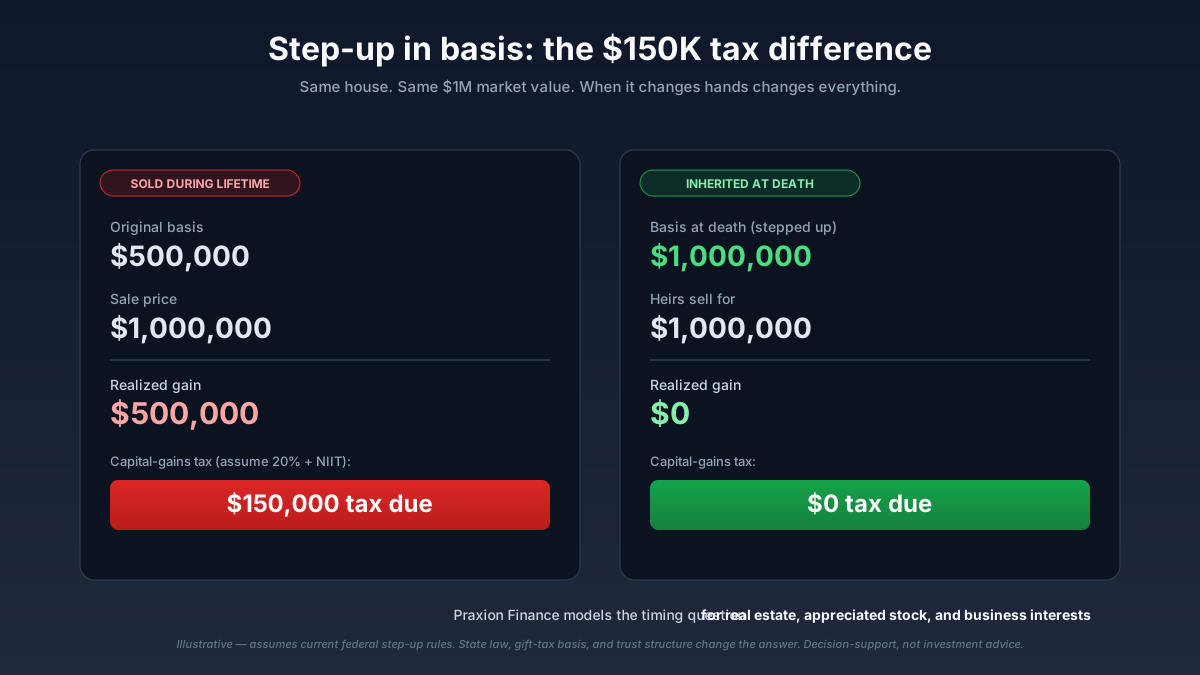
When someone inherits assets, the tax basis of those assets may be adjusted to their fair market value at the time of death. This is known as a step-up in basis, established under Internal Revenue Code Section 1014.
This rule can eliminate large capital gains taxes that accumulated over decades.
Because the basis resets to $1.2M, the taxable gain may be zero.
Without the step-up rule, the heir would owe capital gains taxes on an $800,000 gain.
For families with appreciated assets such as real estate, stocks, business ownership, and long-term investments, this rule can represent one of the largest tax savings opportunities in estate planning.
Why Selling Appreciated Assets in Retirement Can Be Costly
Many retirees sell appreciated assets to fund retirement spending. But doing so can trigger significant capital gains taxes.
At typical federal long-term capital gains rates plus net investment income tax, the tax liability could exceed $300,000 — a serious risk factor for retirement plan sustainability.
In contrast, if the property were held until death, the step-up in basis rule could potentially eliminate the taxable gain entirely.
Tax Impact Comparison
Selling appreciated property vs. holding for step-up in basis
Asset Tax Sequencing: Which Assets Should Be Spent First?
Not all assets are taxed the same. Understanding the tax characteristics of different assets can help retirees make more efficient withdrawal decisions.
Retirement accounts such as IRAs and 401(k)s do not receive a step-up in basis. Instead, beneficiaries must withdraw funds according to rules established by the SECURE Act, which often require inherited retirement accounts to be distributed within 10 years. This interaction between RMDs, Social Security, and tax brackets makes withdrawal sequencing critical.
Because of this difference, some planners suggest prioritizing withdrawals from tax-deferred retirement accounts first, while preserving highly appreciated assets that may benefit from a future step-up.
Asset Tax Hierarchy
Spend first (most tax-costly) to spend last (most tax-efficient)
Coordinating Roth Conversions with Step-Up Planning
A related strategy involves Roth conversions.
A Roth conversion moves funds from a traditional IRA into a Roth IRA. The converted amount is taxed as ordinary income in the year of conversion.
However, once inside a Roth IRA:
- Future growth can be tax-free
- Qualified withdrawals are tax-free
- Heirs inherit tax-free Roth assets (subject to distribution timing rules)
By gradually converting portions of traditional retirement accounts before required minimum distributions begin, retirees may reduce future taxable withdrawals.
The strategic idea is this:
- Pay taxes on retirement accounts gradually
- Preserve assets that could receive a step-up in basis
This approach can reduce both retirement-era taxes and taxes faced by heirs.
Tax Planning Timeline
Key milestones for coordinating Roth conversions, RMDs, and step-up planning
The “Step-Up Harvesting” Concept
Most investors are familiar with tax-loss harvesting, which involves selling investments that have declined in value to offset gains.
A less widely discussed concept is sometimes called step-up harvesting.
Instead of selling appreciated assets and triggering capital gains taxes, investors may choose to hold those assets long term so that gains could potentially disappear through the step-up rule.
This approach may be particularly relevant for:
- Long-term stock portfolios
- Rental real estate
- Family businesses
- Concentrated equity positions
However, holding appreciated assets also carries risks, including market fluctuations and lack of diversification. Each situation should be evaluated individually.
The Role of Living Trusts in Estate Planning
While living trusts typically do not reduce taxes during life, they can provide important planning benefits:
- Avoiding probate
- Maintaining privacy
- Simplifying asset transfers
- Enabling management during incapacity
For many households, a revocable trust acts as the organizational framework for estate planning while tax strategies operate alongside it.
Federal protections such as the Garn–St. Germain Depository Institutions Act of 1982 generally allow homeowners to transfer property into a living trust without triggering mortgage due-on-sale clauses.
Still, documentation requirements and lender policies can vary.
When Professional Advice Is Essential
Tax and estate planning strategies depend heavily on individual circumstances. Factors that may affect planning decisions include:
- Income level
- State tax laws
- Retirement timelines
- Estate size
- Family structure
- Investment holdings
For these reasons, individuals should consult professionals such as:
- Estate planning attorneys
- Certified public accountants (CPAs)
- Qualified financial planners
Professional guidance helps ensure strategies are implemented correctly and in compliance with current tax law and IRS limits.
Key Takeaways
- Revocable living trusts usually do not trigger taxes when property is transferred into them.
- The step-up in basis rule can eliminate large capital gains taxes for heirs.
- Retirement accounts are taxed differently and typically do not receive a step-up.
- Strategic withdrawal planning and Roth conversions may reduce lifetime taxes.
- Estate planning tools like living trusts can help coordinate these strategies.
When thoughtfully combined, these approaches can help families manage taxes across both retirement and inheritance planning.
Frequently Asked Questions
Does property in a living trust receive a step-up in basis?
In many cases, yes. If the trust is revocable and the assets remain part of the grantor’s gross estate for federal estate tax purposes, they typically receive a step-up in basis at death under IRC Section 1014. However, assets in certain irrevocable trusts that are excluded from the estate may not qualify.
Do retirement accounts receive a step-up in basis?
No. Traditional IRAs, 401(k)s, and similar tax-deferred retirement accounts do not receive a basis adjustment at death. Beneficiaries must generally withdraw the funds within 10 years under the SECURE Act, paying ordinary income tax on distributions.
Does gifting property eliminate the step-up in basis?
Yes. When assets are gifted during the owner’s lifetime, the recipient typically inherits the original cost basis (carryover basis) rather than receiving a stepped-up basis. This means the accumulated capital gains remain taxable when the recipient eventually sells the asset.
Which assets are often discussed first in spend-down sequencing?
Educational materials often discuss tax-deferred accounts like traditional IRAs and 401(k)s as earlier candidates for draws, since they don’t benefit from a step-up in basis. Highly appreciated assets like real estate and stocks may be more valuable when held, as they could qualify for a step-up at death.
What timing windows are often discussed for Roth conversions in this strategy?
The window between retirement and the start of required minimum distributions (age 73–75 under SECURE 2.0) is often modeled as favorable for Roth conversions, as taxable income tends to be lowest during this period.
Does transferring property into a revocable trust trigger capital gains tax?
No. Since a revocable trust is treated as a grantor trust under IRS rules, transferring property into it is generally not a taxable event. The grantor continues to report all income and deductions on their personal tax return.
Sources & References
All strategies discussed in this article are based on current U.S. tax law. Relevant IRS publications and authoritative sources:
- IRS Publication 551 — Basis of Assets: irs.gov/publications/p551
- IRS Topic No. 703 — Basis of Assets (including step-up): irs.gov/taxtopics/tc703
- IRS Publication 590-B — Distributions from IRAs (RMD rules): irs.gov/publications/p590b
- IRS Roth IRA Conversion Rules: irs.gov/retirement-plans/roth-iras
- IRS Estate and Gift Taxes: irs.gov — Estate and Gift Taxes
- American Bar Association — Real Property, Trust & Estate Law: americanbar.org
- Investopedia — Step-Up in Basis: investopedia.com/terms/s/stepupinbasis
See How These Strategies Apply to Your Plan
Run a free tax-aware retirement simulation to see how Roth conversions, asset sequencing, and step-up planning affect your outcome.
Related Articles
- The Hidden Trade-Off Between Early Retirement and Roth Conversion Windows
- The Social Security–RMD Collision: How Claiming Age Changes Your Lifetime Tax Curve
- 2026 Financial Planning Update: New IRS Limits
- Will I Run Out of Money in Retirement? 5 Warning Signs
- The Golden Window: Roth Strategy for $5M+ Retirees
- War & Geopolitical Impact on Retirement