Will I Run Out of Money in Retirement? 5 Warning Signs
Modern retirement planning tools detect warning signs years before traditional calculators. Here are the five most common — with real-world examples.
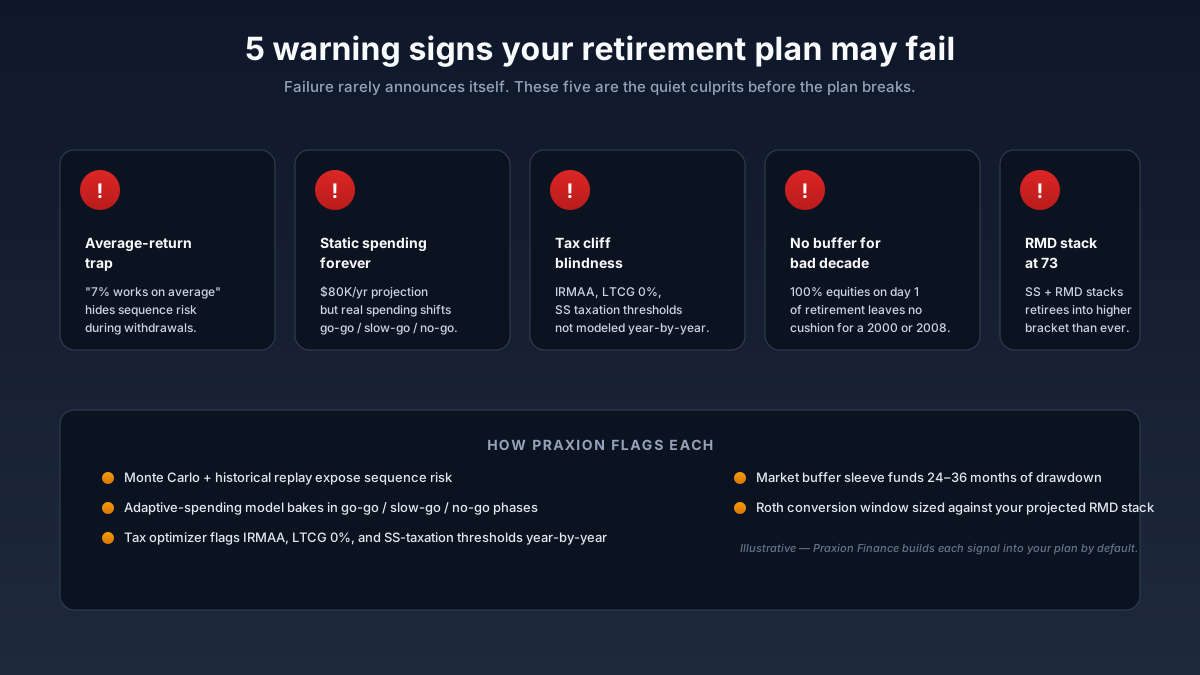
1Your Plan Assumes "Average Returns"
Most retirement projections quietly rely on a smooth, average return assumption.
On paper, that looks responsible.
In real life, it's dangerously misleading.
📋 Real-Life Example: Mark and Susan
Mark and Susan, both 65, retire with:
- $2.4M portfolio
- $95K annual spending
- Same asset allocation
- Same "7% average return" assumption
Their plans look identical.
But here's what happens:
Mark
Major market downturn in his first 3 years of retirement
Susan
Same downturn happens 10 years later
Same average return over 30 years. Completely different outcomes.
Susan's plan survives comfortably. Mark's portfolio never fully recovers — withdrawals lock in early losses. By age 78, Mark's plan enters a downward spiral.
Same Average Return, Different Outcomes
Both experience the same downturn — timing changes everything
Mark
Crash in years 1-3 locks in losses. Portfolio never recovers.
Susan
Same crash, 10 years later. Portfolio survives comfortably.
How Praxion Helps
Praxion runs thousands of forward-looking simulations that model bad early years, capture volatility clustering, and show dispersion — not just averages.
Instead of asking: "What's the expected outcome?"
It answers: "What happens if the bad years come first?"
That's the scenario that ends retirements.
2Large Tax Events Are Treated as Footnotes
Many plans model taxes as a flat percentage.
But retirement taxes don't behave like that.
They arrive in cliffs and shocks.
📋 Real-Life Example: Anita
Anita, age 62, retires early with:
- $1.8M in traditional IRA
- $400K taxable brokerage
- Minimal Roth savings
Her plan shows manageable taxes, strong cash flow, and a high confidence score.
What the plan doesn't show — at age 73:
- RMDs push her into a higher bracket
- Social Security becomes heavily taxed
- Medicare IRMAA surcharges kick in
- Capital gains stack on top
Her tax bill doubles in just two years.
The market didn't fail her. The tax structure did.
Anita's Tax Bill: The Hidden Cliff at Age 73
RMDs, SS taxation, and IRMAA compound together
Tax bill doubles in just two years
At age 73, four tax events hit simultaneously. The market didn't fail her — the tax structure did.
How Praxion Helps
Praxion models taxes year by year, source by source — including Roth conversions, RMDs, and Medicare surcharges.
Instead of minimizing this year's tax bill, it shows how different strategies change lifetime outcomes. Sometimes, paying more tax earlier reduces total damage later.
3Your Plan Never Tells You When It Fails
Most retirement plans end with a single number:
"You have a 92% chance of success."
That sounds comforting — but it's incomplete.
📋 Real-Life Example: David
David, age 60, runs a Monte Carlo analysis:
- 90% success probability
- Portfolio lasts to age 95
- Advisor says, "You're in great shape"
What no one points out — at age 74:
- Cash flow turns negative
- Withdrawals spike
- Portfolio volatility increases
- Recovery depends on perfect markets
The plan doesn't fail immediately — it becomes fragile.
A few bad years later, the probability collapses.
David's "90% Success" Plan: The Hidden Fragility
Probability erodes gradually — then collapses
90%
Age 60
68%
Age 74
22%
Age 82
The problem: David's plan becomes fragile at 74. Without knowing when and why, he loses the chance to adjust.
How Praxion Helps
Praxion explicitly identifies the first stress year, the cause (returns, taxes, spending, longevity), and how quickly risk accelerates afterward.
This reframes planning from:
"Do I succeed?"
to:
"Where does my margin disappear?"
4Your Spending Is Treated as Static
Most plans assume spending is flat, predictable, and unchanged over decades.
That's not how real people live.
📋 Real-Life Example: Linda
Linda, age 67:
- Spends less in early retirement
- Travels heavily from 67–74
- Faces rising healthcare costs after 80
Her plan assumes: $85K every year, adjusted for inflation
Reality:
- Spending spikes early (travel)
- Drops mid-retirement (less activity)
- Rises sharply later (healthcare)
Her plan underestimates late-life risk — exactly when flexibility is lowest.
Linda's Spending: Reality vs. Plan Assumption
Static $85K/year assumption masks the true pattern
67-74
Travel
75-79
Low Activity
80+
Healthcare
Static spending is dangerous: The plan underestimates late-life healthcare costs — exactly when flexibility is lowest.
How Praxion Helps
Praxion models spending as essential vs discretionary, adjustable under stress, and responsive to market conditions.
Instead of asking: "How much do you spend?"
It asks: "What can change if things go wrong?"
That distinction saves plans.
5Your Advisor Can't Show You the Engine
If your plan lives in:
- a static PDF
- a once-a-year review
- a single "prescribed path"
You're not planning — you're trusting.
📋 Real-Life Example: Tom
Tom, age 58, reviews his plan annually:
- One chart
- One projection
- One static takeaway
Markets shift. Tax laws change. Healthcare costs rise.
The plan doesn't adapt.
By the time reality diverges, the assumptions are years out of date.
How Praxion Helps
Praxion exposes assumptions, scenario ranges, and decision impacts.
You don't just get an answer — you get a system you can interrogate.
The Real Advantage Isn't Certainty — It's Early Warning
No plan is perfect.
Markets will surprise you.
Life will change.
The difference between success and failure is often:
That's what modern planning is designed to deliver.
Most Retirement Failures Are Detectable Years in Advance
The problem is most tools never look for them.
👉 Run a Retirement Stress TestSee where your plan bends — before it breaks.
Frequently Asked Questions
What is sequence of returns risk?
Sequence of returns risk refers to how the timing of market returns affects retirement outcomes. Two retirees can experience the same average return over 30 years but have completely different results. Early losses are more damaging because withdrawals lock in losses and prevent recovery.
Why do high success probability plans still fail?
A "90% success probability" doesn't tell you when or why your plan might fail. Many plans show gradual erosion that becomes critical within years. Without knowing where stress begins, you lose the chance to make adjustments while they're still small.
What are hidden tax cliffs in retirement?
Hidden tax cliffs occur when multiple tax events stack together: RMDs at 73 pushing you into higher brackets, Social Security becoming 85% taxable, Medicare IRMAA surcharges, and capital gains on rebalancing. These can cause tax bills to double in 1-2 years.
How can I stress test my retirement plan?
Stress testing runs thousands of simulations modeling bad early market years, tax cliff scenarios, and dynamic spending patterns. Unlike simple Monte Carlo analysis, stress tests reveal when your plan becomes fragile and what causes it — giving you time to adjust before it's too late.