Monte Carlo Retirement Simulation Explained: Probability-Based Planning
Thousands of randomized market scenarios — instead of one average-return guess — to estimate the probability your plan lasts through retirement.
By Praxion Finance Editorial. For educational discussion only—not individualized advice.
A Retirement Monte Carlo Simulation is one of the most powerful tools in modern retirement planning. Instead of assuming fixed annual investment returns, it runs thousands of randomized market scenarios to estimate the probability your retirement savings will last throughout your lifetime.
This probabilistic approach gives you a far more realistic picture than traditional "average return" calculators — helping you understand risk, volatility, and how different decisions affect long-term outcomes.
Want to try one first? The free Monte Carlo retirement calculator tests your savings and yearly spending across 5,000 simulated markets. No sign-up.
What Is a Monte Carlo Retirement Simulator?
A Retirement Monte Carlo Simulation is a statistical forecasting method used in retirement planning to model thousands of possible market outcomes. Each simulation varies returns, inflation, and volatility to estimate a range of potential future portfolio values.
Rather than giving you a single projection (e.g., "You'll have $2.1M at age 90"), it produces:
- Balance solvency and funding success (two related probability metrics)
- Median projected outcome
- Worst-case and best-case percentile scenarios
- Distribution of retirement outcomes
This approach accounts for sequence of returns risk — one of the most important yet overlooked retirement risks.
Important: Monte Carlo results are probabilistic, not predictive. Outcomes depend entirely on the assumptions and data quality built into the simulation tool.
How Monte Carlo Retirement Planning Works
Step 1: Input Your Retirement Plan Details
- Current age & retirement age
- Portfolio balance
- Expected annual spending
- Asset allocation (stocks, bonds, etc.)
- Expected inflation
Step 2: Define Market Assumptions
The simulation uses historical volatility and return assumptions to randomly generate thousands of possible future return paths.
Step 3: Run Thousands of Scenarios
Each simulation models a different market sequence. Some include early downturns, others strong early growth.
Step 4: Score Each Path and Aggregate
Two related success rates are computed across the run. Balance solvency tracks whether the portfolio ends above $0 at life expectancy. Funding success tracks whether required spending was met in every year. They can diverge sharply — assets can remain while a single tight year is flagged as unfunded — which is why both are reported.
Balance Solvency vs. Funding Success
Two failure definitions, two different success rates. Balance solvency answers does anything remain at life expectancy? Funding success answers was every year of required spending actually covered? A plan can pass the first and fail the second.
Percentage of simulations where portfolio balance stays above $0 at life expectancy (and never falls below $1,000 during the plan).
Depletion threshold: Ending balance reaches $0, or total assets fall below $1,000 in any year.
Percentage of simulations with no year flagged planInsolvent — meaning required spending was fully funded from portfolio withdrawals and income in every year.
Failure threshold: At least one year where the plan could not fund required spending (withdrawal shortfall / plan insolvency), even if assets remained.
Balance depletion uses a nominal floor of $1,000. Funding success uses the engine's plan-insolvency flag when withdrawals cannot cover required spending.
How to Interpret Monte Carlo Results
| Metric | What It Means |
|---|---|
| Balance solvency | Percentage of scenarios with positive ending balance (headline success rate) |
| Funding success | Percentage of scenarios with no unfunded spending year |
| Median Outcome | Middle result across all simulations |
| 10th Percentile | Pessimistic market scenario outcome |
| 90th Percentile | Optimistic scenario outcome |
Balance solvency bands (headline rate)
Funding success bands (stricter)
When balance solvency and funding success diverge by 10+ percentage points, prioritize funding success for plan quality.
Sample Monte Carlo Report (What You'll Get)
This is an illustrative sample of the report sections Praxion generates after a Monte Carlo run. Your actual report is personalized to your profile, assumptions, and strategy choices.
Key Concepts in Monte Carlo Retirement Planning
1. Sequence of Returns Risk
Early negative returns in retirement can permanently reduce sustainability — even if long-term averages are strong. This is why when returns occur matters as much as what the average return is.
2. Withdrawal Strategy
Static withdrawals (like the 4% rule) behave differently than dynamic withdrawal strategies. Flexible spending adjustments can significantly improve success rates.
3. Asset Allocation
Higher stock allocations increase expected return — but also volatility and potential failure probability. Finding the right balance is critical.
4. Inflation Risk
Inflation significantly impacts long retirement horizons and should be included in all simulations. A 3% inflation rate can double expenses over 24 years.
Three Worked Monte Carlo Scenarios
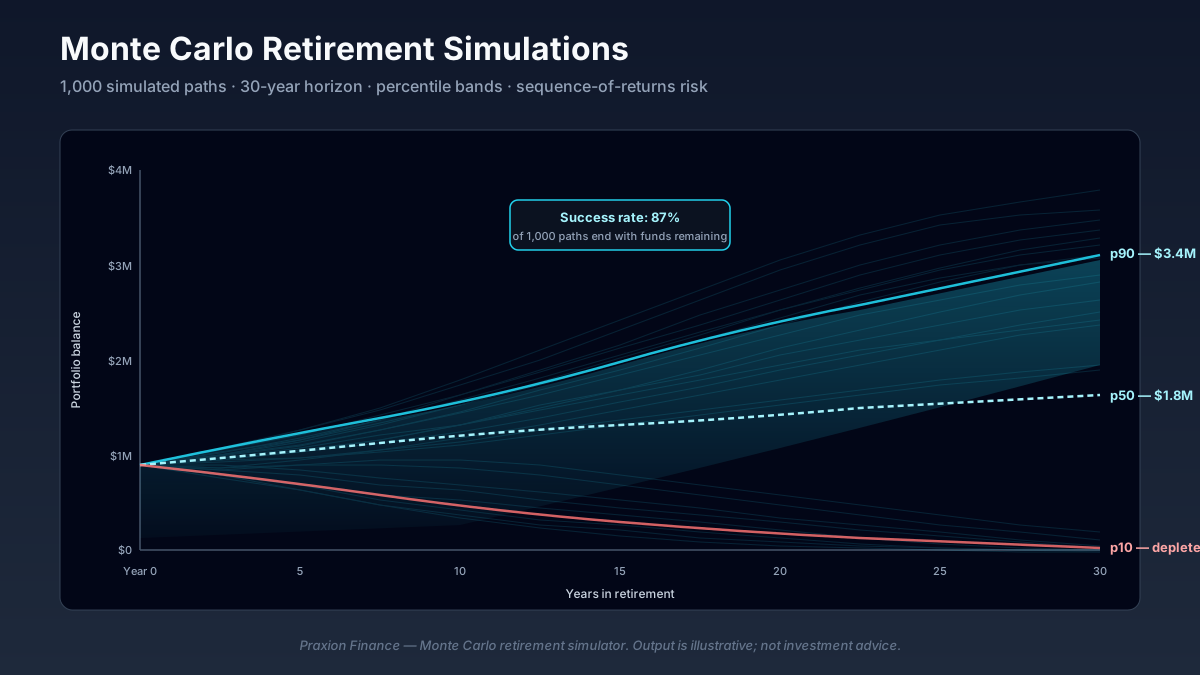
Each scenario below names the inputs, shows the Monte Carlo output as a percentile-band chart, and ends with the sensitivity that matters most for that retiree. Numbers are illustrative modeled outcomes — your actual result depends on your specific assumptions.
Scenario 1 — Conservative 65-year-old retiree
Sensitivity: raising spending to $50K/yr drops success to ~75%. Delaying retirement 2 years and converting them to working savings years lifts success above 92%. Both moves are larger than any reasonable change to expected return.
Takeaway: the 4.5% withdrawal rate is at the upper edge of the "sleep at night" band for a 30-year horizon. Bringing it to 4.0% with the same portfolio shifts the success rate from 87% to ~94%.
Scenario 2 — Aggressive early retiree (age 55)
Sensitivity: shifting to 80/20 lifts success to ~80% (more growth) but widens the p10-p90 band by ~30%. A guardrail withdrawal rule (cut spending 10% in any year the portfolio is down 20%+ from peak) lifts success to ~84% with minimal real-spending impact.
Takeaway: 35-year horizons amplify sequence-of-returns risk. Early retirees often benefit more from a guardrail withdrawal rule than from chasing higher expected return.
Scenario 3 — Late retiree (age 70, shorter horizon)
Sensitivity: a 50/50 allocation is the practical sweet spot here — moving to 40/60 (more conservative) only nudges success to ~94% but caps the upside; moving to 60/40 has almost no downside benefit on a 22-year horizon and meaningfully reduces the p10.
Takeaway: a shorter horizon shrinks sequence-of-returns risk more than asset allocation can. Most of this profile's remaining risk is unmodeled — long-term care and healthcare shocks — not market path.
All three scenarios use the same 1,000-iteration baseline. Real households often see meaningful differences with even small changes in spending, allocation, or retirement age — which is the whole point of using a simulator instead of a fixed-return calculator.
Methodology Deep Dive: How Praxion's Monte Carlo Actually Computes
Most "how it works" sections stop at "we run 1,000 simulations." That doesn't tell you what assumptions are baked in. Here's the honest accounting of what Praxion's simulator does — and what it doesn't.
1. Return distribution: lognormal with σ²/2 adjustment
Each year's return is drawn from a lognormal distribution centered on the expected geometric return (not the arithmetic mean). The naive NORM.INV(RAND(), 0.07, 0.15) approach used by many Excel templates draws from a normal distribution centered on the arithmetic mean — which overstates long-horizon outcomes by approximately σ²/2 per year (about 1.1% per year at 15% volatility). Praxion subtracts this drag explicitly so the modeled growth matches what a portfolio with that volatility actually experiences.
2. Correlation: stocks / bonds / cash modeled jointly
Stocks and bonds are modeled with a negative or near-zero correlation depending on the historical window assumed. Cash is treated as essentially uncorrelated. This matters because a naïve independent draw would overstate the diversification benefit during stress regimes (when stock-bond correlation tends to rise toward zero or above).
3. Regime modeling and fat tails — honest scope
Praxion's current Monte Carlo baseline does not use GARCH (volatility clustering) or regime-switching models. It samples from the historical-window distribution independently year-to-year (IID within the chosen distribution). This is an industry-standard simplification — most consumer Monte Carlo tools (Vanguard, Fidelity, Schwab, Bankrate) make the same simplification — but it's a real limitation. Bear-market clustering (e.g., the 2000-2002 sequence, the 2008-09 collapse, the 2022 stock-bond drawdown) tends to be worse than IID sampling predicts. The honest framing: results are conservative on the tail, optimistic on the typical case.
4. Withdrawal-rule support
Praxion supports four withdrawal patterns:
- Fixed-dollar — inflation-adjusted, classic "4% rule" pattern
- Variable-percentage — withdraw X% of current balance each year
- Guardrails — fixed-dollar with floor/ceiling adjustments triggered by portfolio drawdown or run-up
- Bucket-strategy — discretionary vs essential split with separate refill rules
Most consumer simulators only support fixed-dollar, which overstates sequence-of-returns risk for any retiree who would (in practice) cut spending during a market crash.
5. Tax cascade modeling
The tax cascade is the hardest part to model honestly. Praxion models year-by-year: federal brackets (using 2026 IRS values from the canonical source file), state brackets where specified, Social Security taxation thresholds (the provisional-income formula and the 50%/85% steps), IRMAA tier crossings (Medicare Part B + D combined surcharge per cliff), LTCG bracket fill on taxable-account withdrawals, and NIIT (3.8% on investment income above MAGI thresholds). RMD years use the current IRS Uniform Lifetime Table divisors per the user's birth-year cohort (SECURE 2.0 ages 72/73/75). This level of cascade modeling is what differentiates a planning-grade Monte Carlo from a simple back-of-envelope success-rate calculation.
No model is perfect. The honest claim: this is a sober planning-grade simulator with explicit tax modeling and disclosed limitations — not a guarantee, and not a substitute for a fee-only advisor on complex situations. Praxion is a decision-support tool, not a registered investment adviser.
Why the Withdrawal Rate Matters More Than Almost Anything Else
The single largest lever on Monte Carlo success — for a given portfolio and horizon — is the annual withdrawal rate. The chart below shows how success rate falls non-linearly as the withdrawal rate climbs from 3% to 7% on the Scenario 1 baseline (60/40, 30-year horizon, $1M portfolio).
Two practical implications: (1) the difference between 4.0% and 4.5% (87% → 92% success) is bigger than most asset-allocation decisions will deliver; (2) anything above 5.5% on a 30-year horizon with a 60/40 portfolio is in "needs a guardrail rule" territory.
6 Common Monte Carlo Pitfalls (and How to Avoid Them)
These are the most common ways Monte Carlo simulations mislead — both consumer-tool users and practitioners building their own models.
- Arithmetic vs geometric mean confusion (σ²/2 drag). Drawing from a normal distribution centered on the arithmetic mean — without subtracting σ²/2 — overstates compounded growth. At 15% volatility, that's ~1.1pp/year of phantom return. Over 30 years, it can inflate success rates by 5-10 percentage points. See the Excel-version article for the formula fix.
- IID assumption ignores volatility clustering. Real markets cluster bad years (2000-2002, 2008-09, 2022). IID Monte Carlo treats each year as independent — which underweights the probability that a bad year follows another bad year. Outcome: tail risk is consistently understated. The fix requires GARCH, regime-switching, or historical-sequence bootstrap resampling — none of which most consumer simulators offer.
- Ignoring the tax cascade. Federal brackets, IRMAA cliffs, SS taxation thresholds, LTCG bracket fill, NIIT — every one of these changes the effective withdrawal you need to fund a target after-tax spending number. Simulators that report success rates against pre-tax withdrawals systematically overstate sustainability for retirees with significant Traditional IRA balances. More on what a tax optimizer actually models.
- Ignoring sequence-of-returns risk. Two retirees with the same arithmetic-mean return can end up at opposite ends of the outcome distribution if one experiences bad returns early and the other late. A simulator that reports only the average outcome — without showing percentile bands or worst-case sequences — hides the risk that matters most in early retirement. Deep dive on sequence risk.
- Fixed-dollar withdrawal assumption. Real retirees adjust spending in down markets. A simulator that assumes the same inflation-adjusted dollar withdrawal every year regardless of portfolio value overstates sequence-of-returns risk dramatically. Guardrail rules (e.g., cut spending 10% in years following a 20% portfolio drawdown) shift modeled success rates by 5-15pp.
- Overfitting to one expected-return input. A single "7% expected return" assumption is a point estimate from a distribution that's itself uncertain. Recent academic consensus (Pfau, Kitces) suggests 5-6% forward-looking real return may be more realistic than the historical 7% nominal. Sensitivity-test your model against a range (e.g., 5% / 6% / 7%) and use the conservative end for irrevocable decisions like retirement-date selection.
How to Improve Your Retirement Success Probability
- Delay retirement by 1–3 years — Each year adds savings and reduces withdrawal period
- Reduce annual spending — Even small reductions compound significantly
- Adjust asset allocation — Find the right balance of growth and stability
- Implement tax-efficient withdrawal sequencing — Model the order of account withdrawals
- Use dynamic withdrawal strategies — Adjust spending based on market conditions
You can test these scenarios using our retirement planning tools:
Limitations of Monte Carlo Simulations
While powerful, Monte Carlo simulations are not guarantees. They rely on:
⚠️ Historical Return Assumptions
Past performance doesn't guarantee future results. Return assumptions based on historical data may not hold.
⚠️ Volatility Modeling
Most models assume returns follow a normal distribution, but real markets can have fat tails and extreme events.
⚠️ Behavioral Consistency
Models assume the household follows the plan. Real behavior during market crashes often deviates from plans.
They do not predict black swan events or future structural market changes. Instead, they provide a probabilistic framework for informed decision-making.
Best Free Monte Carlo Retirement Calculators Compared (2026)
The free Monte Carlo retirement simulators currently available differ widely in how they model future outcomes — some run thousands of forward simulations while others replay historical market sequences. The table below summarizes the features that tend to matter most when comparing tools. Information reflects each tool's publicly documented capabilities as of June 2026; check each provider for the latest details.
| Tool | Free? | Modeling approach | Per-account taxes / RMDs / IRMAA | Year-by-year output | Login required |
|---|---|---|---|---|---|
| Praxion Monte Carlo | Yes | Forward Monte Carlo (1,000 iterations) | Federal + state + IRMAA modeled per account | Year-by-year balances, withdrawals, taxes, percentile bands | Yes (free) |
| Bankrate Retirement Income Calculator 1 | Yes | Deterministic (not Monte Carlo) | Not modeled | Required-savings figure only | No |
| cFIREsim | Yes | Historical-sequence replay | Limited (basic tax bracket) | Charts + downloadable table of outcomes | No |
| Empower (Personal Capital) Retirement Planner | Yes | Forward Monte Carlo (proprietary) | Modeled when accounts are linked | Retirement-score dashboard + projection chart | Yes (account linking) |
| Fidelity Retirement Score | Yes | Forward Monte Carlo (proprietary) | Not modeled separately | Single readiness score (1–150) | Optional |
| FIRECalc | Yes | Historical-sequence replay (~115 starting years) | Not modeled | Success probability + line chart of historical paths | No |
| Vanguard Nest Egg Calculator | Yes | Forward Monte Carlo | Not modeled separately | Success probability + portfolio path chart | No |
How to read this table. The biggest practical divide is between forward Monte Carlo simulators (which generate new return sequences from a probability distribution) and historical-sequence tools like FIRECalc (which replay actual historical market periods). Both approaches have merit: historical-sequence tools can capture fat-tail events that normal-distribution Monte Carlo misses, while forward Monte Carlo tools can explore a much larger number of scenarios and let you vary assumptions you have a view on. Many planners use both as cross-checks rather than picking one.
Where tax modeling matters. Tools that don't model per-account taxes, RMDs, and IRMAA can substantially over- or under-state real after-tax withdrawal capacity in the first decade of retirement — especially for households with meaningful Traditional 401(k)/IRA balances. If your retirement plan hinges on Roth-conversion timing, RMD onset, or Medicare premium tiers, a tool that omits these will give you directionally misleading numbers even if its success-probability headline looks similar.
1 Bankrate publishes several different retirement calculators; the “Retirement Income Calculator” referenced here is the deterministic income-replacement tool. Bankrate also publishes other planning calculators with different methodologies.
Table last verified: June 2026. Capabilities and features change; consult each provider for current details before relying on any tool for a planning decision.
Frequently Asked Questions
What is a good Monte Carlo retirement success rate?
Check both metrics. For balance solvency (the headline rate): 95%+ is very conservative, 85–90% is a common target, 75–84% is borderline, and below 75% suggests balance depletion in many paths. For funding success (no unfunded spending years): 90%+ is strong, 75–89% is acceptable, 60–74% is borderline, and below 60% needs review even when assets remain.
Is a 70% Monte Carlo success rate good?
A 70% success rate is generally borderline — roughly 3 in 10 modeled scenarios fell short. Because many planners treat 85–90% balance solvency as a target and 95%+ as conservative, a 70% result usually warrants adjustments (lower spending, a later retirement date, or a guardrail withdrawal rule) rather than proceeding unchanged.
What does a 95% Monte Carlo success rate mean?
A 95% success rate means your plan survived in about 950 of 1,000 simulated market sequences and fell short in the other 50. It is a probability across randomized scenarios, not a guarantee. 95%+ is considered conservative and often signals room to spend a little more or retire slightly earlier.
What does the 10th percentile mean in a Monte Carlo retirement simulation?
The 10th percentile is the pessimistic "bad case": 90% of simulated outcomes did better and only 10% did worse. It is the figure to plan around for downside safety. If your 10th-percentile path still funds essential spending, your plan is robust; if it depletes early, sequence-of-returns risk is your binding constraint.
What Monte Carlo success rate should I have at age 60?
There is no single correct score by age — it depends on horizon and spending flexibility. A 60-year-old planning a 30-year retirement generally wants higher balance solvency (90%+) than a 70-year-old with a 20-year horizon, because a longer horizon carries more sequence-of-returns risk. Always read funding success alongside the headline rate.
How many scenarios does a Monte Carlo retirement simulation run?
Praxion's baseline runs 1,000 iterations per simulation, each modeling a different randomized market sequence. Academic and institutional models often use 10,000+ iterations to tighten the standard error (to roughly ±0.4 percentage points), but 1,000 is enough to see the shape of the outcome distribution and compare plan changes.
Does Monte Carlo simulation guarantee retirement success?
No. Monte Carlo simulations provide probability estimates, not guarantees. A 92% balance solvency rate means 92 out of 100 scenarios ended with a positive balance — but funding success (no unfunded spending years) may be lower. Actual market conditions may differ from the assumptions used.
Is Monte Carlo better than traditional retirement calculators?
For long-horizon retirement planning, Monte Carlo models generally provide a more realistic picture than calculators that assume steady average returns, because they account for market volatility and sequence-of-returns risk. Traditional calculators can still be useful for quick snapshots.
What is sequence-of-returns risk in retirement planning?
Sequence-of-returns risk refers to how the order of market returns affects retirement outcomes. Early negative returns can permanently reduce portfolio sustainability because withdrawals are taken from a shrinking portfolio. Two retirees can experience the same average return but have dramatically different outcomes.
How often should I rerun my retirement simulation?
At least annually, or whenever your financial situation changes significantly — such as a job change, inheritance, major market movements, or life events like marriage or a home purchase.
Run Your Own Retirement Monte Carlo Simulation
Quick Start builds your retirement profile in a few guided steps—then run thousands of Monte Carlo scenarios with balance solvency and funding success metrics. No account required to begin.
Related reading
Note: This article was drafted with AI assistance and reviewed by Praxion Finance experts. Educational purposes only.