Portfolio Rebalancing in Retirement: A Tax-Aware Guide
There is no universally correct rebalancing trade. Across multiple accounts, the right move depends on your household allocation, account types, embedded gains, and taxes — not on which account looks most out of balance.
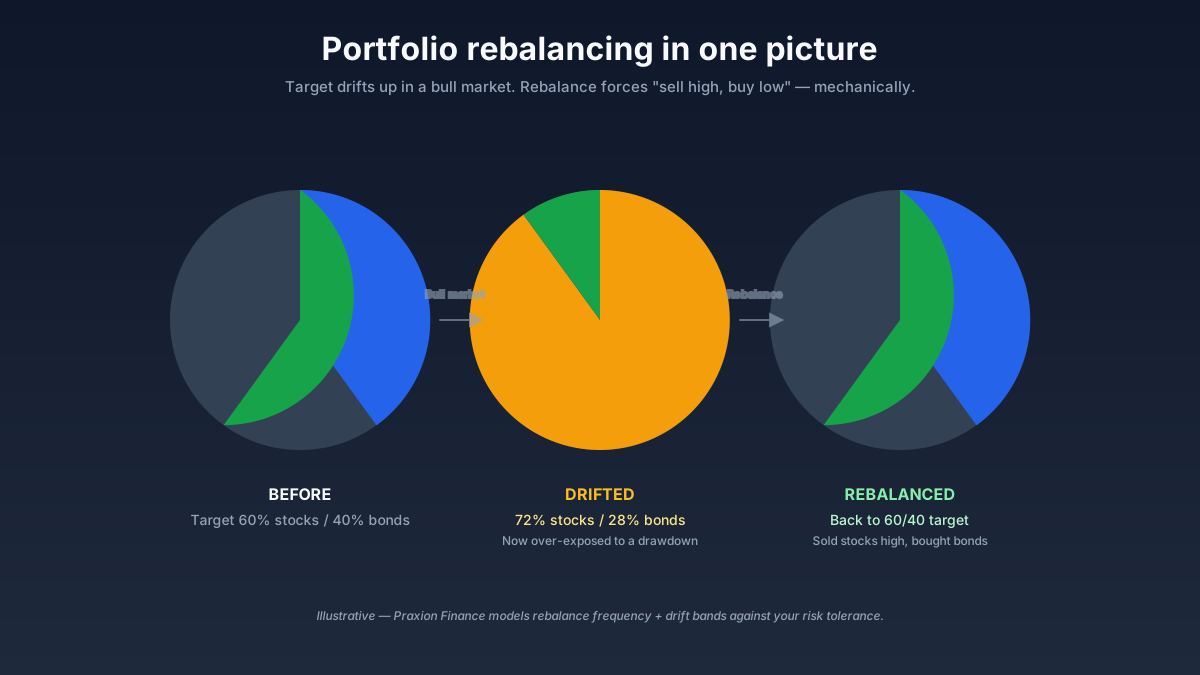
Most articles explain why rebalancing matters. Far fewer explain how to do it when taxes, multiple accounts, and long-term holdings are involved.
This guide focuses on practical, tax-aware rebalancing at the household level — the version investors with a taxable brokerage account, an IRA or 401(k), and a Roth actually need.
Does rebalancing trigger capital gains?
Short answer: only when you sell an appreciated holding in a taxable brokerage account. Rebalancing inside a 401(k), Traditional IRA, or Roth IRA is never a taxable event — you can buy and sell freely. In a taxable account, selling a fund or stock that has gained value realizes a capital gain (long-term if held more than a year), which is taxed that year. The rest of this guide shows how to rebalance while minimizing — or entirely avoiding — those gains.
What Traditional Rebalancing Gets Right — and What It Misses
Classic finance theory suggests that investors should periodically restore their portfolios to a target mix of stocks and bonds in order to:
- Maintain a consistent level of risk
- Prevent overexposure after market rallies
- Enforce discipline during volatile periods
The case for periodic rebalancing is long-established and echoed in practitioner guidance from Vanguard, Morningstar, and the CFA Institute (see the references at the end of this guide). But most of the simple models behind it assume:
- A single account
- No taxes
- No emotional or legacy holdings
That is not how most people invest.
The Real-World Portfolio Problem
In practice, investors often have:
- Multiple brokerage accounts
- 401(k)s, IRAs, and Roth IRAs
- Individual stocks, ETFs, and mutual funds
- Large unrealized capital gains
- Different tax treatments across accounts
A rigid "sell and rebalance" approach can:
- Trigger unnecessary capital gains taxes
- Increase Medicare surtaxes (NIIT)
- Create avoidable state tax exposure
- Reduce long-term after-tax returns
This is why many investors know rebalancing matters — but avoid doing it.
The Three Decisions Hiding Inside "Rebalancing"
Most rebalancing confusion comes from collapsing three separate decisions into one. Pull them apart and the tax-aware version becomes much clearer:
How much stock / bond / cash exposure should the whole household have?
Which account — taxable, Traditional, or Roth — should hold each asset?
Which specific account and holding should actually be bought or sold to correct drift?
The first two get most of the attention. The third — implementation — is where taxes are won or lost, and it is the one this guide focuses on. The question isn't just "am I still 70/30?" It's: given my taxes, account types, unrealized gains, and retirement timeline, what is the lowest-tax-friction way to bring my household back within an acceptable risk range?
Three Ideas Practitioners Increasingly Emphasize
Instead of mechanical, calendar-driven rebalancing, three ideas show up repeatedly in mainstream investor education from firms like Vanguard, Morningstar, and Fidelity (linked in the references below):
- Cash-flow rebalancing — using new contributions, dividends, and interest to steer allocation before selling anything
- Tolerance bands — rebalancing only when drift exceeds a range, rather than chasing an exact target
- Tax awareness — recognizing that, for taxable investors, the tax cost of a trade is part of the decision, not an afterthought
The takeaway is clear:
Risk control matters — but taxes matter too.
How to Rebalance a Portfolio Tax-Efficiently (Step-by-Step)
Rather than asking "How do I rebalance perfectly?", investors can ask:
"How do I reduce risk with the least tax friction?"
The following five steps outline a practical, tax-efficient approach — ordered roughly from most to least tax-efficient — for keeping a household portfolio in its target range.
Step 1: Set Allocation Ranges Instead of Exact Targets
Instead of aiming for precision, use allocation ranges.
Example:
Target: 70% stocks / 30% bonds
Acceptable range:
- Stocks: 60%–80%
- Bonds: 20%–40%
This approach:
- Reduces unnecessary trading
- Avoids taxes triggered by minor market moves
- Reflects how risk actually behaves
Range-based (or "tolerance band") rebalancing is commonly used to avoid unnecessary trading — and the taxes that come with it — when portfolio drift is modest.
Step 2: Use Cash Flows to Rebalance Without Selling
The most tax-efficient rebalancing tool is new money.
This includes:
- New contributions
- Dividends
- Interest payments
Directing cash flows into underweighted assets can gradually rebalance a portfolio without selling existing holdings — the single most tax-efficient tactic available while you are still contributing. It is a mainstay of Vanguard, Fidelity, and Bogleheads investor education (see the references at the end).
Step 3: Use Tax-Advantaged Accounts as a Primary Rebalancing Lever
Trades inside a 401(k), Traditional IRA, or Roth IRA are not taxable events — you can buy and sell freely without realizing a capital gain. That makes these accounts a powerful place to do required selling, and it lets you rebalance at the household level even when an individual account looks unbalanced on its own.
The best rebalancing account isn't necessarily the account that's most out of balance. It's the account that lets you correct household risk with the least lifetime tax cost.
"Use tax-advantaged accounts" is a lever, not an automatic rule. Whether trading inside an IRA is the best household move depends on how it interacts with the rest of your plan:
- Withdrawal sequencing and which accounts you'll draw down first
- Planned Roth conversions and current-vs-future tax brackets
- Required minimum distributions (RMDs) and legacy objectives
- The equity exposure you actually want in your tax-free Roth
The practical takeaway: reach for tax-advantaged accounts first, but decide at the household level — not by mechanically fixing whichever account drifted most.
Step 4: Allow Controlled Drift When Capital Gains Are High
Controlled drift is not negligence — it is strategy.
Allowing a portfolio to remain slightly overweight in stocks may be reasonable when:
- Gains are large and long-term
- The investor remains within acceptable risk bounds
- Selling would materially reduce after-tax returns
The idea that after-tax return — not pre-tax precision — is what matters runs through tax-efficient investing literature, including the CFA Institute's work on taxable portfolios and Vanguard's Advisor's Alpha framework.
Step 5: Sell Strategically When Rebalancing Is Required
Sometimes selling is unavoidable:
- Risk exceeds acceptable limits
- Life events require liquidity
- Retirement income planning begins
When selling is required, common techniques include:
- Selling highest cost-basis shares first
- Favoring long-term over short-term gains
- Coordinating with available capital losses
- Monitoring income thresholds that affect tax rates
This is not "market timing" — it is tax-aware tradeoff analysis.
When You Should Not Rebalance
Rebalancing is a tool, not a virtue — doing it on a fixed schedule regardless of context can cost more in taxes than it saves in risk. It is often reasonable to wait when:
- The portfolio is only slightly outside its target range
- Selling would realize a large taxable gain relative to the risk being corrected
- Upcoming contributions or cash flows can absorb the drift over the next few months
- A single account looks off but the household allocation is still on target
- A near-term Roth conversion, withdrawal, or bracket change will shift the optimal account sourcing anyway
- The allocation moved on purpose because your own risk target changed
The point isn't to avoid rebalancing — it's to recognize that rebalancing has a cost, and a small deviation is not automatically a problem to be fixed today.
Tax Context: The 3.8% Net Investment Income Tax (NIIT)
One tax that materially affects rebalancing decisions for mass-affluent households is the Net Investment Income Tax (NIIT) — a 3.8% surtax on investment income (interest, dividends, capital gains, rental income, royalties) above certain MAGI thresholds.
- Threshold (single): $200,000 MAGI (2026 statutory amount)
- Threshold (married filing jointly): $250,000 MAGI (2026 statutory amount)
- Surtax rate: 3.8% on the smaller of your net investment income or the amount your MAGI exceeds the threshold
Important detail: these are fixed statutory dollar amounts that have been frozen since 2013 — they are not indexed for inflation. As wages and portfolio balances grow over time, more mass-affluent households are pulled into NIIT each year without any change in their actual lifestyle.
For rebalancing, this means a sale that triggers a $50,000 long-term capital gain can face a combined federal rate of up to 18.8% — the 15% long-term capital-gains rate plus the 3.8% NIIT — when both apply to the same gain, not just the 15% the quick-math LTCG bracket implies. (Whether 18.8% actually applies depends on your bracket and how much of your MAGI is over the threshold; state taxes can stack on top.) Coordinating sales with low-MAGI years — or absorbing the gain inside tax-advantaged accounts where the trade doesn't hit NIIT — is the practical response.
Worked Example: A $1.5M Household, 12 Points Overweight Stocks
Numbers make the tradeoff concrete. Consider a pre-retiree whose household has drifted from a 70/30 target to 82/18 after a strong equity run:
The setup
- $700K taxable brokerage — with ~$250K of embedded long-term gains (cost basis ~$450K)
- $600K Traditional IRA — trades here are tax-free
- $200K Roth IRA
- Target 70/30; household is at 82/18, so ~$180K of exposure needs to move from stocks to bonds
The same $180K shift can be executed four ways — with dramatically different tax bills:
Sell $180K of appreciated taxable stock, buy bonds
Hits 70/30 now, but locks in a tax bill (15% LTCG, up to 18.8% with NIIT).
Sell $180K stock / buy bonds inside the $600K IRA; leave taxable untouched
Hits 70/30 now, tax-free — the $250K taxable gain is never triggered.
Point new contributions, dividends, and interest at bonds (~$45K/yr)
Corrects gradually over ~4 years; some drift remains in the meantime.
Do nothing now; revisit if drift widens or your risk target changes
Stays ~82/18; acceptable only if that risk is still tolerable.
Illustrative only — the dollar figures assume a ~36% embedded-gain ratio on the taxable account and 2026 long-term capital-gains and NIIT rates. Your numbers depend on your basis, bracket, MAGI, and state. This example is not the same scenario shown in the header image.
The point: Strategy B reaches the identical 70/30 allocation as Strategy A — while avoiding Strategy A's entire tax bill of roughly $9,600–$12,100 — purely by choosing the account that lets the household correct risk without realizing a gain. That is the whole thesis of tax-aware rebalancing: what you change matters less than which account you change it in. (Strategy B assumes the IRA holds enough stock to sell; if it doesn't, C and D keep taxes at zero while you correct more slowly.)
Asset Location: Where You Hold Each Asset Matters As Much as What You Hold
Asset allocation is the mix of stocks, bonds, and cash across the entire portfolio. Asset location is which type of account each asset sits in. The two concepts are routinely conflated, but for tax-aware investors they are the highest-leverage decision after allocation itself.
A common asset-location starting point looks like this:
Broad-market equity index funds and ETFs; municipal bonds
Long-term capital gains and qualified dividends are taxed at preferential rates; index ETFs distribute few internal capital gains; munis are federally tax-free interest.
Bonds and bond funds; REITs; high-turnover active funds
Ordinary-income rates apply on withdrawal anyway, so high-tax-drag assets (bond interest, REIT distributions, short-term gains) cause no extra harm here.
Highest-expected-return assets (small-cap, emerging markets, growth equity)
All gains compound tax-free and come out tax-free in retirement — so concentrate your highest expected returns here.
This is a starting heuristic, not a rule. The "right" location for an asset can conflict with several other goals — your rebalancing needs, withdrawal sequencing, planned Roth conversions, estate objectives, concentration risk, and the desire for tax diversification across account types. Household-specific factors routinely override this starting point.
Why it matters for rebalancing: if your bonds are inside the 401(k), you can rebalance them freely without triggering any taxable event. If bonds are held in a taxable account, two different tax effects come into play: selling an appreciated bond holding to rebalance can realize a capital gain, while the interest and ordinary-income distributions the holding throws off each year create ongoing tax drag — potentially including NIIT. Putting tax-inefficient assets in tax-advantaged accounts often does more for long-term after-tax returns than fine-tuning the allocation itself.
Direct Indexing and SMA Tax-Loss Harvesting
For households with substantial taxable assets (typically $500K+ in a single account), direct indexing — sometimes delivered through a separately managed account (SMA) — is an alternative to holding a single index fund. Instead of owning one ETF that tracks the S&P 500, the account holds the individual underlying stocks. The implementation is the same exposure; the tax mechanics are different.
- Systematic loss harvesting at the individual security level. When any single stock falls below cost basis, the manager can sell it, take the loss, and immediately buy a non-substantially-identical replacement that preserves index exposure. Losses become available to offset gains elsewhere in the portfolio.
- More harvesting opportunity than a single ETF. A broad-market index ETF rarely shows a loss in a positive-trend year because winners offset losers inside the fund. Direct indexing exposes the dispersion underneath, so even in a year the index is up, dozens of individual stocks may be down — each a harvesting opportunity.
- Practical tradeoffs. Direct indexing typically carries higher fees than an index ETF (often 25–40 basis points / 0.25–0.40% vs. 3–5 bps for a broad-market ETF), complex tax-lot accounting that can complicate brokerage transfers, and concentration constraints if you have appreciated single stocks you do not want to sell. The fee differential is usually justified only when harvested losses exceed the fee drag — typically requiring meaningful capital gains elsewhere in the portfolio to absorb.
- Best fit: households with large taxable balances, regular realized gains from concentrated positions or business sales, and a long enough horizon for accumulated loss carryforwards to be useful.
What If One Stock Dominates the Portfolio?
This section is for households where a single appreciated position is the largest line item — executives, founders, and long-time holders of one name. If that isn't you, feel free to skip ahead to the worked example.
For high-net-worth households, a single concentrated position (often appreciated employer stock, a founder's shares, or a long-held growth name) is frequently the largest line item on the balance sheet. Standard rebalancing advice — "sell down the overweight, rebalance to target" — runs into two HNW-specific tensions: the embedded capital-gains tax can be a meaningful percentage of the position's value, and concentration itself amplifies portfolio volatility in ways the household's risk tolerance was probably not modeled against.
The volatility math worth knowing:
- A single stock typically carries 25–40% annualized volatility vs. roughly 15–18% for a broad index.
- When that stock is also 30%+ of the household portfolio, the household's effective equity volatility meaningfully exceeds what their target allocation implies.
- The asymmetric downside (a single-stock 50% drawdown) can be a portfolio-wrecker that no rebalancing schedule will recover from quickly — especially close to or in retirement.
Practitioner-standard tax-aware unwind tactics (most useful when used in combination, not in isolation):
- Exchange funds (Section 351 / Section 721 vehicles) — contribute the concentrated position to a pooled fund in exchange for a diversified basket without realizing a gain. Multi-year lockup (typically 7 years) and accredited-investor requirements apply.
- NUA (Net Unrealized Appreciation) on employer stock — for company stock held inside a 401(k), a lump-sum distribution can be structured so the appreciation is taxed as long-term capital gains rather than ordinary income at withdrawal. Highly specific eligibility rules; works once per employer.
- Charitable Remainder Trusts (CRTs) — gift the position to a CRT, get an income stream for life plus a partial charitable deduction, and the trust sells the position tax-free. Useful when charitable intent is genuine and the position is large enough that the structure pays for itself.
- 10b5-1 trading plans (for insiders) — pre-committed selling schedule that allows executives subject to trading windows to systematically unwind without running afoul of insider-trading rules.
- Completion portfolio via direct indexing — leave the concentrated position untouched and build a diversified portfolio in the rest of the account that explicitly under-weights the concentrated stock's sector / factor exposure. Reduces net concentration without realizing gains.
Practical heuristic: don't unwind faster than the tax-loss harvest budget can absorb the gain. If the concentrated position has $500,000 of unrealized gain and the rest of the portfolio generates roughly $30,000–$50,000 of harvestable losses per year via direct indexing, the natural unwind cadence is multi-year (5–10 years), not all-at-once. Combine with the NIIT context above — a sale that triggers a long-term capital gain in a year your MAGI already exceeds $250,000 for MFJ filers carries an additional 3.8% NIIT on top of the LTCG bracket.
Concentrated-stock unwinds are one of the more complex personal-tax planning situations and the right structure depends heavily on charitable intent, employment status (insider vs. retired), estate goals, and state-tax exposure. Consult a fee-only financial planner and tax professional before committing to any of these tactics.
Who Often Uses This Tax-Aware Rebalancing Approach
This tax-aware rebalancing approach is especially relevant for:
- Investors with both taxable brokerage accounts and retirement accounts (401(k), IRA, Roth IRA)
- Long-term holders with large unrealized capital gains
- Pre-retirees looking to manage risk without triggering unnecessary taxes
- Professionals contributing regularly to investment accounts
- Anyone seeking to improve after-tax returns over time
This strategy prioritizes household-level allocation rather than forcing each individual account to match a rigid target. For more on comprehensive retirement planning strategies, see our complete user guide.
Common Misconceptions About Rebalancing
"If I don't rebalance exactly, I'm doing it wrong."
→ Staying within a safe range is often sufficient.
"Rebalancing always means selling."
→ Cash flows and tax-advantaged accounts often solve the problem.
"Taxes are secondary to allocation."
→ After-tax outcomes are what investors actually keep.
How Praxion Models the Rebalancing Decision
Everything above points to one conclusion: the right rebalancing move depends on your whole household picture — allocation, account types, embedded gains, cash flows, and retirement timeline. That is exactly the tradeoff Praxion is built to quantify.
Not sure whether to sell, redirect contributions, or rebalance inside an IRA? Model the tradeoff.
Praxion can compare how different rebalancing approaches affect your taxes, portfolio risk, and long-term retirement outcomes — without requiring you to link any accounts. You enter the picture; Praxion models the tax-friction of each path.
Praxion Finance is a decision-support tool, not a registered investment adviser.
Key Takeaway
There is no universally correct rebalancing trade. The best move depends on household allocation, account type, embedded gains, taxes, cash flows, and retirement objectives — so rebalance to manage risk intelligently, not to chase a perfect number.
Methodology and Research Foundation
The tactics in this guide — cash-flow rebalancing, tolerance bands, location-aware trading, and after-tax decision-making — draw on widely published investor education from the organizations linked in the references below. The through-line is a focus on after-tax outcomes, the returns investors actually keep: traditional rebalancing optimizes for risk control, while a tax-aware approach treats the tax cost of each trade as part of the same decision.
To put the tradeoff to work on your own numbers, Praxion's Monte Carlo simulation and tax analysis calculator let you model how different rebalancing paths affect risk and lifetime taxes.
External References & Further Reading
You can explore these authoritative sources for more information:
Frequently Asked Questions
Does rebalancing a portfolio trigger capital gains taxes?
Only when you sell an appreciated holding in a taxable brokerage account. Rebalancing inside a 401(k), Traditional IRA, or Roth IRA is not a taxable event — you can buy and sell freely. In a taxable account, selling a fund or stock that has risen in value realizes a capital gain (long-term if held more than a year, short-term if held less), which is taxed for that year.
How do I rebalance without triggering capital gains?
Four tactics, in order of tax efficiency: (1) direct new contributions, dividends, and interest into underweighted assets so you buy your way back to target without selling; (2) do required selling inside tax-advantaged accounts (401(k), IRA, Roth), where trades are tax-free; (3) allow controlled drift within an allocation band rather than selling for small deviations; and (4) when you must sell in a taxable account, pair the gain with harvested losses and favor long-term lots.
Does rebalancing inside an IRA or Roth IRA cause taxes?
No. Buying and selling inside a Traditional IRA, Roth IRA, or 401(k) does not create a taxable event — no capital gains, dividends, or interest are taxed while the money stays in the account. This is why many households run all of their rebalancing trades inside tax-advantaged accounts and leave appreciated taxable holdings untouched.
What is the difference between tax-aware and tax-optimized rebalancing?
Tax-aware rebalancing treats taxes as one factor while restoring your target allocation — for example, preferring cash-flow rebalancing and trades inside IRAs. Tax-optimized rebalancing goes further and explicitly minimizes the tax bill: coordinating lot selection, loss harvesting, NIIT and bracket thresholds, and multi-year sequencing, sometimes accepting slightly more allocation drift to lower lifetime tax.
Do index funds and ETFs reduce rebalancing taxes?
Partly. Broad-market index ETFs distribute few internal capital gains, so holding them in a taxable account creates fewer surprise taxable events than actively managed funds. But selling an appreciated ETF to rebalance still realizes a capital gain. ETFs help with a fund's internal tax drag — not with the gain you realize when you sell to rebalance.
Editorial Note: This article is for educational purposes only and does not constitute individualized investment or tax advice. Investors should consider their own circumstances or consult a qualified professional.