What a Tax Optimizer Actually Does (and What It Can't)
The four levers a tax optimizer pulls, the inputs it needs, and where it stops being useful.
"Tax optimizer" appears in marketing copy across financial planning tools, but the term itself isn't a regulated definition. This article describes what a tax optimizer is doing under the hood — and equally important, what it isn't doing.
What "tax optimization" means
Tax filing is annual and backward-looking. It computes what you owe on income you already realized. Tax optimization is multi-decade and forward-looking. It models how the order, timing, and account-source of future income affects your lifetime tax bill, and it suggests adjustments while you still have time to make them.
A typical retirement-tax-optimizer answers questions like: Should I take this year's spending from my Traditional IRA, my brokerage, or my Roth? Should I convert $40K to Roth this year, or wait until I'm 65? If I take Social Security at 67 instead of 70, how much more tax do I pay over the next 25 years?
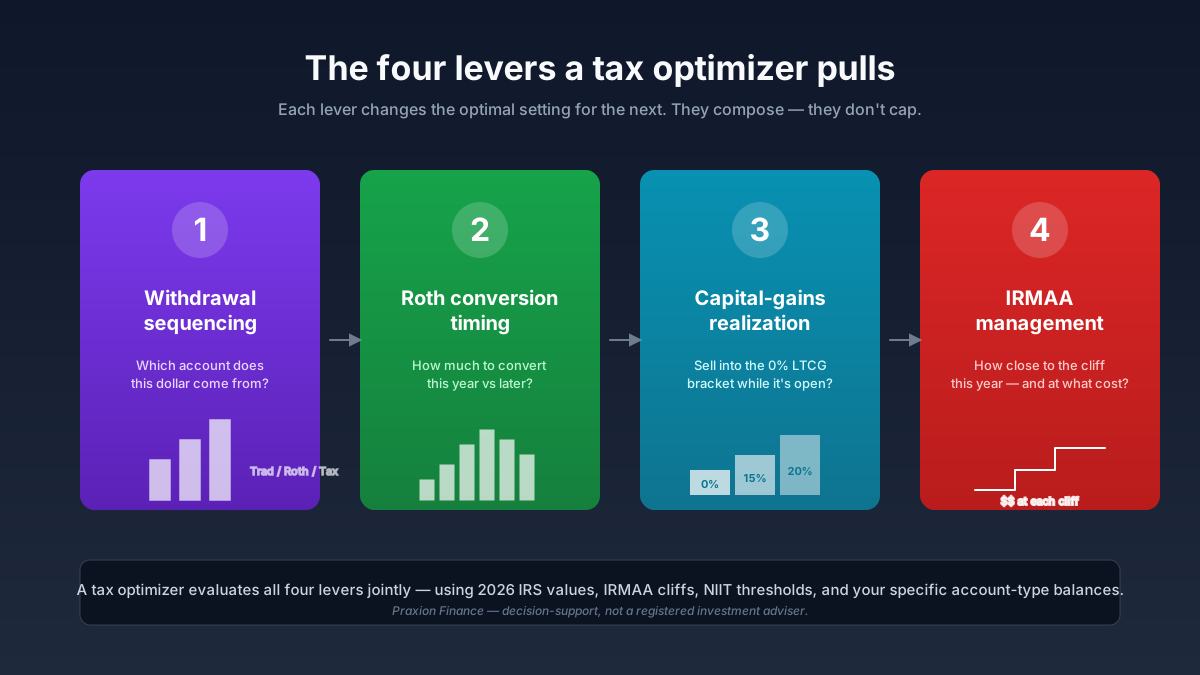
The four levers a tax optimizer pulls
1. Withdrawal sequencing
Which account does each year's spending come from? The traditional "taxable → tax-deferred → Roth" rule is one heuristic, but a tax optimizer evaluates per-year alternatives. Drawing more from a Traditional IRA in a low-income year fills lower brackets cheaply; drawing from Roth in a high- IRMAA-risk year keeps MAGI under a cliff. Optimal sequencing is rarely the same as the textbook order.
2. Roth conversion timing
A multi-year Roth conversion strategy fills lower brackets each year before RMDs arrive. The optimizer decides how much to convert in each year, balancing today's marginal rate against the projected rate when RMDs become forced withdrawals. Done well, it can shift significant pre-tax balances to Roth at meaningfully lower lifetime cost than waiting.
3. Capital-gains realization timing
Long-term capital gains have their own bracket structure (0%, 15%, 20%). The 2026 0%-rate cap is $48,350 taxable income single / $96,700 MFJ. A tax optimizer identifies years when your total income leaves room under the 0% cap and recommends realizing long-term gains to reset cost basis tax-free. It also coordinates loss harvesting and avoids stacking large realizations against Roth conversion years.
4. IRMAA threshold management
Medicare Part B + D surcharges (IRMAA) jump at cliffs — not phase-outs. Crossing the 2026 tier-1 threshold of $109,000 MAGI single / $218,000 MFJ by even a single dollar triggers an annual surcharge per person. A tax optimizer models the MAGI consequence of every withdrawal and conversion decision and warns when you're crossing a cliff for marginal benefit. For a worked example of how IRMAA stacking impacts an HNW Roth conversion strategy, see the Golden Window article.
(Honorable mention) 5. NIIT awareness
The 3.8% Net Investment Income Tax kicks in above $200,000 MAGI single / $250,000 MFJ — thresholds frozen since 2013 and never indexed for inflation, so more households drift into NIIT each year. A reasonable tax optimizer models NIIT implicitly when it computes the effective marginal cost of additional investment income.
What inputs a tax optimizer needs
- Account balances by tax type (Traditional / Roth / brokerage / cash) — not just total net worth
- Annual spending target (and whether it's inflation-adjusted)
- Social Security claim age (or range of ages being evaluated)
- Pension or annuity income, if any, with start year
- Marital filing status and state of residence (state-tax bracket varies wildly)
- Expected investment return and volatility (or a default the tool justifies)
- Life expectancy (single or joint) — affects RMD horizon and Roth payoff window
- Charitable intent — QCDs after 70½ change the optimization meaningfully
Tools that ask for fewer inputs than this are taking shortcuts. That can be fine for a first-pass estimate, but it means the output is a starting point, not a recommendation.
What it produces
- A year-by-year withdrawal plan that names which account each dollar comes from
- A recommended Roth conversion schedule (per-year dollar amounts)
- Cumulative federal + state tax paid over the modeled horizon vs. a baseline strategy
- The lifetime tax savings of the recommended plan vs. doing nothing
- Sensitivity: how the answer changes if expected return, lifespan, or spending changes
What a tax optimizer CAN'T do
1. Predict future tax law
No model knows 2032 marginal rates. Most tax optimizers assume current law continues; some let you toggle "TCJA sunset" or "rates rise to X%" scenarios. Take any tax-savings figure as conditional on the assumed legal regime, not a guarantee.
2. Override behavior
The optimizer can compute the optimal plan. Whether you follow it for 25 years is a separate question. A 5-year-cumulative-savings number assumes 5 years of disciplined execution that real households often don't deliver.
3. Know when you actually die
Roth conversions are most valuable when paid back with many years of tax-free compounding. They're least valuable if you die before recovering the conversion tax. The optimizer uses an assumed life expectancy; reality varies by 10+ years either direction.
4. Hedge against unmodeled cost shocks
Long-term care costs, sudden healthcare events, family financial obligations — most tax optimizers don't model these. A plan that's optimal under modeled cash flows can become wrong when an unmodeled $200K cost arrives.
How to tell if a tax optimizer is reasonable
A quick credibility checklist when evaluating any tool:
- ✅ Uses current-year IRS values (2026 brackets, IRMAA tiers, contribution limits)
- ✅ Models IRMAA as cliffs, not phase-outs (the actual statutory behavior)
- ✅ Runs a multi-year horizon, not just a single year
- ✅ Surfaces assumptions (returns, volatility, life expectancy) and lets you change them
- ✅ Produces results you can roughly verify by hand for simple cases
- ✅ Tells you when its recommendation isn't actionable (e.g., "you're already optimal")
- ⚠️ Cautious of: black-box outputs, no assumption disclosure, single-year-only horizon, no IRMAA modeling
The honest framing
A good tax optimizer turns a question that's impossibly large to evaluate by hand — "what withdrawal sequence and conversion schedule minimizes my lifetime tax" — into something tractable. It doesn't replace judgment, doesn't replace an advisor, and doesn't deliver guaranteed savings. It does deliver a defensible quantitative starting point for the conversation.
Praxion's tax optimizer models all four levers above with 2026 IRS values and per-year IRMAA cliff awareness. See the methodology doc for the inputs, assumptions, and limitations — or run a free analysis against your own numbers. Praxion is a decision-support tool, not a registered investment adviser.