When Is It a Good Time to Retire? How to Know You're Ready
You've run the numbers, or your advisor insists the portfolio math works, but you still freeze on a date. Retirement readiness mixes U.S.-specific policies, liquidity and sequence risk, and identity and rhythm that spreadsheets cannot fully capture.
Note on scope: This guide prioritizes U.S. rules and programs (SSA, Medicare, ACA marketplaces). If you reside or retire abroad or hold non-U.S. assets, treat timelines and illustrations as directional—verify with professionals in each jurisdiction.
By Praxion Finance Editorial. For educational discussion only—not individualized advice nor a fiduciary relationship.
Last updated: April 28, 2026
Looking for answers fast? Jump to the FAQ · Retirement readiness checklist
You hit your target. The planner says you're funded to 94. Still—nothing clicks. That paralysis is rarely pure math; it usually bundles respect for sunk career identity with fear of boredom, health unknowns, and “what if the first three years crater?” Retirement readiness merges budget fidelity, U.S. policy choreography, and what Tuesdays look like without email. Start with context you can reuse: Retirement guide hub, projection realism pitfalls, and—when you're ready to model— Can I Retire? (Monte Carlo scenarios).
Below: a skim box, FAQs (many readers land mid-question), then the fuller framework—including when money is “enough,” how Medicare gaps bite, why emotional readiness stalls more retirements than balance sheets admit, and a downloadable-style retirement readiness checklist.
Regret slices both directions: quitting early and missing skills or income flexibility, versus staying put and trading healthful years you cannot buy back—planning illuminates forks before cement sets.
TL;DR
Retirement timing is not a single portfolio balance—it is modeled spend vs. pessimistic funded income, a Medicare/ACA bridge priced into pre-65 years, tax-aware draw sequencing, probability under stress—not averages—and intentional life structure. For the condensed action list, go to our retirement readiness checklist; for single-question lookups, see the FAQ.
Retirement readiness FAQ (quick answers)
Prefer the long form afterward? Jump to spending & withdrawals · emotional readiness.
- How do I know if I'm emotionally ready—not just financially?
- Emotional readiness tends to hinge on restoring structure, stature, and social contact without a paycheck. If Fridays feel empty—not because you dislike leisure but because belonging disappeared—financial adequacy rarely fixes it. Prototype substitutes (teaching, advisory days, stewardship roles) months before quitting.
- Is retiring at a market peak safest?
- Balance helps arithmetic, yet early-retirement sequencing matters more than the index print on farewell day—stress worst-case scenarios explicitly in your model.
- Should we pay off the mortgage before retiring?
- After-tax borrowing cost versus expected returns and sleep-at-night clarity—often both paths deserve a worksheet.
- How much cash should sit outside the market?
- Enough to survive known tax spikes, premium cliffs, plus comfort selling equities depressed—typically discussed as multi-year discretionary buffers, individualized.
- Is delaying Social Security always optimal?
- Attractive for longevity and survivor optics when liquidity survives the deferral—but not if bridging cash fails or horizons shorten materially.
- Why isn't there one universal net-worth finish line?
- Identical balances meet different taxable mixes, pensions, rents, gifting goals—funded lifestyle beats headline assets.
- What builds a healthcare bridge before Medicare?
- COBRA, spouse coverage, marketplace plans with subsidy awareness—price premium + yearly out-of-pocket caps; see Medicare section below.
Why one “magic number” usually misleads
Two households with the same investable net worth can diverge sharply: one may hold mostly Roth and taxable assets with low fixed costs; another may hold heavily concentrated employer stock, looming fixed obligations, and longevity in a high-tax state. Funding ratio thinking—do expected resources cover modeled spending across bad timing, not just average returns—captures more truth than a single balance screenshot.
Spending is usually the dominant dial. Longevity (90th-percentile life expectancy for planning, not average), inflation that hits categories unevenly (housing vs. discretionary vs. health), legacy vs. consumption goals, and how draw order across account types interacts with marginal tax brackets all shift how aggressively you can harvest principal.
What silently changes the calculus
- Inflation specificity: modeling one flat CPI for everything underestimates healthcare and long-term care regimes; modeling three bands (base, health, discretionary) beats one annual figure.
- Debt & optionality: large fixed obligations reduce flexibility exactly when part-time earnings or relocating might otherwise absorb shocks—duration and rate environment matter alongside balance size.
- Correlation of shocks: layoffs cluster with equity drawdowns; elder care timing can overlap with peak education spend for grandchildren or adult children—a static “success rate” ignores correlation unless you deliberately stress it.
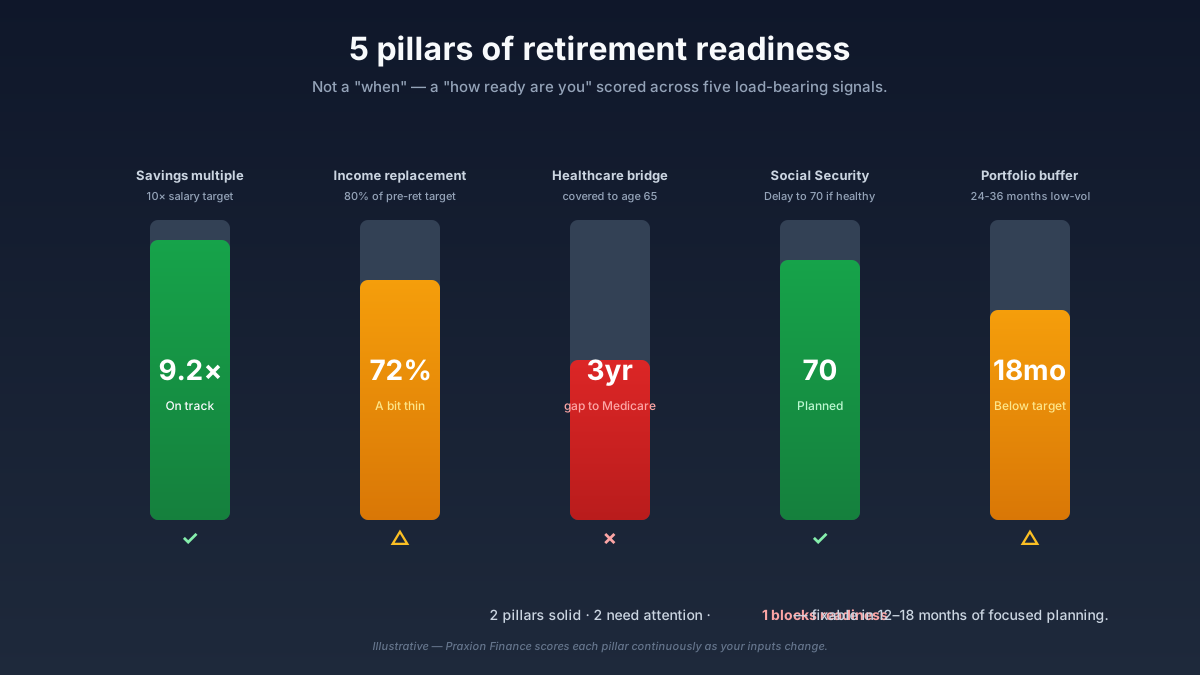
Pillars visualization

Simple tension map (illustrative)
Planners sketch two tensions at once: financial breathing room (horizontal) and purpose, structure, and social connection (vertical)—not to label you forever, but to see where deliberate work belongs before you set a date.
Purpose & connection (vertical axis)
stronger ↑
weaker ↓
When Can You Afford to Retire? Spending, Withdrawals & Social Security (U.S.)
Financial readiness means matching real spend to after-tax, stress-tested income streams—including Social Security timing (see SSA planners)—not benchmarking your neighbor's FIRE post.
Spending fidelity: trailing data beats aspirational budgets
Bank and card exports from the last 24 months beat “what we think we spend.” Separate nondiscretionary (housing, insurance minimums, core utilities) from elastic lifestyle you could compress in stress (travel, hobbies, replacement vehicles). Explicitly tag lumpy cash needs—roof replacement, helping adult children episodically, capital for an RV or boat—so they do not silently live inside an inflated “annual need.”
Many plans layer age bands: higher spend ages 62–72 (travel and vitality), moderated mid-70s, then rising medical or caregiving allocations later—your curve may differ, but flat spending for thirty years rarely matches lived experience.
Withdrawals, longevity, and sequence risk (how the pieces interact)
Academic “safe withdrawal” discussions (often summarized around historically informed starting percentages on a diversified U.S. balanced portfolio over multi-decade horizons) are starting hypotheses—not personalized guarantees. Your stock/bond mix, fee drag, retiring into high valuations, retiring outside the U.S. capital-market history underpinning classic studies, and whether RMD streams later push taxable income higher all change outcomes.
Mitigations planners commonly discuss include larger cash or T-bill runway buckets, lower initial spends, annuity-like income flooring, phased work, delaying Social Security when liquidity supports deferral, and tax-aware glidepaths—not a universal recipe—see sequence of returns explained and withdrawal heuristics.
Policy clocks: Social Security FRA, Medicare 65, and RMD timelines
Readiness interacts with statutory ages: full retirement age (for unreduced benefits context), Medicare at 65 for most (with enrollment windows carrying late penalties if missed), Roth conversion windows before taxable RMD stacks hit, and eventual RMD ages from tax-deferred accounts per IRS schedules—collectively shaping marginal tax cliffs and bracket management. Your household's spreadsheet should list these anchors alongside claiming strategies you are testing (early vs. delayed Social Security—not moral, mathematical for your lifespan and liquidity).
Tax location and draw order briefly
Roth, traditional, and taxable accounts are taxed differently when spent; sequencing withdrawals to stay under bracket cliffs while funding lifestyle is often worth more debate than tweaking equity beta by 2%. Partial Roth conversions in lower-income years—which early retirement sometimes creates intentionally—carry their own ACA subsidy and IRMAA trade-offs (premiums rising with MAGI)—another reason “only portfolio size matters” flattens real decisions.
Liquidity ladders and runway
Many retirees hold separate near-term liquidity (money market, short bonds, CDs) sized to voluntary spending bumps and known tax bills so equities are not forced-sold across a bear market's opening years—a behavioral and mathematical cushion, not abandonment of equities long term. Layer earned income, pensions, annuity-like cash flows where appropriate, rental net of realistic vacancies and capex—all before leaning on risky assets for next month's grocery bill.
Hypothetical illustration—not advice · numbers rounded
Household A: Combined Social Security at claimed ages plus a small pension ≈ $80k/year pre-tax household cash inflow under one filing scenario. Lifestyle and taxes imply they still need roughly $95k/year after-tax—the $15k bridge might come from brokerage draws, part-time wages, delaying larger Social Security boosts, or trimming discretionary categories. The takeaway is methodological: margins this tight mean subsidy cliffs, tax rounding, and health-premium resets swing outcomes more than a single Monte Carlo percentile.
Medicare Bridge & Coverage Before Age 65 (U.S.)
For Americans, Medicare familiarity matters before eligibility— Medicare.gov explains Parts A–D, Advantage vs. Original pathways, penalties for late enrollment, and Medigap vs. Advantage trade-offs once you enroll. None of that substitutes for individualized enrollment counseling, but the vocabulary anchors conversations with brokers and accountants.
Bridging ages 62–65 (or stopping work earlier): common pillars include continuation coverage (often expensive but familiar network—COBRA rules are codified separately from ACA but interact with subsidy eligibility), spouse employer plans where available, ACA marketplace subsidies that vary with household MAGI (meaning large Roth conversions or realized capital gains can spike premiums even when you do not intend to consume that cash immediately), HSAs accumulated pre-retirement paired with qualifying expenses, and—where applicable—military TRICARE or other retiree carve-outs. Modeling premiums + out-of-pocket maximums annually beats multiplying one monthly premium forever.
Couples asymmetric by age: Medicare for one spouse plus marketplace or COBRA for the other is a recurrent pattern—the younger partner's runway may dominate total household bridge cost years beyond the older partner's Medicare start. Drawdown plans that temporarily elevate taxable income may need coordination with subsidy cliffs; this is rarely optional detail work.
Dental, vision, hearing: often absent from stripped-down Medicare setups—either budget standalone coverage or earmark discretionary cash; hearing-aid outlays shock people who modeled only premiums. Long-term care remains a separate unpredictable future cost many plans isolate—insurance carve-outs or self-funded pools—because it isn't “part of Medicare” in most cases.
Am I Emotionally Ready to Retire? Identity Beyond the Spreadsheet
Surveys routinely surface boredom, irrelevance anxiety, collapsed routines, and fractured social graphs—not sudden investment panic—as the regrets people voice within the first retirement years when asked what they underestimated. Work—even frustrating work—bundled status, camaraderie, objections worth fighting, and plausible excuses when life feels chaotic. Remove it abruptly and Mondays no longer scaffold your week unless you scaffold them yourself.
Emotional readiness cues worth pressure-testing quietly: Would you voluntarily schedule non-paid commitments that mildly hurt (early alarms, constructive criticism, serving people who bore you)—that is, endeavors with stakes comparable to workplaces? If every post-career aspiration is endlessly deferrable, motivation may still be drifting. Also watch cognitive identity—some professionals mourn not boredom but usefulness; volunteer depth or mentorship with accountability can refill that differently than unstructured leisure alone.
Emotional fitness is not fluff stacked atop financial fitness—it predicts whether withdrawals happen at plan discipline or panic rhythms. Counseling or guided couples conversations may help sooner than iterative portfolio tinkering once dread already drives portfolio choices.
Partnership Choreography & What Strong Phased Exits Look Like
Once emotional baselines (prior section) are surfaced, logistical alignment still matters—household budgeting is political.Partners: asynchronous retirement remains common—one spouse flourishes unstructured while another craves bustle; disparate health arcs may veto synchronized exits regardless of symmetrical spreadsheets. Write down geography elasticity, gifting guardrails toward adult children versus retained emergency reserves, parental caregiving split, travel frequency tolerances—not only dollars.
Surveys—for example thematic EBRI retirement confidence studies—chart cohort-level optimism; treat them as cultural context, not verdicts on your kitchen table.
Phased retirement patterns that often work (illustrative menu, not endorsements):
- Three-day weeks for 18–24 months while delegating legacy projects—buys healthcare continuity plus emotional runway.
- Quarterly contracting retainers (fractional CFO, fractional HR, instructional design)—clear hour caps preventing drift back to burnout.
- Teaching or clinical supervision blocks that trade modest pay for community structure—not generic “maybe volunteer someday.”
- Portfolio guardrails coupling partial wages + dynamic spending, so spreadsheets align with voluntarily stepped-down—not cliff-dropped—income psychology.
Goal: deliberately surface whether burnout or boredom drives you—something no spreadsheet captures end-to-end even when cash-flow reconciles flawlessly.
Stress Tests, Monte Carlo Pitfalls & Margin of Safety Questions
This section overlaps ideas from our unrealistic projections critique—read both if calculators keep disagreeing with your instincts.
Margin-of-safety question
If two setbacks stack in early years—investment drawdown + roof + caregiving pivot—does the plan degrade gracefully or unravel?
Reverse trial retirement (behavior > imagination)
Sabbaticals, extended vacations, contracting down to fractional work before a point-of-no-return date surface emotional pacing and latent spend drivers spreadsheets hide. Track discretionary spending during leave—coffee shops, hobbies, impulse travel—versus work weeks; many people underestimate substitution effects (time suddenly available for discretionary categories).
What “probability of success” does (and doesn’t) mean in Monte Carlo projections
Aggregator tools that report e.g. “78% probability of funding age 95” encode assumptions—return distributions, correlations, withdrawal rules, longevity table, inflation model—that may or may not match your implementation. A high score is not permission to ignore worst-case scenarios; a low score is not destiny if you can alter spending or extend work—modest course corrections early often move outcomes sharply. Treat outputs as comparative scenario intelligence: stress higher-than-modeled longevity, lower real returns early, higher healthcare inflation—then ask whether resilience actions (raising cash, delaying claims, narrowing optional spend) move the discomfort band enough to proceed. See Monte Carlo simulations: strengths & limits.
| Shortcut | Risk |
|---|---|
| Flat percentage of salary spend projection | Leisure substitution & health transitions change categories—scenario bands beat single lines. |
| One static withdrawal heuristic | Dynamic adjustments, glidepaths, Roth flexibility, annuity floors—context matters; treat research as context not scripture. |
| “We’ll move somewhere cheap” | Travel back to family, climate risks, local tax structure—pilot months before irreversible relocation. |
| Ignoring tax drag on realized gains in taxable accounts | Harvesting living expenses from appreciated stock isn’t “tax-free spend”—lot selection, loss harvesting windows, and basis step-up planning matter for net cash. |
| Assuming both spouses share one risk tolerance | Sleep-at-night allocation may differ; forced equity exposure for one partner can implode the plan behaviorally even if the math “averages out.” |
| Single-point Social Security benefit estimate | Run early / FRA / delayed scenarios; policy uncertainty (trust fund projections) deserves scenario weighting, not denial. |
| “I’ll cut spending if needed” (unpriced) | Name the categories and dollar amounts you would actually cut first—if the list is empty, the buffer is imaginary. |
Trusted external resources (non-exhaustive)
- Social Security Administration — Retirement planner (benefit timing basics & estimates)
- Medicare.gov (program structure & enrollment orientation)
- IRS — Retirement plans & IRAs (tax treatment of accounts & distribution concepts)
- FINRA — Investor education (foundational risk & diversification concepts)
- Kitces.com — Research-driven planning commentary (widely cited analyses of withdrawal sequencing, taxes, annuities—cross-check assumptions against your situation)
- HealthCare.gov — marketplace coverage orientation (eligibility, enrollment periods—pair with state-specific rules)
- Investor.gov (SEC) — compound interest, fees, and fraud-avoidance fundamentals alongside retirement account concepts
- DOL / EBSA — retirement security & plan participant rights (context for employer plan protections and disclosures)
For more Praxion education, see our retirement guide hub and related articles on projection realism and withdrawal heuristics. For a quick savings benchmark check, see Am I on Track to Retire?.
Retirement readiness checklist (staged steps—editorial; not prescriptive)
Skimming? This block condenses deliberate sequencing—paired with TL;DR and FAQ above—for readers who execute better from lists than narratives. Return to spending & withdrawal depth afterward if any line stalls.
- Quantify spend with evidence: export 24 months of actuals; tag recurring vs. lumpy; separate health, housing, travel; adjust for one-time windfalls or disaster years so the base case doesn't distort your baseline.
- Build three capital narratives: lean (cuts you could tolerate), base (intended), enriched (if markets cooperate)—each mapped to portfolio + income + tax bill approximations; ensure lean still clears catastrophic floors you refuse to cross.
- Document Social Security matrix: ages 62 / FRA / 70 (+ survivor scenarios if relevant), spousal coordination, hypothetical benefit reductions if legislatively modeled—paired with liquidity if delayed filing means bridge spending.
- Healthcare workbook: annual premium + out-of-pocket max per covered person across bridge-to-Medicare years; subsidy cliff notes; pharmacy assumptions; HSAs/IRMAA sensitivities noted where applicable.
- Written household compact: relocation appetite, gifting guardrails, elder-care roles, solitude vs. companionship rhythms, discretionary “no-ask” personal budgets—all signed off at least verbally in good faith—reduces resentment-driven sabotage later.
- Behavioral rehearsal: measured leave-of-absence test or materially reduced bandwidth quarter—meter mood, marital friction, discretionary leakage; debrief jointly with numbers, not vibes alone.
- Define review triggers: e.g. portfolio −X% peak with Y consecutive quarters withdrawal, caregiver event, SSA rule shifts, ACA regime changes—in advance so panic doesn’t reinvent process mid-crisis.
- Professional triage roster: know which CPA, CFP®, estate attorney enrollment window you'd invoke before the fog—shopping under stress breeds mistakes.
Turn the checklist into a plan you can stress-test
Quick Start walks you through a retirement profile in a few guided steps—spending, accounts, Social Security timing, and healthcare bridge years—so you can see whether your target date holds up under scenarios, not just spreadsheets. No account required to begin.
Disclaimer
This educational article generalizes publicly discussed themes; it does not constitute personalized investment, tax, legal, medicare enrollment, estate, or longevity advice. Regulations and personal circumstances dominate—consult appropriately credentialed professionals before acting on strategies referenced here or elsewhere.