Most retirement advice treats three decisions separately: when to claim Social Security, whether to convert to Roth, and how to manage Required Minimum Distributions. In reality, these decisions interact. To illustrate, we modeled three retirement strategies using a simplified simulator based on tax rules administered by the Internal Revenue Service and benefits from the Social Security Administration.
Base Assumptions
We model a realistic high-income retiree couple:
| Parameter | Value |
|---|---|
| Retirement age | 62 |
| Current 401(k) | $2,000,000 |
| Brokerage | $250,000 |
| Roth | $0 |
| Portfolio return | 5% |
| Filing status | Married filing jointly |
| Social Security FRA benefit | $3,000/month |
| RMD start age | 73* |
*Under SECURE 2.0, the RMD start age is 73 for individuals born 1951–1959 and 75 for those born 1960 or later. This article uses 73 as a baseline assumption. If your RMD start age is 75, the planning window extends by two years — but the underlying collision dynamics remain the same.
Pre-Tax Portfolio Growth Before and During RMD Phase
$2M starting balance at 5% annual return — no withdrawals modeled
Unchecked growth creates larger RMDs
Without withdrawals or conversions, a $2M portfolio nearly quadruples by age 90. Once RMDs begin at 73, forced distributions grow exponentially — creating tax pressure that compounds each year.
Required Minimum Distribution Growth Over Time
Annual forced withdrawals from Traditional accounts starting at age 73
RMDs grow from $129K to $643K
Without Roth conversions to reduce the Traditional balance, RMDs nearly 5x over 17 years. Each dollar of RMD is fully taxable ordinary income.
Strategy 1: Claim Social Security at 62
Claiming early reduces the benefit by approximately 30%. Annual Social Security: $25,200. The portfolio grows until RMD age without competition from conversions.
Estimated values at age 73
| Source | Income |
|---|---|
| RMD | $113,000 |
| Social Security | $25,200 |
| Total income | $138,200 |
Estimated taxable income: ~$155K–$165K. Estimated marginal bracket: 22–24%.
Pros
- Provides income earlier
- Reduces portfolio withdrawals in early retirement
- Lower income stacking in later years
Cons
- Permanently lower Social Security benefit
- Less inflation-protected guaranteed income
- Lower survivor benefit
Strategy 2: Delay Social Security Until 70
Delayed retirement credits increase benefits ~24%. Annual Social Security: $44,640.
Estimated values at age 73
| Source | Income |
|---|---|
| RMD | $113,000 |
| Social Security | $44,640 |
| Total | $157,640 |
Estimated taxable income: ~$175K–$185K. Estimated marginal bracket: 24–32% depending on deductions and state.
Pros
- Higher guaranteed income
- Better longevity protection
- Higher survivor benefit
Cons
- Higher tax stacking once RMDs begin
- Reduced tax bracket flexibility
- Possible Medicare premium increases
Strategy 3: Delay Social Security + Roth Conversions
Now we model annual Roth conversions between ages 62–70. Conversion amount: $120,000 per year. The goal is to fill the 22% tax bracket before RMDs begin.
Account Balance Impact at Age 73
| Account | Balance |
|---|---|
| Traditional | ~$1.8M |
| Roth | ~$900K |
Estimated RMD: $66K instead of $113K.
Retirement Income at 73
| Source | Amount |
|---|---|
| RMD | $66K |
| Social Security | $44K |
| Total | $110K |
Tax pressure drops dramatically
By converting $120K/year during the low-income window, the Traditional balance is reduced enough to cut the first RMD nearly in half. Total income at 73 drops from $157K to $110K — a lower marginal bracket with significantly less Medicare IRMAA exposure.
Visualizing the Collision
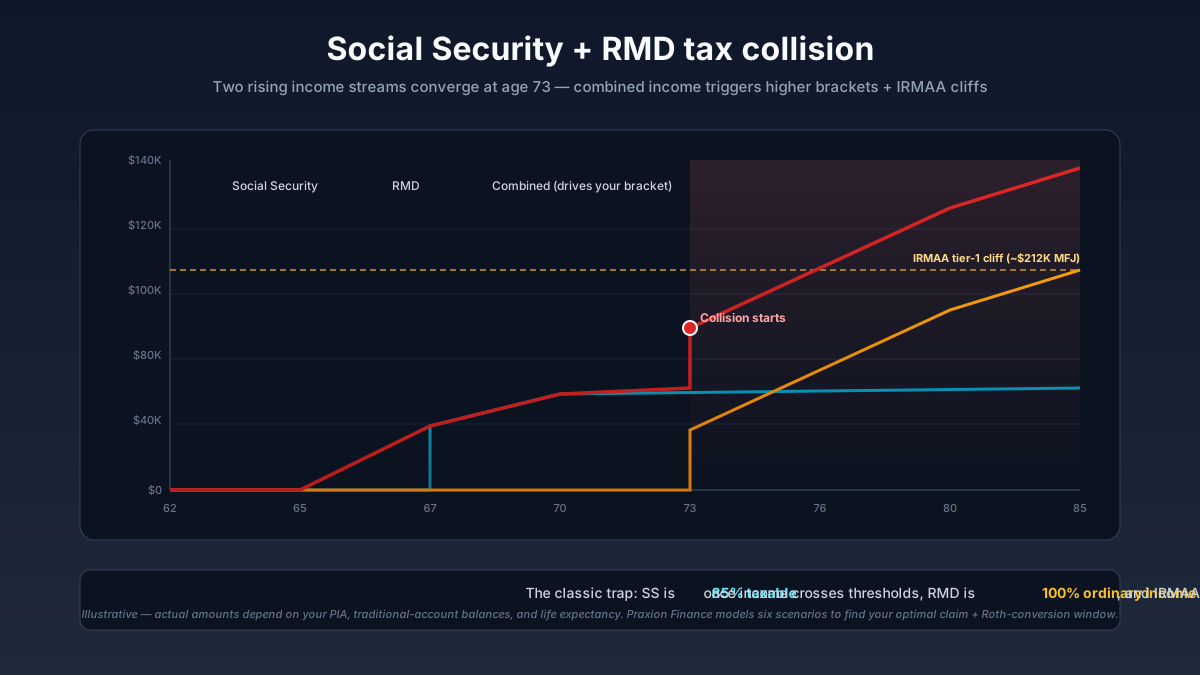
The chart below illustrates the income stacking effect. In early years, income comes mainly from portfolio withdrawals. In later years, income stacks from three sources: Social Security, RMDs, and investment income. When those layers overlap, marginal tax rates rise.
This is what we call the Collision Phase — the period when forced distributions (RMDs) stack on top of guaranteed income (Social Security), compressing tax bracket flexibility.
Income Stacking Explorer
Use the sliders below to model your own scenario. Adjust the Social Security claiming age, retirement age, 401(k) balance, and expected return to see how income composition changes over your retirement.
Income Stacking Explorer
Adjust the sliders to see how Social Security timing affects income composition
Roth Conversion Window Simulator
The years between retirement and age 72 — before RMDs begin — are the most tax-efficient window for Roth conversions. Adjust the annual conversion amount to see how it shifts balances from Traditional to Roth and suppresses future RMDs.
Roth Conversion Window Simulator
See how conversions shift balances from Traditional to Roth and suppress future RMDs
Marginal Tax Rate Timeline
This chart compares your marginal federal tax rate across three strategies. Notice how delaying Social Security without conversions (red line) creates a spike at age 73, while the conversion strategy (green dashed line) smooths the curve.
Marginal Tax Rate Timeline
How claiming strategy and Roth conversions reshape your tax bracket over time
The Tax Collision Index (TCI)
To quantify the collision risk, we introduce the Tax Collision Index — a measure of how much retirement income streams overlap and push taxpayers into higher marginal brackets.
TCI Formula
TCI = (RMD + Taxable Social Security + Pension Income) ÷ Top of Current Tax Bracket
| TCI Value | Interpretation |
|---|---|
| < 0.6 | Low collision risk |
| 0.6 – 1.0 | Moderate tax stacking |
| 1.0 – 1.4 | High bracket pressure |
| > 1.4 | Severe tax collision |
Try it with your own numbers:
Tax Collision Index Calculator
Your retirement income streams have minimal overlap. Tax bracket pressure is manageable with standard planning.
Taxable SS: $37,944 of $44,640 total
Retirement Tax Milestones
Key retirement milestones create distinct tax planning periods. The 62–70 window is often the most flexible period for tax optimization.
Key Retirement Tax Milestones
Praxion Insight: The Retirement Tax Window
Many retirees believe their taxes will automatically drop in retirement. In practice, tax rates often follow a U-shaped pattern: low during early retirement (62–70), rising sharply when RMDs begin (73+), and compounding further as income sources stack in late retirement. Strategic Roth conversions during the low-income window can smooth that curve.
Scenario: Pension + Social Security (Federal Employee)
A federal employee with a TSP balance of $1.2M and a $60K/year pension. The pension already fills lower tax brackets, changing the Social Security calculus.
Retirement income at 73
| Source | Amount |
|---|---|
| Pension | $60,000 |
| RMD (TSP) | $45,000 |
| Social Security | $44,000 |
| Total | $149,000 |
Key takeaway
Because the pension already fills lower brackets, delaying Social Security creates little additional tax benefit. Pension households may prefer earlier Social Security claims to reduce the stacking effect.
Scenario: Early Retirement Entrepreneur
Retires at 55 with $3M in brokerage and $1.5M in a 401(k).
Strategy: Withdraw from brokerage first, then convert 401(k) to Roth gradually over 18 years (ages 55–72).
Result by age 73
| Metric | Value |
|---|---|
| Traditional balance | ~$800K |
| Estimated RMD | ~$30K |
Dramatically lower tax stacking
An 18-year conversion window drops the RMD from $110K+ to ~$30K — virtually eliminating the collision. The longer conversion runway available to early retirees is a significant tax planning advantage.
Scenario: The “No Planning” Household
Retires at 65 with $3M in a Traditional IRA. No conversions. No strategy.
At age 73
| Source | Amount |
|---|---|
| RMD | $120,000+ |
| Social Security | ~$45,000 |
| Total income | $165,000+ |
Maximum collision risk
Taxable Social Security reaches 85%. IRMAA thresholds may be triggered. Lifetime taxes increase significantly compared to any planned strategy. The cost of inaction compounds every year RMDs grow.
Lifetime Tax Comparison
Over a 30-year retirement, the differences between strategies are substantial. The chart below compares estimated lifetime federal taxes across four approaches.
Estimated Lifetime Federal Taxes by Strategy
30-year retirement, $2M Traditional starting balance, MFJ filing
Roth conversions paired with delayed Social Security produce the lowest lifetime taxes
Delaying Social Security without conversions can actually increase lifetime taxes by ~$160K compared to claiming early. But when paired with a structured conversion strategy, delaying produces the best outcome — saving ~$240K vs. the baseline.
The Roth Conversion Shield
When you convert Traditional assets to Roth during the low-income window, two things happen simultaneously: the Traditional balance shrinks (reducing future RMDs) and the Roth balance grows (providing tax-free income). This creates a “shield” against future tax pressure.
The Roth Conversion Shield
$120K annual conversions ages 62–70 — Traditional shrinks, Roth grows, RMDs flatten
The Real Insight
Most retirement calculators maximize monthly Social Security income. Very few optimize lifetime marginal tax rate, RMD compression, IRMAA exposure, or after-tax estate value.
The Social Security decision is not a benefits decision. It is a tax sequencing lever.
If you have $1M+ in Traditional accounts, plans to retire before 70, and a multi-decade retirement horizon, the real question is not “Should I delay Social Security?” It is: “How does my claiming age reshape my lifetime tax curve?”
Because once RMDs begin, the collision is structural. You cannot undo it. You can only plan before it.
See how your claiming age affects your taxes
Praxion models Social Security timing, Roth conversions, and RMD projections together — so you can see the full picture before you decide.
Frequently Asked Questions
How does delaying Social Security affect my taxes when RMDs begin?
Delaying Social Security increases your guaranteed monthly benefit, but that higher income stacks on top of Required Minimum Distributions starting at age 73. This can push you into higher marginal tax brackets and trigger Medicare IRMAA surcharges. Strategic Roth conversions before RMDs begin can offset this effect.
What is the Tax Collision Index (TCI)?
The TCI measures how much of your current tax bracket capacity is consumed by overlapping retirement income streams (RMDs, taxable Social Security, and pension). A TCI above 1.0 means your income exceeds your bracket ceiling, indicating high tax stacking pressure.
Should I claim Social Security early if I have a large 401(k)?
It depends on whether you plan to do Roth conversions. Without conversions, claiming early may actually result in lower lifetime taxes because it reduces income stacking during RMD years. With a structured Roth conversion plan, delaying Social Security often produces the best after-tax outcome.
How do Roth conversions reduce RMDs?
Each dollar converted from a Traditional IRA to a Roth IRA reduces your future Traditional balance. Since RMDs are calculated as a percentage of your Traditional balance, a lower balance means smaller forced withdrawals — and less taxable income in retirement.
What is the best age window for Roth conversions?
The years between retirement and age 72 — before RMDs begin — are typically the most tax-efficient window. Income is often lower during this period, allowing you to convert at lower marginal rates and reduce future tax pressure.
Related Articles
- → The Golden Window: How $5M+ Tech Retirees Beat the RMD Tax Trap with 32% Roth Conversions
- → The Hidden Trade-Off Between Early Retirement and Roth Conversion Windows
- → What If Social Security Is Cut in 2032?
- → Social Security Benefits Estimator: 62 vs FRA vs 70
- → The Hidden Cost of Social Security on Taxes
- → War & Geopolitical Impact on Retirement