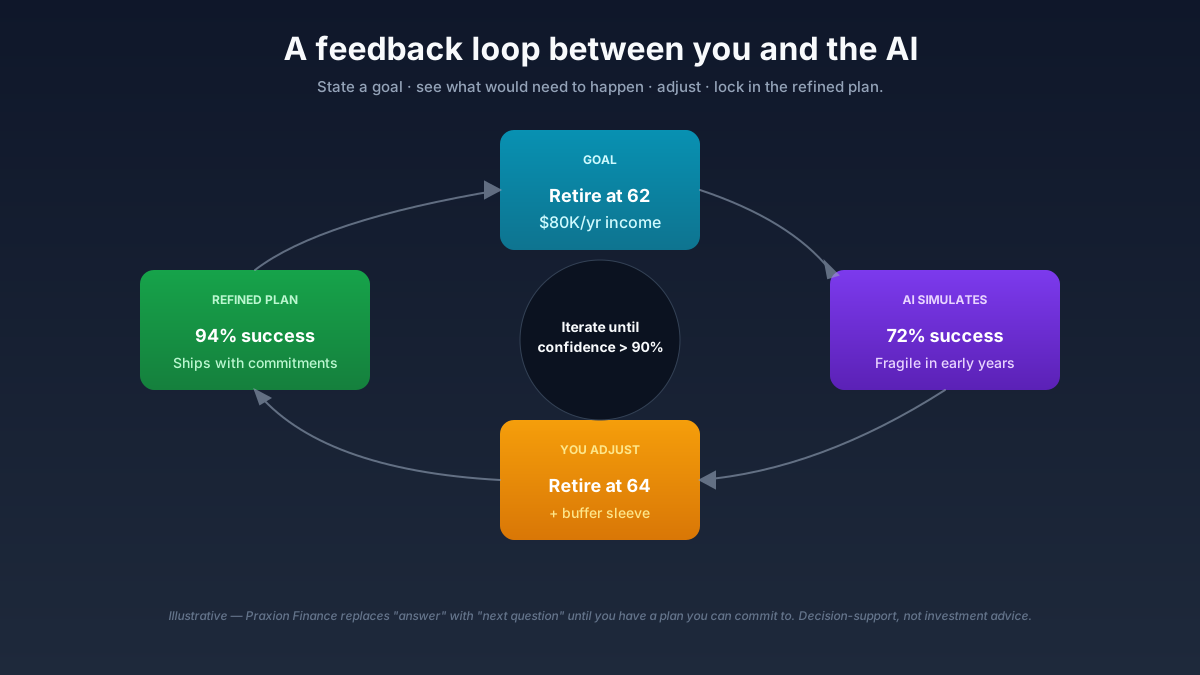
Artificial Intelligence has transformed financial planning from guesswork into data-driven decision-making. Once reserved for institutional investors, AI-powered tools are now accessible to everyone—helping you budget smarter, invest better, and plan retirement with confidence.
This comprehensive guide explains how to use AI to achieve your financial goals through practical strategies, real-world examples, and actionable steps you can implement today.
What AI Means in Personal Finance
Artificial Intelligence refers to systems that analyze large volumes of data, identify patterns, learn from historical outcomes, and generate forecasts or scenario summaries. In financial planning, AI typically:
- Analyzes spending, saving, and investment behavior
- Forecasts long-term outcomes like retirement readiness
- Runs thousands of scenario simulations under different market conditions
- Models tradeoffs across investments, taxes, and benefits
Unlike static spreadsheets, AI-based models update dynamically as new data is introduced, making them far more responsive to real-world changes.
Learn more: See how major institutions are using AI in finance with research from McKinsey Financial Services Insights and World Economic Forum.
Why AI Is Valuable for Financial Goals
Financial goals are long-term by nature, which means uncertainty is unavoidable. AI helps manage this uncertainty by shifting planning from single-point estimates to probability-based outcomes.
🎯 Personalization
Plans adjust to your individual income, spending, and risk tolerance
🔄 Adaptability
Projections update as markets and life circumstances change
⚡ Speed & Scale
Thousands of simulations can be run in seconds
🧠 Bias Reduction
Data-driven insights reduce emotional decision-making
Common financial goals supported by AI tools include retirement planning, debt reduction, saving for large purchases, tax analysis, and investment growth.
Step 1: Define Clear Financial Goals
AI is only as useful as the information provided to it. Before using any AI-based financial tool, clearly define your objectives with specific, measurable targets.
Examples of Well-Defined Goals:
- Retire at age 65 with $80,000 in annual after-tax income
- Save $60,000 for a home down payment within five years
- Pay off high-interest debt within three years
- Maintain a long-term investment portfolio aligned with moderate risk
Clear goals allow AI models to generate more accurate and actionable insights tailored to your specific situation.
Step 2: Use AI to Model Future Scenarios
One of the most powerful uses of AI in financial planning is scenario modeling. Instead of producing a single forecast, AI systems simulate thousands of possible futures based on market volatility, inflation, contribution levels, and withdrawal strategies.
Monte Carlo Simulations
Monte Carlo simulations estimate the probability of achieving a financial goal by testing it against many potential market outcomes. This approach provides a range of results rather than a single projection.
Example Scenario Analysis:
| Year | Conservative | Baseline | Optimistic |
|---|---|---|---|
| 2026 | $850,000 | $900,000 | $980,000 |
| 2028 | $920,000 | $1,020,000 | $1,120,000 |
| 2030 | $1,070,000 | $1,210,000 | $1,390,000 |
Note: This example shows how the same financial plan performs under different market conditions.
Try it yourself: Use Praxion Finance's Monte Carlo simulator to test your retirement plan against thousands of market scenarios.
Learn more: See our deep-dive on Monte Carlo simulations in retirement planning — probability bands, success rates, and the assumptions that drive them.
Step 3: AI-Driven Cash Flow and Budget Forecasting
AI budgeting tools analyze historical transaction data to predict future spending patterns and identify opportunities to improve savings rates. These forecasts help you adjust behavior before problems arise rather than reacting afterward.
Sample AI Budget Forecast:
| Month | Predicted Spending | Target Budget | Variance |
|---|---|---|---|
| January | $3,200 | $3,000 | +$200 |
| February | $3,000 | $3,000 | $0 |
| March | $2,800 | $3,000 | -$200 |
Explore cash flow tools: Use Praxion Finance's cash flow modeling tool to forecast your budget and identify savings opportunities.
Step 4: AI-Powered Investing and Portfolio Modeling
AI investment tools, often referred to as robo-advisors, use algorithms to construct and maintain portfolios aligned with specific goals and risk profiles.
What Robo-Advisors Do:
- Model asset allocation based on your risk tolerance
- Automatically rebalance portfolios to maintain target allocations
- Implement tax-loss harvesting strategies
- Adjust strategies based on market volatility
Learn more: Read about robo-advisors on Wikipedia and BlackRock AI Labs research.
While robo-advisors excel at systematic allocation models, a common approach combines AI efficiency with human oversight for complex decisions.
Step 5: Tax Planning and Social Security Timing Analysis
Taxes and government benefits can significantly impact long-term financial outcomes. AI tools can model how different claiming strategies, withdrawal sequences, and income sources affect lifetime net income.
AI-Based Tax & Benefits Analysis:
- Estimate future tax brackets based on income projections
- Compare Roth vs. traditional retirement account strategies
- Analyze Social Security claiming age for modeled lifetime value
- Model tax-efficient withdrawal strategies from multiple account types
Try these tools:
- Social Security Strategy Analyzer — Compare modeled claiming-age scenarios
- Tax analysis tools — Model Roth conversions and withdrawal strategies
Official resources: The Social Security Administration provides guidance on retirement benefits and claiming strategies.
Risks and Limitations of AI in Financial Planning
While AI is powerful, it is not infallible. Responsible use requires understanding its limitations.
Common Risks:
- Poor or incomplete input data — AI is only as good as the information you provide
- Overreliance on projections — Forecasts are probabilities, not guarantees
- Lack of emotional context — AI doesn't understand life circumstances or anxiety
- Data privacy concerns — Ensure tools use secure, encrypted data handling
AI is often most useful as a decision-support system rather than a decision-maker. Combine AI insights with human judgment or professional advice for major financial decisions.
Further reading: Investopedia on AI risks and Kiplinger on trusting AI advice.
Practical habits for using AI to reach financial goals
✓ Define Clear Goals
Clearly define and update your financial goals regularly with specific, measurable targets
✓ Review Assumptions
Review assumptions used in projections (returns, inflation, lifespan) to ensure they're realistic
✓ Re-run After Changes
Re-run simulations after major life changes (marriage, job change) or significant market events
✓ Combine AI + Human Judgment
Combine AI insights with human judgment or professional advice for complex decisions
Frequently Asked Questions
How can AI help me achieve my financial goals?
AI helps achieve financial goals by analyzing data, running thousands of scenario simulations, forecasting outcomes, and providing personalized analysis. AI tools can analyze retirement planning, budgeting, investing, and tax strategies based on your unique situation.
What are Monte Carlo simulations in financial planning?
Monte Carlo simulations test your financial plan against thousands of possible market scenarios to estimate the probability of achieving your goals. Instead of a single projection, you see a range of outcomes from conservative to optimistic, helping you make more informed decisions.
Are robo-advisors better than human financial advisors?
Robo-advisors excel at portfolio modeling, automatic rebalancing, and tax efficiency at lower costs. However, they may lack emotional context and personalized advice. A common approach combines AI tools for analysis with human judgment for complex decisions.
Can AI help with retirement planning?
Yes. AI tools can model retirement scenarios, analyze Social Security claiming strategies, project portfolio longevity, and test different withdrawal strategies under various market conditions. This helps you plan with confidence based on probabilities rather than guesswork.
What are the risks of using AI for financial planning?
Key risks include poor input data quality, overreliance on projections, lack of emotional context, and data privacy concerns. AI is often most useful as a decision-support tool combined with human judgment, not as a complete replacement for financial expertise.
Is Praxion Finance free to use?
Yes. Praxion Finance offers free access to AI-powered financial planning tools including retirement simulations, cash flow analysis, Social Security timing analysis, and scenario modeling. Create an account to start planning your financial future.
How Praxion Finance Supports AI-Driven Financial Planning
Praxion Finance integrates advanced analytics and simulation-based planning to help users explore realistic financial futures — including Praxion AI, which layers conversational guidance and specialized agents on top of the same retirement engine. Through tools focused on retirement planning, cash flow analysis, and Social Security timing analysis, you can better understand trade-offs and probabilities rather than relying on guesswork. Learn how Praxion AI works →
📊 Monte Carlo Simulations
Test your retirement plan against thousands of market scenarios
Try it free →Conclusion
Using AI for financial goals allows individuals to move beyond static planning and into adaptive, probability-based decision-making. When combined with sound judgment and quality data, AI can dramatically improve clarity, confidence, and long-term financial outcomes.
Start exploring AI-powered financial planning today with Praxion Finance's free tools—no credit card required.
Ready to Use AI for Your Financial Goals?
Get started with free AI-powered financial planning tools today