Retirement Care Costs: What to Expect and How to Model Them in Your Plan
Benchmark costs, two-layer risk framing, and illustrative modeling — educational discussion only.
Important: This article is for informational and educational purposes only — not financial, tax, legal, or insurance advice, and not a personalized action plan. Consult a qualified professional (such as a CFP® professional or CFA charterholder) before making care-funding or insurance decisions.
At age 65, many retirees budget for Medicare premiums.
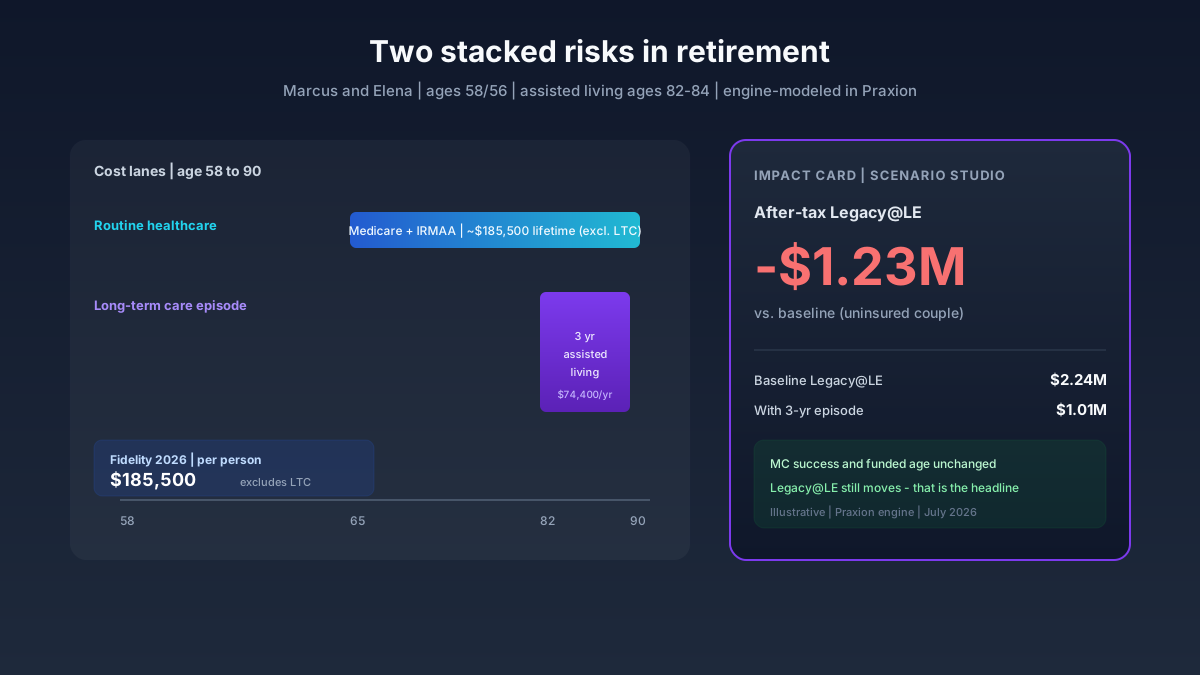
Few budget for the possibility that one spouse may spend three years in assisted living at nearly $74,400 per year.
That single event can reduce after-tax legacy by over $1.23M in our reference scenario — even for households that appear financially secure on headline Monte Carlo metrics.
The challenge isn't predicting whether long-term care will happen. It's understanding how your retirement plan performs if it does.
Most retirement software treats healthcare as one predictable annual expense. Praxion models healthcare as two independent risks: steady routine costs and an optional late-life care episode you can explore without changing your persisted plan.
Key takeaways
- Routine healthcare and long-term care are separate risks — budget and model them independently.
- Medicare does not pay custodial long-term care.
- Assisted living now averages roughly $74,400 annually (CareScout 2025 median).
- Care costs often grow faster than general inflation — historically about 3–5% per year.
- Scenario modeling is more useful than assuming one lifetime average.
How much should you budget for healthcare in retirement?
Searchers and planners often ask one question that hides two different answers: how much healthcare will cost, and whether a care episode could arrive on top.
Layer 1 — Routine healthcare (from Medicare eligibility)
Fidelity's 2026 retiree healthcare estimate is about $185,500 per person from age 65 — premiums, copays, and out-of-pocket medical under standard Medicare, excluding long-term custodial care ( source).
Layer 2 — A possible care episode (often in your 80s)
About 50–70% of adults 65+ will need some form of long-term care. A common planning benchmark is a three-year assisted-living stay at the national median near $74,400/year — potentially $912K gross over three years in our reference scenario before portfolio effects.
What long-term care costs in retirement
Long-term care is help with daily activities — bathing, dressing, medication management — not a short hospital stay. National medians from the CareScout Cost of Care Survey (2025) are reference benchmarks often cited in educational materials. Actual costs in your area may differ by 20–40% depending on location, provider, and level of care.
| Care type | Annual median | Notes |
|---|---|---|
| Adult day health care | $24,700 | Praxion-derived: CareScout daily rate annualized at 5 days/week — the 5 d/wk basis is a Praxion assumption, not CareScout-published. |
| Home health aide | $80,080 | Praxion-derived: CareScout hourly rate annualized at 44 hours/week — the 44 hr/wk basis is a Praxion assumption, not CareScout-published. |
| Assisted living | $74,400 | Community median ($6,200/mo). |
| Memory care | $93,000 | Estimate only: assisted living + 25% (midpoint of a 20–30% memory-care premium) — not CareScout-published. |
| Nursing home (semi-private) | $114,975 | Semi-private room ($315/day). |
| Nursing home (private) | $129,575 | Private room ($355/day). |
The average long-term care need runs about three years, but roughly 20% of people need care for five years or more. Cognitive conditions can extend needs to eight or ten years. Care costs also inflate faster than general CPI — historically about 3–5% per year.
For funding options — self-insurance, traditional LTC, hybrid policies, Medicaid, and family caregiving — see the retirement insurance guide.
Two different risks — why planners often separate them
| Routine healthcare | Care episode | |
|---|---|---|
| When | Steady from ~65 (earlier if pre-Medicare) | Concentrated burst, often late 70s–80s |
| Predictability | High (premiums + inflation) | Low (if, when, how long) |
| Typical source | Fidelity benchmark, Medicare modeling | CareScout / Genworth medians |
| In Praxion | Always-on in projections | Opt-in via Scenario Studio |
Fidelity's 2026 retiree health care estimate ($185,500 per person, excluding LTC — source) covers premiums, copays, and out-of-pocket medical costs under standard Medicare. It does not cover a multi-year assisted-living stay. About 50–70% of adults 65+ will need some form of long-term care during their lifetime.
Medicare does not cover custodial long-term care. It may cover short-term skilled nursing after a hospital stay, but extended nursing home care, assisted living, or in-home aide services require separate funding considerations. Choosing your path at 65 matters — see Medicare Advantage vs. Medigap. Fidelity research finds that roughly 54% of pre-retirees incorrectly believe Medicare covers all health expenses.
Static spending assumptions often miss late-life shocks. Retirement hardship detection explains why funded-age and success-rate metrics can look fine while legacy falls. Monte Carlo simulations stress-test market paths — but unmodeled care episodes remain a common gap.
How people commonly pay for long-term care
There is no single right answer — only trade-offs that vary by net worth, health, family support, and state rules. The following summarizes approaches often discussed in planning literature.
- Sometimes discussed for very high net worth
- Concentration risk if care runs long
- No premium drag
- Often discussed for roughly $250K–$2M in assets
- Typical application window: 50s–early 60s
- Premiums and eligibility vary widely by health
- Permanent life with LTC rider
- Higher premium than traditional LTC
- Death benefit if care unused
- Asset and income limits apply
- Spend-down rules vary by state
- Consult an elder-law attorney
- Real cost in time and career
- Often unpaid family labor
- Genworth caregiver research documents burden
For deeper comparisons, see the retirement insurance guide.
Illustrative example: a couple models a 3-year care episode
Hypothetical, engine-modeled illustration — not a client case study or recommendation.
Marcus (58) and Elena (56) are seven years from retirement with about $1,940,000 saved.
Their plan already models Medicare premiums and IRMAA. It does not yet include a late-life care episode.
Marcus has a family history of dementia. During onboarding he records this information.
Nothing changes in his retirement projections. Instead, Praxion later suggests modeling a long-term care scenario.
He explores a three-year assisted-living episode from ages 82–84 at $74,400/yr (CareScout median). The what-if stays separate from his dashboard until he chooses to add it.
The impact card compares before and after. Monte Carlo success and funded age still read 100% and age 90.
But after-tax Legacy@LE drops −$1.23M — from $2.24M to $1.01M. That headline metric moves even when other metrics saturate on well-funded plans.
A second what-if adds illustrative LTC coverage ($200/day, 90-day elimination, 3-year benefit).
Legacy@LE delta improves to −$706K. Net three-year care cost falls from $912K to $766K — but legacy still falls materially.
Why Legacy@LE? Success rate and funded age can read "fine" while after-tax estate at life expectancy drops by seven figures. Praxion surfaces Legacy@LE on the impact card because it responds when other metrics do not.
How to model care costs in your plan
Most retirement software assumes healthcare behaves like a predictable annual expense. Praxion models healthcare as two independent risks — and lets you explore the second without silently changing your persisted plan.
- Baseline healthcare — Medicare path, premiums, IRMAA, and pre-65 costs run in every projection.
- Optional LTC policy — if you enter coverage during onboarding, the model can net benefits against a care episode.
- Scenario Studio what-if — configure care type, onset age, duration, and cost benchmark; review the impact card; optionally add to your plan.
How the engine handles care episodes (technical)
- Care benchmarks from CareScout medians, inflated at a care-specific rate separate from general medical inflation.
- LTC policy netting applied when both a policy and an episode are present.
- What-ifs are transient until you persist them as a life event tagged
care_model. - Care cost rolls into total expenses; the itemized breakdown appears on the Scenario Studio impact card.
Topics to discuss with a qualified professional
Common discussion starters when exploring care-cost planning with a qualified adviser:
- Separating routine healthcare benchmarks from long-term care risk in your mental model.
- Choosing a benchmark care type (assisted living is a common middle scenario in published data).
- Running an illustrative multi-year episode in your 80s to see how legacy and sustainability metrics respond.
- Comparing insured vs. uninsured scenarios if you have or are evaluating LTC coverage.
- Weighing self-fund, insurance, or hybrid approaches against your balance sheet and family preferences.
- Revisiting assumptions when new benchmark data is published (typically each summer).
Disclaimer: This article is provided for informational and educational purposes only. It does not constitute individualized investment, tax, legal, or insurance advice, and it is not a substitute for consultation with a qualified financial professional — such as a CFP® professional or CFA charterholder — or other licensed specialists where appropriate. Praxion does not recommend or endorse any specific care-funding strategy, insurance product, or course of action. See also our site disclaimer.