When a Roth Conversion Lowers Your Taxes but Shrinks Your Legacy
The same conversion can be a win for taxes and a quiet loss for the estate. Here is the mechanism, the assumptions that drive it, and when it still makes sense.
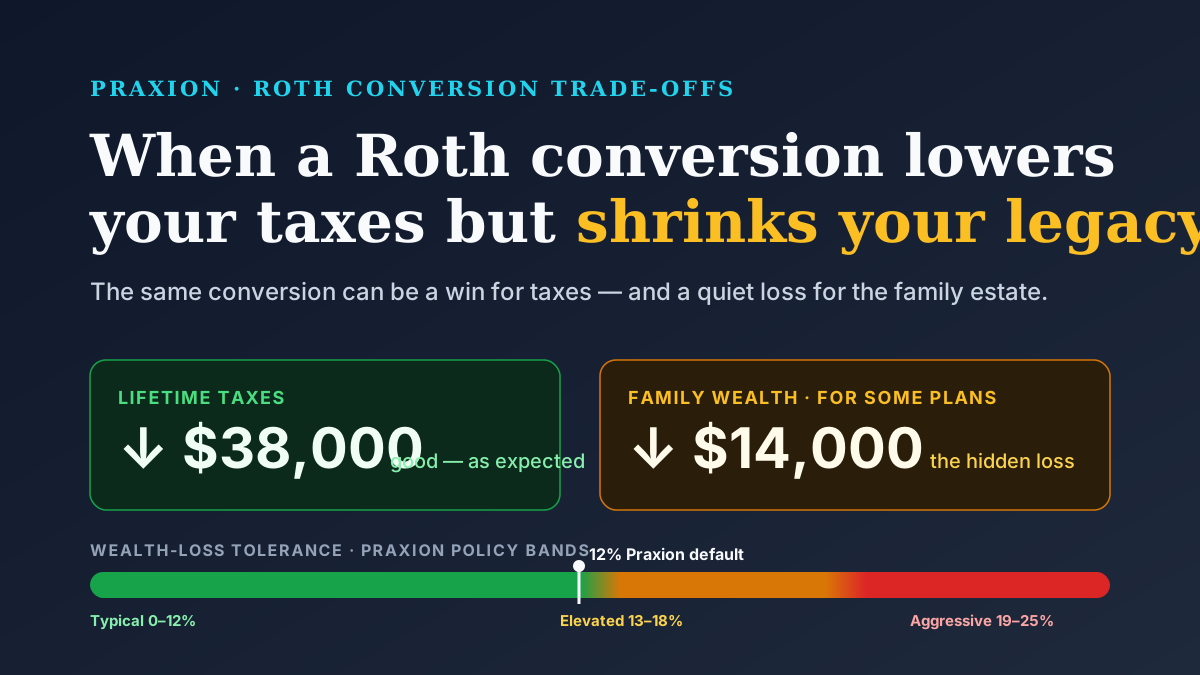
Most Roth-conversion advice points in one direction: convert now, pay tax at today's rates, and enjoy tax-free growth later. For many retirees that is genuinely the right call. But a Roth conversion is an asymmetric bet — you pay a certain tax today for an uncertain future benefit — and for some families the same conversion that lowers lifetime taxes quietly lowers the wealth that reaches heirs.
That trade-off usually stays hidden, because the tax saving is easy to show and the estate cost is not. This piece makes it visible: where the hidden loss comes from, the one assumption that drives your legacy result, and how Praxion puts the trade-off in front of you instead of burying it.
Figures throughout use one illustrative plan — a married couple, both 66, roughly $1.2M in a traditional IRA — to keep the numbers comparable. They are illustrative, not a recommendation.
Why a conversion is a bet, not a free lunch
A Roth conversion moves money from a traditional (pre-tax) account to a Roth account and taxes it in the year you convert. In exchange, that money grows tax-free and is never subject to required minimum distributions. The pitch is simple: pay tax at a low rate now to avoid a higher rate later.
The catch is that almost every part of that sentence is uncertain. You know today's tax cost exactly. You do not know your future tax rate, how long the money stays invested, whether you will spend it, what your heirs' tax rates will be, or how the assets would have been taxed if you had left them alone. The conversion is a bet that the certain cost today is smaller than the uncertain benefit later. Sometimes it is. Sometimes it is not.
The tell: a conversion always looks good on the tax line, because paying tax at a lower rate than you expect later is a real saving. The question is never “did taxes go down” — it is whether total lifetime family wealth went up once every effect is counted.
The same conversion, two different verdicts
Take one conversion and run it for two households with identical accounts but different goals. Both cut lifetime taxes by about the same amount. The bottom-line effect on family wealth points in opposite directions.
Nothing is wrong with either number. The conversion really did save tax in both plans. It is just that “save tax” and “grow the estate” are not the same objective, and a conversion can serve one while working against the other.
Where the hidden loss comes from
Four forces, all of them ordinary tax mechanics, can pull the family-wealth line below zero even as taxes fall:
- Paying the tax from the portfolio. If the conversion tax comes out of the IRA or brokerage rather than outside cash, you shrink the invested base. That lost compounding is a real, permanent cost that the headline tax saving never shows.
- The brokerage step-up you give away. Taxable brokerage assets get a step-up in basis at death — heirs inherit them with the embedded gains wiped out for tax purposes. Spending brokerage dollars to pre-pay conversion tax can forfeit a benefit the family would otherwise have received for free.
- The SECURE Act 10-year drain. Most non-spouse heirs must empty an inherited traditional IRA within 10 years. Whether converting helps depends on the tax rate the heirs pay during their 10-year window — not yours.
- The heirs' bracket. A conversion pre-pays tax at your rate to spare your heirs their rate. If your heirs would have drained the account in a lower bracket than you paid, you overpaid on their behalf.
A conversion can also push a single year's income across an IRMAA cliff (above $218,000 for a couple in 2026), adding a flat Medicare-premium surcharge that year — a separate, lumpy cost that never appears in a “marginal rate” comparison. For context, a couple can also realize long-term gains tax-free up to $96,700 of taxable income, which is part of why the step-up and bracket math matter so much.
The one assumption that drives your legacy result
Because the whole legacy case rests on the heirs' tax rate, that single assumption can flip the answer. Assume your heirs are in a high bracket and a conversion looks like a gift to them. Assume they are in a modest bracket and the same conversion looks like an overpayment.
A weak model just hard-codes one heir rate — often a flat 32% — for everyone. Praxion does not. It estimates a heir tax rate that scales with the size of the inherited balance (a larger inherited IRA drained over 10 years pushes the heirs into higher brackets), and it lets you override that rate if you know your children's actual tax situation. The legacy number you see is only as good as this assumption, which is exactly why we surface it rather than hide it inside a single fixed percentage.
If you take one thing from this article: ask what heir tax rate a Roth-conversion tool is assuming. A conversion that “wins” under a 32% heir rate can “lose” under a 22% one. It is the most important number you are not usually shown.
Two kinds of plans — and when the trade-off actually bites
Whether the hidden loss matters depends on what your plan is trying to do.
Tax-first plans: lower lifetime taxes and RMDs
If your goal is your own lifetime — smaller RMDs, a lower lifetime tax bill, staying under IRMAA cliffs, more tax-free flexibility in your 80s — a conversion usually helps on both fronts at once. Here the family-wealth trade-off rarely binds, because the same move that cuts your taxes also leaves more for the estate. The tolerance guardrail almost never gets in the way.
Legacy-first plans: maximize what reaches heirs
If your primary goal is the estate, the picture changes. Now the step-up you forgo, the heirs' bracket, and the portfolio dollars spent on conversion tax all count against you — and a conversion that trims your taxes can still shrink the inheritance. This is the plan where the hidden loss is real and where a wealth-loss tolerance earns its keep.
What you are actually hedging: wealth-loss tolerance
“Wealth-loss tolerance” is a plain name for a real question: how much modeled lifetime family wealth would you knowingly trade for tax savings?It is not a market-risk setting and has nothing to do with stock-market drawdowns — it is purely about the family-wealth cost a conversion strategy is allowed to accept in pursuit of a lower tax bill.
Set it at zero and the engine will only recommend conversions that never reduce modeled family wealth. Raise it and you permit strategies that give up some estate value for a larger tax saving. That is the hedge: you are deciding, up front and explicitly, how much of the family's modeled wealth you are willing to put on the table.
An honest note on 12%. There is no industry-standard wealth-loss-tolerance percentage — the profession evaluates conversions with break-even tax rates, funding source, RMDs, IRMAA, and estate goals, not a single number. Praxion's 12% is a conservative default guardrail we selected so that automated recommendations stay cautious while still allowing economically meaningful strategies. It is a Praxion policy parameter, not a claim about what you personally prefer.
How Praxion puts the trade-off in front of you
The whole point of the wealth-loss tolerance is transparency. Rather than quietly assuming a number and handing you a recommendation, Praxion:
- Shows the default, never hides it. If you have not set a tolerance, the recommendation is labeled a preview computed under the 12% Praxion default — not presented as a choice you made.
- Names the band. Your setting is labeled Typical, Elevated, or Aggressive, with an explicit warning at the aggressive end — so you always know where your choice sits.
- Tells you when tolerance is the lever. If raising your tolerance would change the recommendation, Praxion says so and shows the specific level — and if it would nothelp, it says that too, rather than nudging you to accept more risk for nothing.
- Keeps a separate safety floor. A fiduciary guardrail can cap a recommendation regardless of your tolerance — and Praxion discloses when that floor, not your tolerance, is the binding constraint.
You can explore exactly this on your own numbers in the tax optimizer and the Roth analysis inside Praxion.
When a conversion still makes sense — and accepting tolerance is wise
None of this is an argument against Roth conversions. It is an argument for doing them with your eyes open. A conversion — and accepting some modeled wealth-loss tolerance to enable it — tends to be the stronger move when several of these hold:
- Your future tax rate is likely higher than today's (low-income gap years before RMDs, or expected rate increases).
- You can pay the conversion tax from outside cash, not the portfolio.
- Your heirs are in high brackets and would drain an inherited IRA at high rates.
- You have a long investing horizon for the converted dollars to grow tax-free.
- You are managing RMD and IRMAA pressure, or you face potential estate-tax exposure.
When the case is that strong, a small modeled dip in family wealth is a price worth paying — and that is precisely the judgment the tolerance setting lets you make on purpose, instead of by accident.
Plain-English glossary
- RMD (Required Minimum Distribution): the amount the IRS requires you to withdraw from pre-tax retirement accounts each year, generally starting at age 73.
- IRMAA: an income-related surcharge on Medicare premiums. It is a flat dollar amount per income cliff, not a percentage — cross a threshold and the whole surcharge applies.
- Step-up in basis: at death, taxable brokerage assets reset to their current value for tax purposes, so heirs can sell without owing tax on the prior gains.
- SECURE Act 10-year rule: most non-spouse beneficiaries must fully withdraw an inherited IRA within 10 years, which concentrates the heirs' taxable income.
- BETR (Break-Even Tax Rate): the future tax rate at which a conversion breaks even — convert if you expect your (or your heirs') future rate to exceed it.
Related reading
See the trade-off on your own numbers
Praxion shows you both sides of a Roth conversion — the tax saving and the modeled family-wealth cost — and lets you set the wealth-loss tolerance yourself instead of accepting a hidden default.
Start your plan →Praxion Finance is a decision-support tool, not a registered investment adviser. Illustrative figures are modeled examples, not a recommendation or a guarantee of results. Tax rules change; confirm your situation with a qualified professional.
Last updated: August 19, 2026