Why Static Retirement Plans Are Failing
The shift from accumulation to decumulation is the hardest phase of financial planning. You're no longer just saving — you're simultaneously managing withdrawals, Roth conversions, RMDs, Social Security timing, Medicare premiums, and capital gains — across accounts with different tax treatments, in a market that doesn't care about your spreadsheet.
Sequence-of-Returns Risk
A -20% drop in year 1 of retirement can permanently reduce your portfolio, even if markets recover.
Rising Tax Uncertainty
Expiring TCJA provisions, shifting brackets, IRMAA cliffs — the tax landscape changes every year.
Longevity Risk
Plans built for 85 fail at 93. Living longer means more years of compounding mistakes — or compounding optimizations.
Decumulation Complexity
Which account do you withdraw from first? How much Roth to convert this year? These interact in ways that are impossible to intuit.
The cost of a static plan: A poorly timed Roth conversion strategy or a missed tax-bracket opportunity can cost $30,000–$80,000+ in after-tax wealth over a 30-year retirement. Most people never realize they lost it.
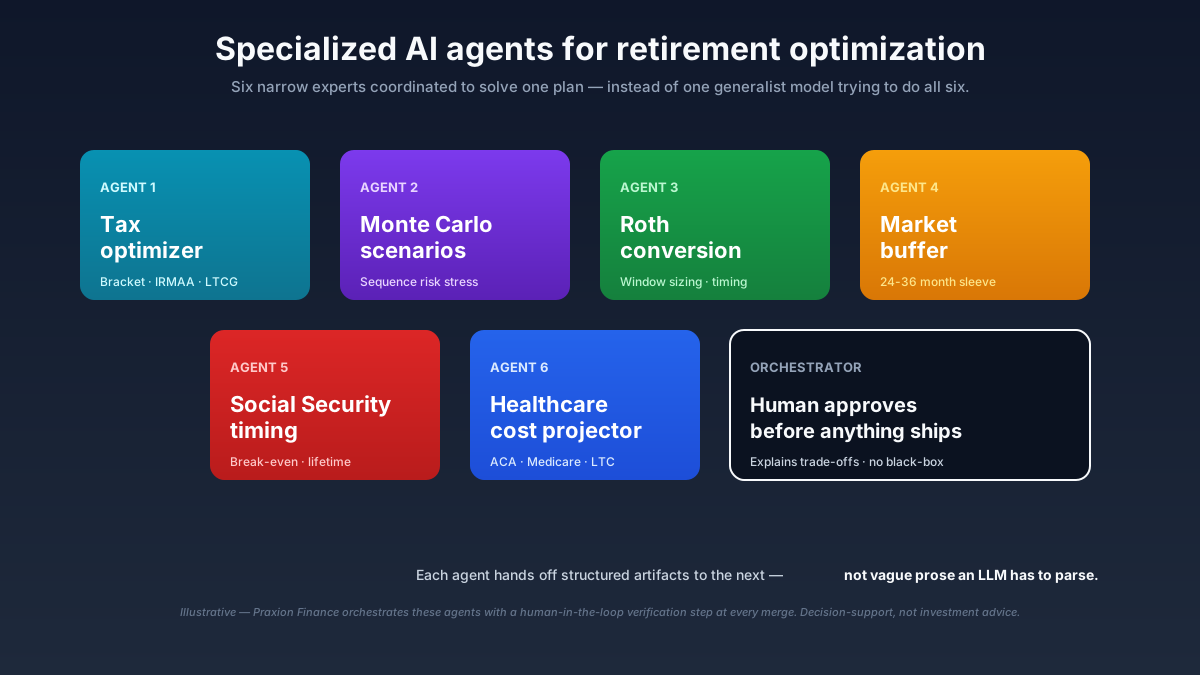
The Solution: A System of Specialized AI Agents
Praxion doesn't use one monolithic AI. It uses a network of purpose-built agents, each responsible for a specific domain. These agents share data through a common financial engine, but operate independently — so each analysis is grounded in real calculations, not generic advice.
| Agent | What it does | Where you see it |
|---|---|---|
| Tax Strategy Agent | Roth conversion and tax bracket optimization | AI Review |
| Shock Simulation Agent | Market deviation detection and shock-year scenarios | AI Optimizer |
| Withdrawal Sequencing Agent | Tax-efficient drawdown ordering across accounts | AI Review |
| Data Health Agent | Balance drift tracking and reconciliation | Data Health gauge |
| Critic Agent | Independent validation of every proposed change | Runs across all of the above |
Engineering-detail cross-reference: see Agent Fabric: The Infrastructure Behind Praxion's AI for the platform architecture that powers these agents.
Roth Conversion & Tax Bracket Optimization
Scans every Roth conversion preset against your multi-decade tax projection. Tests aggressive, moderate, conservative, and bracket-filling strategies — then identifies the specific bracket transition (e.g., 22% → 24%) that maximizes your after-tax wealth.
What it actually does: Runs your full projection against every Roth optimization preset, computes Total Economic Wealth (TEW) for each, and identifies the preset that improves your outcome the most. For one modeled profile, it found that switching from "Custom" to "Aggressive (32%)" increased total Roth conversions from $594K to $676K and improved after-tax wealth by $53,150 (+3.6%).
Market Downturn Detection & Response
Connects to live market data, calculates your portfolio's weighted return based on your actual asset allocation (US stocks, international, bonds), and compares it against your projected plan value for today's date. When deviation exceeds thresholds — or when you simulate a scenario — it triggers the optimization pipeline.
What it actually does: Pulls YTD returns for VTI (US stocks), VXUS (international), BND (bonds), computes your weighted portfolio return, and interpolates your expected plan value for today's exact date. If your portfolio is at -20.6% deviation, it re-runs the full projection under shocked conditions to find the best response.
Tax-Efficient Drawdown Ordering
Determines the optimal order to draw from pre-tax (401k/IRA), Roth, and brokerage accounts each year. Factors in RMD requirements, capital gains brackets, Social Security taxation thresholds, and IRMAA income limits to minimize your lifetime tax burden.
What it actually does: Models year-by-year withdrawals across all accounts, respecting tax-lot ordering, RMD floors, and Social Security provisional income rules. The engine calculates exact federal and state tax for each year and optimizes the sequence to minimize the total.
Balance Drift Tracking & Reconciliation
Monitors how your account balances drift over time as markets move. Uses proxy-ticker market data (VOO for equities, BND for bonds, BIL for cash) to estimate current values, scores each account's freshness as a confidence percentage, and lets you accept updated balances with one click.
What it actually does: Reads your last-known balances and their timestamps from a time-series ledger. Fetches real market returns since those dates for each account's proxy ticker. Applies cumulative drift to estimate current values (e.g., a $3.5M brokerage entered in Jan 2025 becomes ~$3.79M by March 2026 based on VOO's actual return). Presents the delta per account and overall, with a "Yes, looks close" button that writes the accepted values back to your profile — so every subsequent projection uses current, market-adjusted figures.
How certain is your plan? Data Health tracks whether your data reflects reality — and alerts you when market moves require attention.
✦ Does this look right?
Based on market movements, we estimate your balances have shifted.
Independent Validation & Guardrails
Every proposed change from every agent passes through this independent critic. It validates that proposed changes actually improve your outcome, checks parameter validity, verifies the reasoning, and rejects proposals that don't meet safety thresholds.
What it actually does: Receives the Generator's proposal with full financial context. Independently verifies TEW improvement. If rejected, sends structured feedback explaining why — and the Generator must try again with that feedback incorporated. This loop runs up to 3 times before falling back to the deterministic best-preset result.
Shock-Year Simulation: From Probability to Specific, Modeled Change
Monte Carlo tells you the probability your plan succeeds — a 78% success rate, say. That's a useful signal (and Praxion runs Monte Carlo on every plan), but probability alone doesn't tell you what to change.
Praxion's Shock Simulation Agent layers on top of that probability with something different: it simulates a specific, concrete financial shock — then surfaces a specific change and the modeled improvement.
Portfolio Estimate as of Mar 20, 2026
● Plan data currentBased on current market conditions. Is this accurate?
That's the difference: a probability tells you how your plan tends to perform; this output tells you what change would move it. You can apply the change with one click — and revert if conditions shift.
Why this matters: During a downturn, portfolio values are depressed. Converting to Roth at these lower values means you pay less tax on the conversion, and all future recovery growth is tax-free. The agent identifies this window automatically.
Under the Hood: Generator-Critic Architecture
All agents feed into a Generator-Critic pipeline — an architecture pattern where one AI proposes and a separate, independent AI validates. This prevents the single-point-of-failure problem that plagues most AI systems.
Key Design Decisions
- Deterministic before AI — Before any AI is involved, the system exhaustively tests every known strategy preset against your projection. If no preset improves your outcome, the AI is never invoked — you see a clear "your current strategy is already optimal" message. This prevents hallucinated outputs.
- Structured output, not free text — The AI Generator doesn't write prose. It returns a structured JSON object with specific field names, current values, proposed values, and numerical impact. Every output is schema-validated before it reaches the Critic.
- Independent validation — The Critic Agent receives the full financial context independently. It doesn't trust the Generator's claims — it re-verifies TEW improvement, parameter validity, and reasoning coherence. Rejection feedback is structured so the Generator can meaningfully iterate.
- Deterministic fallback — If the AI fails after 3 attempts, the system falls back to the best result from the preset scan. You always get the mathematically best answer — the AI just provides richer reasoning when it succeeds.
What This Looks Like in Your Dashboard
These agents don't run in the background invisibly. Every analysis appears in your AI Optimizer tab with full transparency.
Portfolio Health Check
One-click scan that pulls live market data, calculates your portfolio's deviation from plan (e.g., "-4.6% below expected"), and shows exactly where you stand today.
Data Health Gauge
A per-account confidence score (0–100%) shows how fresh your balances are. When values drift beyond thresholds, the gauge drops and a reconciliation prompt appears — accept the estimated values or enter your own. Full balance history is maintained in a time-series ledger.
Scenario Simulation Buttons
Simulate market drops down to −40% with one click. Each simulation runs the full agent pipeline and returns a concrete analysis with before/after comparison in seconds.
Clear Analysis Cards
Each analysis card shows: what changes, the before/after values, the dollar and percentage impact on your after-tax wealth, and the AI's reasoning. Example: "Roth Optimization Strategy: Custom → Aggressive (32%)" with "+$53,150 (+3.6%)".
Apply, Revert & History
Apply any suggested change with one click. Every change is tracked with timestamps and previous values, and can be reverted with one click at any time — nothing is permanent unless you keep it.
Why This Is Different
Built-In Safety Features
Dual-AI Validation
Independent Generator and Critic agents. The Critic can reject and force re-iteration with structured feedback.
Deterministic Fallback
If no preset improves your outcome, AI is never invoked. You see "your strategy is already optimal" — no unnecessary changes.
One-Click Revert
Every applied change can be undone instantly. Nothing is permanent unless you choose to keep it.
Full Audit Trail
Every applied change is recorded with before/after values, timestamps, and one-click revert. You own the history.
Important: Praxion Finance is a decision-support tool, not a financial advisor. The analysis is based on your inputs and publicly available market data. Always consult a qualified professional for major financial decisions.
From Planning to Ongoing Optimization
Most retirement tools help you build a plan. Praxion helps you run one.
The shift is fundamental: instead of a static document you revisit once a year, you get a living system that watches the market, tests strategies continuously, and surfaces specific, validated analysis — with the safety rails to apply changes confidently.
This is what a financial operating system looks like.
Related Reading
Praxion AI: From Data to Dialogue
How conversational AI meets CFP-grade financial modeling to answer your retirement questions in real time.
How AI Is Transforming Financial Planning
An evidence-based guide to AI in financial planning — tools, benefits, risks, and best practices.
Using AI to Achieve Financial Goals
Practical ways AI helps retirees weigh competing goals — legacy, spending, taxes, and risk tolerance.
Stop Planning. Start Optimizing.
See what specialized AI agents find in your retirement strategy — free, no credit card required.