AI Financial Planning for Retirement: Free Planner Guide (2026)
What AI actually does in retirement planning — forecasting, tax optimization, withdrawal sequencing — with real examples and where it stops being useful.
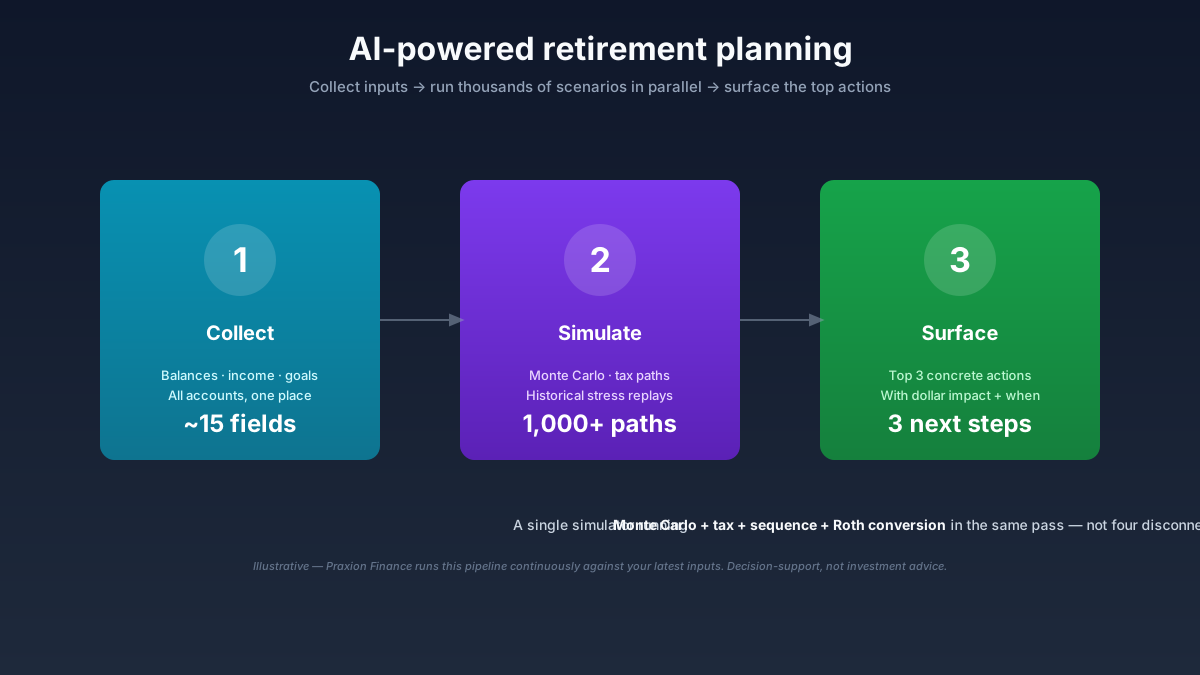
Quick answer: A free AI financial planner for retirement uses simulation engines — not generic chat — to model Monte Carlo success probability, Roth conversion timing, withdrawal sequencing, and Medicare IRMAA cliffs from the numbers you enter. Praxion AI runs these analyses free, with no bank-account linking. It is planning software, not personalized investment advice.
Financial planning has traditionally relied on static projections — fixed assumptions about returns, inflation, and spending.
But real life doesn't follow a straight line.
Today, artificial intelligence (AI) is changing how financial plans are built and managed. Instead of relying solely on fixed forecasts, modern systems can simulate thousands of potential outcomes, adapt to changing conditions, and analyze decisions over time.
In this guide, we'll break down:
- What AI means in financial planning
- Where it's actually useful (and where it isn't)
- Real-world examples, including advanced retirement scenarios
What Is AI in Financial Planning?
At its core, AI in financial planning refers to systems that can:
- Analyze large datasets across market history, tax tables, and personal financial variables
- Identify patterns in spending, income, and market behavior
- Simulate multiple future scenarios rather than relying on a single average-return assumption
- Surface modeled strategies based on outcomes across thousands of paths
Unlike traditional models, which often rely on a single "average return" assumption, AI-driven approaches evaluate ranges of outcomes and adjust decisions dynamically.
Key Use Cases of AI in Financial Planning
1. Retirement Forecasting
Traditional retirement tools often project a single path forward. AI-enhanced models simulate many possible futures:
- Different market return sequences
- Inflation variations
- Longevity scenarios
This provides a more realistic view of risk — especially the probability of running out of money. Tools like Monte Carlo simulation run thousands of randomized scenarios to stress-test whether a plan survives bad sequences of returns. The underlying Monte Carlo method was originally developed for nuclear physics — today it's one of the most widely used techniques in financial modeling.
Monte Carlo simulations run thousands of scenarios using randomized returns, producing a distribution of outcomes instead of a single estimate. This helps retirees understand not just the expected path — but the range of possible outcomes and the probability of each.
2. Withdrawal Analysis (Where AI Really Shines)
One of the hardest problems in retirement is deciding: How much should I withdraw each year — and from which accounts?
AI can analyze:
- Tax-efficient withdrawal order (Roth vs Traditional vs brokerage)
- Dynamic spending adjustments based on market performance
- Long-term sustainability vs short-term income needs
This goes far beyond fixed rules like the 4% rule. AI-driven withdrawal strategies adapt year-by-year based on portfolio value, tax bracket position, and remaining life expectancy. Understanding the safe withdrawal rate methodology is essential context for why dynamic approaches can behave differently than static rules under volatility.
3. Shock Scenario Modeling (Underrated but Critical)
Real life includes unexpected events:
- Market crashes (-20% or worse)
- High inflation periods
- Sudden expenses or income changes
AI systems can simulate these "shock years" and show:
- How your plan responds under stress
- What adjustments improve outcomes
- Whether you stay on track or need to course-correct
This is where static planning tools often fall short. Understanding sequence-of-returns risk is critical — a -20% drop in year one of retirement can permanently reduce a portfolio, even if markets recover. Read more about how this plays out in our guide to sequence of returns risk.
Early negative returns during retirement can permanently damage a portfolio because withdrawals lock in losses. This is why stress-testing across many return sequences — not just averages — is essential.
4. Tax Analysis
Taxes are one of the largest — but most overlooked — variables in financial planning. AI can model:
- Future tax bracket changes
- Roth conversion strategies across different income levels and time horizons
- Required Minimum Distributions (RMDs) and their interaction with Social Security
- Multi-decade tax impact across pre-tax, Roth, and brokerage accounts
This allows for strategies that minimize lifetime tax burden — not just this year's bill. Advanced financial modeling techniques make it possible to evaluate these trade-offs across 20-30 year horizons.
Benefits of AI in Financial Planning
AI-driven planning introduces several advantages:
Personalization
Strategies tailored to individual financial situations, not generic rules of thumb.
Adaptability
Plans that adjust to market conditions rather than waiting for an annual review.
Scenario Awareness
Visibility into best-case, worst-case, and most-likely outcomes simultaneously.
Multi-objective analysis
Better visibility across taxes, withdrawals, and timing — not just one dimension at a time.
Limitations (Important for Trust)
AI is powerful — but not perfect. Key limitations include:
- Model assumptions still matter — projections are only as good as the inputs and assumptions behind them
- Overfitting risk — tuning models too tightly to specific past scenarios can produce strategies that fail in novel conditions
- Data quality issues — "garbage in, garbage out" applies to AI just as much as spreadsheets
- Interpretation challenges — users need to understand what AI outputs mean, not just accept them blindly
A strong financial plan combines AI insights with human judgment. AI tools are decision-support systems, not decision-makers.
Real Example: Market Downturn Early in Retirement
Consider this scenario:
A retiree begins withdrawals at age 65. The market drops 20% in year two.
Traditional Approach
- Continue fixed withdrawals
- Risk accelerating portfolio depletion
- No mechanism to adapt
AI-Driven Approach
- Adjust withdrawal amounts dynamically
- Shift account draw strategy (Roth vs Traditional)
- Re-analyze long-term plan in real time
The difference can significantly impact how long a portfolio lasts. A well-designed system detects these risks early and suggests specific adjustments — not vague advice like "spend less."
Tools Using AI in Financial Planning
AI is being integrated across different types of tools:
- Robo-advisors for automated portfolio management
- Budgeting platforms with pattern detection
- Advanced financial planning software with multi-decade modeling
More advanced platforms now combine:
- Multi-decade simulation with Monte Carlo analysis
- Tax-aware strategies including Roth conversions and RMD planning
- Dynamic withdrawal analysis that adapts to market conditions
- Real-time balance tracking that keeps projections grounded in current reality
These systems aim to move beyond static projections toward adaptive financial planning — where your plan evolves as your life and markets change.
The Future: Adaptive and Agent-Based Planning
The next evolution of financial planning is moving toward:
- Continuous plan monitoring — not just annual reviews
- AI-driven insights — specific, validated strategy changes for review
- Agent-based systems — specialized AI agents that proactively adjust strategies
Instead of reviewing a plan once a year, future systems will continuously evaluate and improve financial outcomes over time. Some platforms are already implementing this approach with a system of five specialized AI agents — Tax Strategy, Shock Simulation, Withdrawal Sequencing, Data Health, and an independent Critic Agent — that handle distinct responsibilities and feed user-facing surfaces like AI Review, AI Optimizer, and the Data Health gauge. The full mapping is covered in the linked article.
What agent-based planning looks like in practice
- AI Review — exhaustively tests Roth conversion presets and withdrawal strategies through a Generator-Critic architecture
- AI Optimizer — connects to live market data to detect deviation from plan and simulate shock scenarios
- Data Health — tracks how account balances drift with market movements and provides one-click reconciliation
- Praxion AI — answers your retirement questions conversationally against the same engine
Conclusion
AI is not replacing financial planning — it's making it more realistic, adaptive, and personalized.
As financial lives become more complex, the ability to simulate scenarios, analyze decisions, and adjust dynamically will become increasingly important.
The real value of AI lies not just in prediction — but in better decision-making over time.
Frequently Asked Questions
What is AI financial planning?
AI financial planning uses artificial intelligence to analyze large datasets, simulate thousands of potential market and life scenarios, and surface modeled strategies for retirement, taxes, and withdrawals. Unlike static models that rely on a single average-return assumption, AI evaluates ranges of outcomes and adjusts decisions dynamically.
Is there a free AI financial planner for retirement?
Yes. Praxion is a free AI financial planner focused on retirement — Praxion AI models Monte Carlo success rates, Roth conversion timing, withdrawal sequencing, IRMAA cliffs, and Social Security claiming from the numbers you enter, with no bank-account linking. It is planning software, not personalized investment advice.
Do AI financial advisors include tax and retirement planning?
Many do, though coverage varies widely. General-purpose AI chat tools tend to give broad answers, while retirement-focused planners like Praxion model the specifics — Roth conversions, withdrawal sequencing, IRMAA, and Social Security taxation — that can materially change after-tax outcomes. Always confirm what a given tool actually calculates.
Can AI be used for financial planning without linking my bank account?
Yes. Praxion runs its analyses from the balances and assumptions you enter, so no account aggregation or bank linking is required. That keeps sensitive credentials out of the picture while still modeling taxes, withdrawals, and market scenarios.
What is the best way to use AI for personalized financial planning?
Generally, use AI to simulate ranges of outcomes rather than to produce a single "answer" — test how retirement timing, Roth conversions, and withdrawal order change your success probability, then revisit the plan as markets and tax law shift. Pairing the AI's scenarios with your own judgment, or a qualified professional for high-stakes decisions, tends to work best.
How does an AI financial planner compare to a human financial advisor?
They tend to complement each other. An AI planner can model thousands of scenarios instantly and at low cost, while a human advisor adds behavioral coaching, accountability, and judgment on situations the model does not capture. For many households, AI-driven analysis informs the decisions a human advisor then helps execute.
Is AI reliable for retirement planning?
AI is a powerful decision-support tool for retirement planning, but it is not infallible. Its reliability depends on model assumptions, data quality, and how well it accounts for uncertainty. The best approach combines AI-driven scenario analysis with human judgment and periodic review by a qualified financial professional.
How does AI compare to Monte Carlo simulation?
Monte Carlo simulation is one technique used within AI-driven financial planning. It runs thousands of randomized market scenarios to estimate the probability of a plan succeeding. AI goes further by also analyzing withdrawal order, tax strategies, and Roth conversions across those scenarios — and by adapting insights when market conditions change.
See How Your Plan Performs Under Real-World Scenarios
Run simulations that model market downturns, tax impacts, and withdrawal strategies — free, no credit card required.
Related Reading
How AI Agents Analyze Your Retirement Plan
Tax Strategy, Shock Simulation, Data Health, and Critic Agent working together.
Using AI to Achieve Financial Goals
Practical ways AI helps retirees decide between competing goals: legacy, spending, taxes.
Praxion AI: Redefining Financial Intelligence
How conversational AI meets CFP-grade modeling for real-time retirement answers.
Monte Carlo Simulations Explained
What they get right, where they fall short, and how to interpret results.
Roth Conversion Windows for Early Retirees
Data-driven analysis of optimal conversion timing before age 59 1/2.
Sequence of Returns Risk Explained
Why timing of market returns matters more than average returns in retirement.
About Praxion Finance
Praxion Finance is a quantitative financial modeling platform specializing in multi-decade retirement and tax simulations. The platform integrates AI-driven analysis — including specialized agents for strategy analysis, market-aware adjustments, and balance reconciliation — with deterministic financial modeling to deliver institutional-grade analysis through an accessible consumer experience.
Learn more about our methodology →Important Disclosures
Educational Content: This article is for educational purposes only and does not constitute personalized financial, tax, or investment advice. All examples are illustrative and hypothetical.
Professional Review Required: Before implementing any financial strategy, consult with a qualified Certified Financial Planner (CFP), tax advisor, or investment professional who can provide personalized guidance based on your complete financial situation.