AI Agentic Engineering: How Praxion Finance Builds Software
Multi-agent AI software development with domain specialists, structured handoffs, and independent verification — how our agentic engineering team ships fintech you can trust.
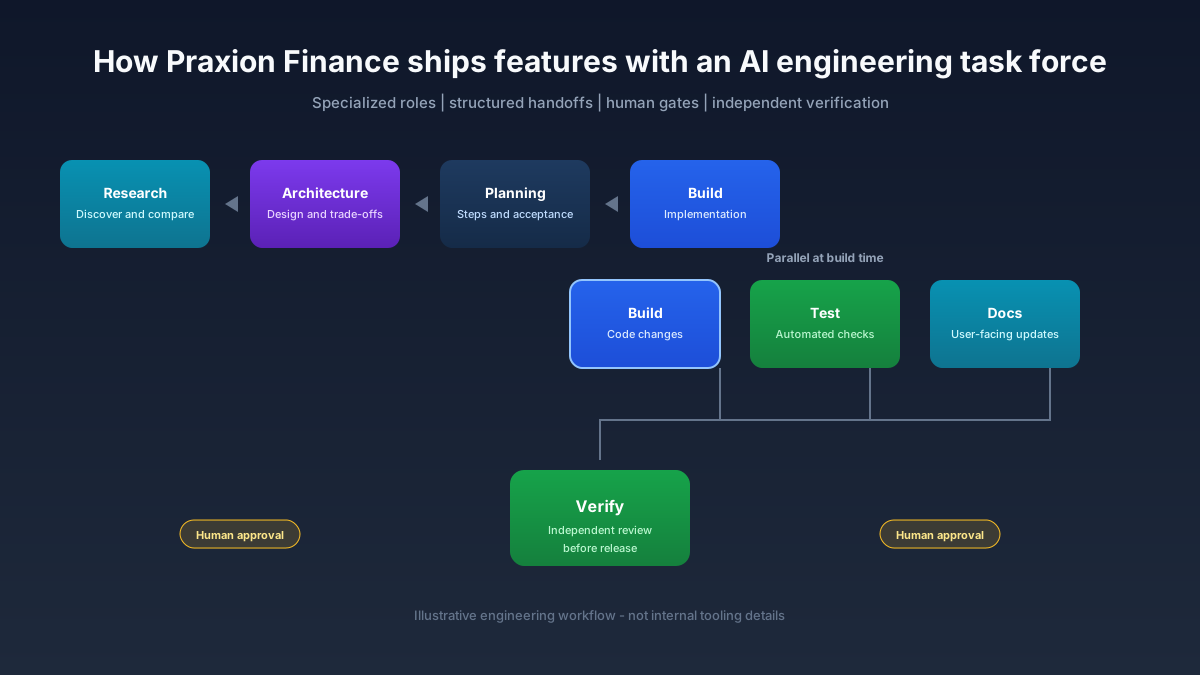
What is AI agentic engineering?
AI agentic engineering is an approach to building software where work is split across a multi-agent AI team — each agent owns one slice of the delivery lifecycle (research, architecture, planning, implementation, testing, documentation, or verification) and passes structured handoffs forward. It is the engineering counterpart to "one chatbot does everything": an agentic SDLC with auditable artifacts instead of opaque conversation history.
Teams exploring agentic AI development, AI agent orchestration, and multi-agent software development often hit the same wall in regulated products: one generalist model cannot hold tax logic, UX brand rules, and verification discipline in a single thread. Fintech needs narrow roles, domain guardrails, and human approval. That is why Praxion Finance invested in an AI engineering task force rather than a single prompt chain.
This article describes our AI agentic engineering model in plain language: the delivery pipeline, how domain specialist AI agents join when work touches design systems or financial methodology, and how that differs from the retirement-planning agents inside your plan.
Why a task force — not one mega-prompt
Retirement planning software touches taxes, projections, security, and user trust. A single all-purpose AI prompt cannot reliably hold that much context while still shipping fast.
Praxion Finance operates an AI Agentic Engineering practice: a coordinated team of specialized AI engineering roles, each responsible for one kind of work — discovery, design, planning, implementation, testing, documentation, or verification. They do not debate in one endless chat. They produce structured handoffs the next role can audit.
That is how we iterate quickly on Monte Carlo engines, tax optimizers, and conversational planning features while keeping human experts in the loop at the moments that matter.
The engineering roles (high level)
Think of it as a software delivery pipeline where each station has a narrow job and a clear output. The names below describe responsibilities — not chatbot personas you interact with inside the product.
Research
- Maps what the product already does
- Surfaces credible external options
- Hands off evidence, not opinions
Architecture
- Turns requirements into a design
- Records trade-offs in plain language
- Flags risks before code is written
Planning
- Breaks design into ordered steps
- Defines acceptance criteria per step
- Scopes what is explicitly out of bounds
Build · Test · Docs
- Implementation changes production code
- Tests exercise real behavior
- Docs update in parallel when users need them
Verify
- Independent review before release
- Checks criteria from the plan
- Can send work back for revision
Multi-agent AI coordination in the delivery pipeline
Coordination is document-driven. When research finishes, architecture reads a findings summary — not a memory of a conversation from last week. When planning finishes, builders receive steps with explicit acceptance criteria. When implementation finishes, an independent verification pass checks those criteria before anything reaches production.
At larger scope, build, test, and documentation often run in parallel so user-facing copy and automated checks keep pace with code — instead of arriving as an afterthought.
Four engineering principles every role follows: surface assumptions early, push back when scope is wrong, change only what the task requires, and prefer the simplest solution that meets the behavior.
Where domain specialists join the flow
The engineering task force is built for delivery — moving a feature from idea to verified release. Praxion Finance also maintains domain specialist agents that activate when work touches their surface. They do not replace engineering roles; they constrain, review, and enrich the handoffs so brand, financial logic, and public copy stay aligned with how the product actually works.
Design system specialists
When they engage: User-visible UI, layout, color, typography, accessibility
- Anchor to Praxion Finance design tokens and shipped components
- Triple-lens review: product design, financial-claim accuracy in the UI, concise copy
- Block off-brand visuals before users see them
Financial methodology specialists
When they engage: Tax, Roth conversions, withdrawals, Monte Carlo, IRS-sensitive logic
- Enforce canonical architecture docs and current-year tax constants
- Challenge marginal-vs-flat mistakes (e.g. IRMAA cliffs, not percentages)
- Keep recommendations educational — not personalized advice
Public content specialists
When they engage: Articles, guides, SEO pages, user-facing methodology copy
- Match article anatomy, metadata, and branded SVG visuals
- Apply not-an-RIA framing and banned superlative patterns
- Cross-link tools and keep hero numbers consistent with body examples
Example: shipping a new Roth conversion chart triggers the financial methodology lane (canonical tax rules and assumption disclosure) and the design system lane (navy brand tokens, accessible status colors, chart labels that match the calculator below). Shipping a public article triggers the content lane plus design review for hero SVGs — without waiting for a separate manual audit cycle.
Human experts still approve. Domain specialist agents accelerate review; they do not auto-merge UI, tax logic, or published copy. Sensitive surfaces — especially anything a user reads as financial guidance — pass human gates before production.
Quality gates you would notice as a user
You do not see the internal handoffs — you see the outcome:
- UI changes stay on-brand with the Praxion Finance design system users already see in the app
- Tax and projection features cite current-year IRS frameworks where applicable
- Calculators expose assumptions instead of hiding them in a black box
- Documentation and in-product copy tend to update when behavior changes
- Regressions are caught by automated tests before release, not by users in production
- Major changes pass human review — AI accelerates the work; it does not auto-ship unchecked
We publish methodology articles and stress-test reports because transparency is part of the same quality bar. See our Monte Carlo stress test report for an example of verification made public.
Three layers of AI at Praxion Finance
Praxion Finance uses AI in three distinct layers. Conflating them creates confusion about who is building the product, who is guarding domain quality, and who is optimizing your plan.
1. Engineering delivery
Research, architecture, planning, build, test, docs, verify — the pipeline described in this article.
2. Domain specialists (during build)
Design system, financial methodology, and public content agents that join engineering work when their surface is touched.
3. Retirement-planning agents (in-product)
Tax Strategy, Shock Simulation, Withdrawal Sequencing, Data Health, and Critic validation inside your plan. In-product deep dive →
What we share — and what stays internal
We are proud of the engineering discipline — and we are deliberate about competitive boundaries. This article describes how we organize work, not proprietary prompts, orchestration internals, or security-sensitive implementation details.
- We share: role specialization, domain specialist lanes, parallel delivery, verification mindset, privacy posture
- We do not share: internal tooling configurations, exact agent prompts, or operational playbooks
Your plan data remains siloed — it is not used to train public AI models. That privacy boundary applies regardless of how we build the product. Read more on our About page.
Frequently Asked Questions About AI Agentic Engineering
Common questions about multi-agent AI software development, agentic SDLC practices, and how Praxion Finance applies them to build retirement-planning tools.
What is AI agentic engineering?
AI agentic engineering is a software delivery discipline where specialized AI agents — each with a narrow role such as research, architecture, planning, implementation, testing, documentation, or verification — coordinate through structured written handoffs instead of one monolithic chat. Human approval gates sit at major transitions. Praxion Finance uses this multi-agent model to build retirement-planning software with domain specialist reviewers.
What is a multi-agent AI development team?
A multi-agent AI development team splits software work across focused AI agents rather than a single generalist model. Agents pass artifacts forward — findings, design plans, implementation steps, test results — so context stays auditable. At Praxion Finance, build, test, and documentation often run in parallel, then an independent verification agent checks acceptance criteria before release.
What is an agentic SDLC?
An agentic SDLC (software development lifecycle) assigns specialized AI agents to each delivery phase — discovery, design, planning, implementation, testing, documentation, and verification — with explicit handoffs and human gates. Domain specialist agents (design system, financial methodology, public content) join when work touches their surface. Praxion Finance uses an agentic SDLC to ship fintech features with parallel execution and independent review.
How does AI agent orchestration work in software development?
AI agent orchestration sequences specialized agents through defined phases rather than one open-ended conversation. Each agent reads the previous agent's written output, performs one scoped task, and produces a handoff the next agent can audit. Human orchestrators approve major transitions. At Praxion Finance, orchestration is document-driven — not a black-box chain of prompts.
What is the difference between agentic AI development and AI copilots?
AI copilots assist a human in the same editor or chat session — useful for autocomplete and local edits. Agentic AI development assigns persistent roles across an entire feature lifecycle: research, architecture, planning, build, test, docs, and verification. Copilots accelerate typing; agentic engineering structures accountability for whole features, which matters more in regulated fintech.
Why use specialized AI agents instead of one large language model?
One LLM thread accumulates context noise, mixes concerns (UI copy, tax logic, test plans), and is hard to audit. Specialized agents keep each phase narrow, produce reviewable artifacts, and allow parallel work — for example, documentation and tests alongside implementation. That pattern tends to reduce regression risk in complex products like retirement-planning software.
What is human-in-the-loop AI development?
Human-in-the-loop AI development keeps people at approval checkpoints while AI agents do scoped work between gates. Agents may draft research, designs, code, or tests — but humans approve scope, architecture, and production releases. Praxion Finance treats human approval as non-optional for user-visible UI, tax-sensitive logic, and published content.
How do engineering agents work with domain specialists at Praxion Finance?
Engineering agents handle delivery phases from research through verification. When work touches a specialized surface — the design system, financial methodology, or public content — domain specialist agents join the flow to enforce brand tokens, CFA-level financial accuracy, and editorial standards. They review and constrain; they do not replace the engineering pipeline or human approval gates.
What are domain specialist AI agents?
Domain specialist AI agents are narrow reviewers that activate when work touches their expertise — for example, design tokens and accessibility, Roth conversion tax architecture, or public article SEO and compliance copy. They sit alongside general engineering agents. At Praxion Finance, three common lanes are design system, financial methodology, and public content.
How does Praxion Finance verify AI-built features before release?
Verification is a dedicated phase: an independent agent checks work against acceptance criteria from the plan — tests run, documentation updated, assumptions disclosed. Domain specialists review UI, financial claims, or public copy where applicable. Humans approve before production. Automated tests catch regressions; verification catches spec drift and missing disclosures.
Can agentic AI engineering work for fintech and regulated software?
Agentic AI engineering is often a strong fit for fintech because regulated products need auditable handoffs, assumption disclosure, and separation of concerns — tax logic vs marketing copy vs UI. Praxion Finance applies the model to retirement planning: IRS-sensitive calculators, branded UI, and educational content each get domain guardrails instead of one undifferentiated AI thread.
Is AI agentic engineering the same as the AI agents inside my retirement plan?
No. AI agentic engineering is how Praxion Finance builds and improves the product — a behind-the-scenes delivery pipeline. The retirement-planning agents (tax strategy, shock simulation, withdrawal sequencing, data health, and critic validation) run inside your plan and optimize your numbers. Read the in-product agent deep dive →
Does Praxion Finance use my financial data to train public AI models?
No. Your financial data is siloed and is not used to train public or global AI models. The agentic engineering workflow described here is about how we build the product — separate from how your plan data is processed at runtime.
What this means for you
AI Agentic Engineering is how Praxion Finance ships ambitious financial software with a small team: faster iteration, clearer accountability per phase, and multiple independent checks before a feature affects your retirement numbers.
Explore what the team has built: AI Capabilities · Start a free plan
Praxion Finance is a decision-support tool, not a registered investment adviser.