Most retirement calculators assume the market behaves. They run smooth average returns (7% a year, 8% a year, take your pick) and tell you when your portfolio runs out. The number they spit back is plausible. It is also, in real-world terms, deceptive.
The reason: the order in which good and bad years arrive matters enormously when you are withdrawing money. A market that drops 30% the year you retire does damage that a market that drops 30% the year you turn 75 simply does not. The technical name is sequence-of-returns risk, and it is the single biggest killer of retirement plans that look healthy on paper.
The same average, very different outcomes
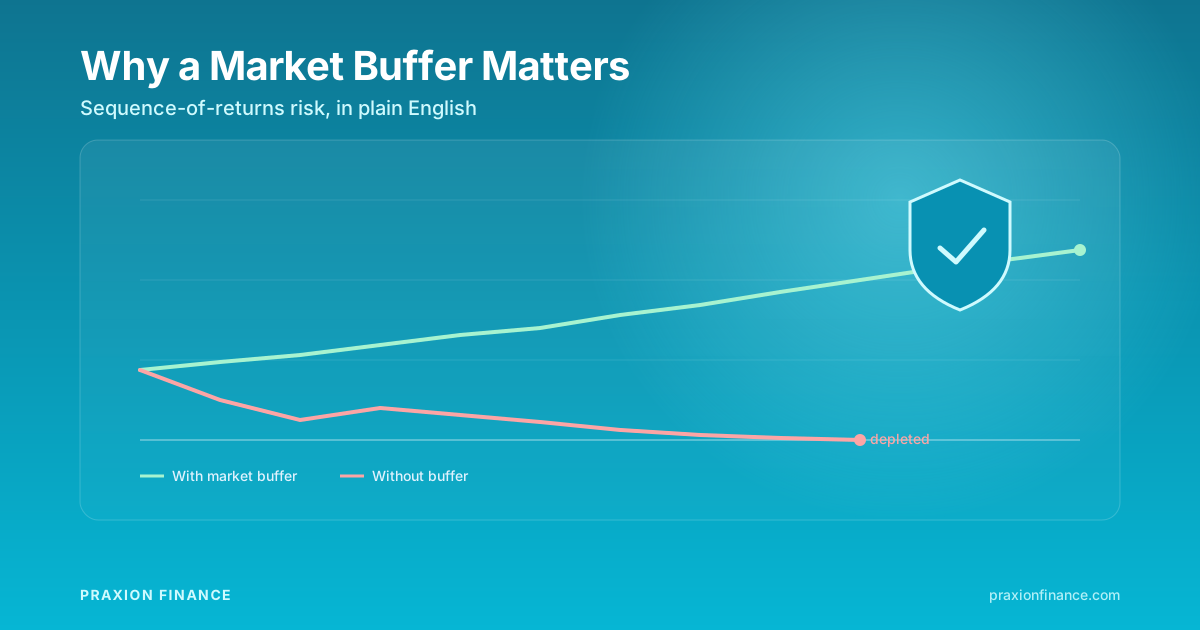
Two retirees start with $1,000,000 and withdraw $50,000 a year (inflation-adjusted). Both portfolios average 6% over 30 years. The only difference is the order in which the bad years arrive.
Same withdrawals. Same 30-year average return. Different order → completely different outcomes.
- Calm years first: portfolio has time to compound before withdrawals bite. Ends at about $1.4M.
- Bad years first: three negative years (−15%, −20%, +5%) plus mandatory withdrawals force selling shares at depressed prices. Those shares are never around to participate in the eventual recovery. Portfolio depletes by year 18.
Same average, same withdrawal rate, same investments — different sequence, different retirement.
The CFA-grade protection: a three-tier portfolio
Practitioners have known about sequence risk for decades. The standard answer is a layered bucket strategy with three tiers:
- Cash reserve — 6 to 12 months of expenses for immediate needs.
- Market buffer — 24 to 36 additional months in low-volatility instruments inside your brokerage. T-bills, money-market funds, ultra-short bond funds.
- Growth portfolio — the rest, invested in equities for long-term return.
The middle tier — the buffer — is the part most retail calculators ignore. It earns less than equities (typically 3–5% versus 7–9%) but it does not crash with them. In a year where stocks drop 20%, the buffer is steady. You can fund a full year of expenses from it without touching equities at all. Then you let the market recover, and you replenish the buffer gradually from gains over the next few years.
The cost of insurance — and why it's worth it
A market buffer is insurance, and like any insurance, it has a cost. Money in T-bills earning 4.5% is not earning 8% in stocks. For a 24-month buffer of around $260,000, the opportunity cost over a 25-year retirement is roughly $200K–$400K in compounded growth.
That sounds steep. The trade-off, though, is that you have eliminated the largest single source of plan failure. The downside scenarios where the buffer matters — bear markets in the first decade of retirement — are also the scenarios where the rest of your plan gets badly damaged. The math of compound losses is unforgiving: a 30% drop requires a 43% gain just to break even. Avoiding being forced to sell during those years is worth a steady tax on growth in normal years.
How Praxion models the buffer
When you configure a market buffer in your Praxion profile, the projection engine treats it as a distinct sleeve inside your brokerage account. Three rules govern it:
- Sleeve-based returns. The buffer earns its own rate (default 4.5%). The rest of brokerage earns the equity rate. The two are not blended — that would hide the protection.
- Maintenance band. If the buffer drifts more than 10% above or below its target, the engine moves dollars between the buffer and equity sleeves to restore the target. Pure accounting; no tax event.
- Drawdown trigger. When the modeled equity return for a year falls below −10%, the buffer absorbs that year's brokerage withdrawal instead of equities. Your stock allocation survives the crash intact and participates in the recovery.
The result on your projection: a slightly lower average final balance in calm years, but a meaningfully better outcome in the stress scenarios that actually determine whether a plan succeeds or fails.
Who should consider a buffer?
The buffer matters most for retirees within five years of (or already in) the retirement transition. If you are in late accumulation — say, age 60 with retirement at 65 — there is still time to reposition a slice of brokerage into low-volatility instruments. If you are already retired and your plan does not have a buffer, the opportunity cost of moving funds now versus waiting through a future correction usually favors moving now.
The buffer is less compelling for very young retirees (40s and 50s with multi-decade horizons) where equity exposure has more time to recover, and for very late retirees (80+) where the remaining horizon is short enough that simple cash management suffices.
Setting it up
Praxion lets you configure the buffer in your retirement profile under cash reserves. Pick the number of months (24 is a sensible default), the return rate you expect on the low-volatility instruments, and a maintenance band. The engine handles the rest — sleeve tracking, growth attribution, band rebalancing, drawdown-year flipping. You see the impact in your projection numbers immediately.
See the companion article How to Set Up Your Market Buffer in Praxion for a step-by-step walkthrough.
Frequently asked questions
Is a market buffer the same as just holding bonds in my portfolio?
No. A general bond allocation is a risk-balancing tool that earns a blended return inside your equity strategy. A market buffer is a dedicated, sized sleeve — 24 to 36 months of expenses — held specifically so withdrawals during equity drawdowns come from low-volatility instruments instead of forcing stock sales at depressed prices. The buffer is replenished from equities in recovery years; a static bond allocation is not.
Why hold the buffer inside brokerage instead of in a separate cash account?
Two reasons. First, cash earning ~4% in a money-market account drags more on long-term return than 4.5% T-bills inside brokerage. Second, keeping the buffer inside brokerage lets the engine flip the withdrawal source seamlessly when an equity drawdown is detected — no inter-account transfer is required, and the rebalancing has no tax cost.
How much does a market buffer reduce my projected final balance?
In a deterministic (no-crash) projection, expect a 1-3% reduction in final balance — roughly $200K on a $7M portfolio over 25 years. This is the cost of insurance. The benefit shows up in Monte Carlo and stress-test paths, where plan success rates typically improve by 5-15 percentage points for a 24-month buffer.
At what age should I set up a market buffer?
Within 5-7 years of retirement, or any time you are already retired without one configured. Pre-retirement, the buffer is less critical because you still have wage income to absorb equity volatility. Once withdrawals begin, sequence risk becomes the dominant threat — that is when the buffer earns its keep.
What return rate should I assume on the buffer?
Default is 4.5%, which reflects T-bills and money-market funds in a normal interest-rate environment. Ultra-short Treasury ETFs (SHV, BIL) often clear 4.5-5.5%; short-duration corporate or muni funds 5.5-6.5% with slightly more volatility. Avoid setting it close to your equity rate — the engine will still treat it as a buffer, but the protection benefit collapses.
Related Articles
Ready to model market protection?
The buffer is one of the few decisions where the academic case and the practitioner case actually align. If you do not have one configured, your projection is implicitly optimistic about the worst scenarios.