Last updated: September 30, 2026
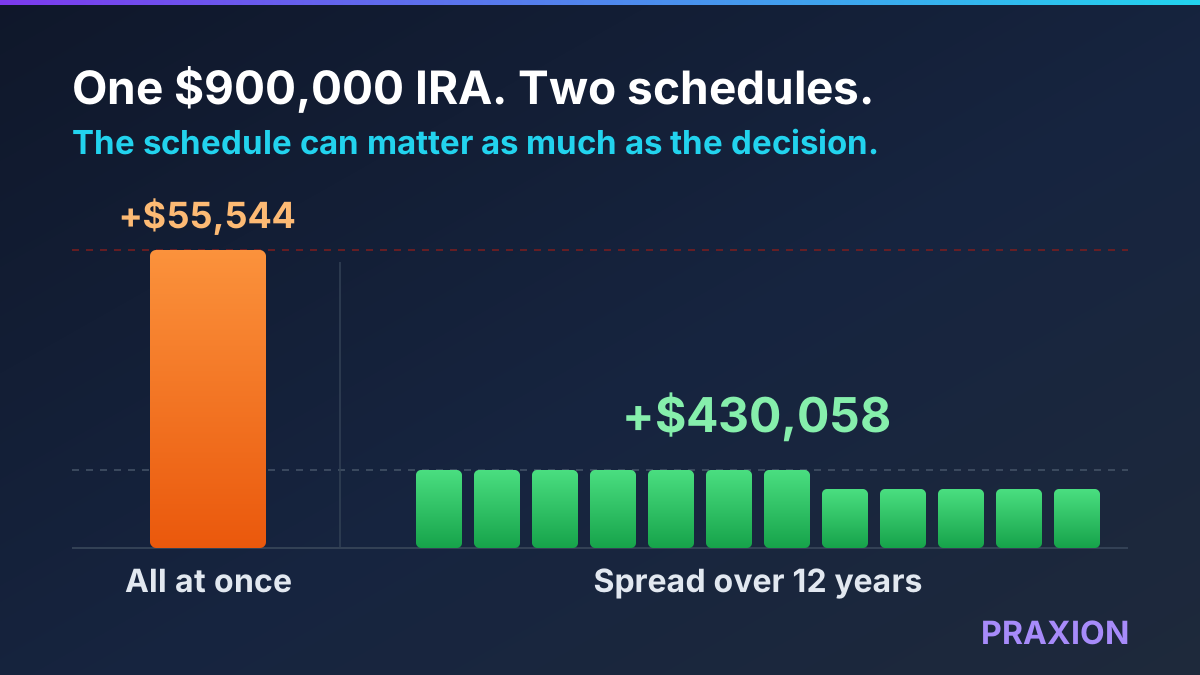
For many households, spreading Roth conversions across several years reduces how much is taxed at higher marginal rates and gives you more control over RMDs and Medicare's IRMAA surcharges. Converting it all at once can still make sense when the balance is small enough to stay in a favorable bracket, when income is unusually low for a single year, or when a large one-time deduction offsets the conversion. For the couple modeled below, spreading a $900,000 IRA over 12 years was worth +$430,058 against not converting, while the same balance converted in one year was worth +$55,544 — but those are their numbers, not a forecast for yours.
A Roth conversion is one trade: pay tax now at a rate you know, to avoid tax later at a rate you do not. Whether to do it all in one year or spread it over several turns largely on which of those two rates is higher, and by enough to outweigh the compounding you give up by waiting — though, as the rest of this article shows, several other things get a vote.
The trade, in one question
Money in a traditional IRA has never been taxed. It will be, eventually — by you when you withdraw it, by required minimum distributions, or by your heirs, since under current law most non-spouse beneficiaries have ten years to empty an inherited account. Traditional IRA owners generally must begin RMDs at the applicable age — currently 73 or 75 depending on birth year — whether or not they need the money. Employer-plan rules can differ.
It helps to see where this article sits in the larger decision. There are five questions, and they have to be answered roughly in this order:
- Should I convert at all? — settled elsewhere; see the link below.
- How much, in total?
- How fast — one year or several? ← this article
- Which years, and up to which bracket? ← this article
- Where does the tax payment come from? ← this article
Converting moves that money into a Roth. You pay ordinary income tax on the amount converted, and after that it grows and comes out untaxed, with no RMDs for your lifetime.
Once you have settled that you are converting at all, the question that decides the schedule is:
What is this dollar worth after tax if I move it to a Roth today, rather than leaving it in the traditional account?
Comparing today's rate against the rate the money would face later is the intuition behind that question, and it is the right place to start. But it is not the whole calculation. The full answer also takes in the tax on future RMDs, how much of your Social Security becomes taxable, Medicare surcharges, the brackets a surviving spouse would file under, your heirs' rates, the growth you give up by paying tax early, and where the money to pay that tax comes from. This article works through those one at a time, because each of them can move the answer.
The schedule is where that calculation bites hardest. Converting everything in one year stacks the whole balance into a single tax return, dragging the last dollars through your highest brackets. Spreading it lets you convert only the dollars that fit inside a bracket you are willing to pay — filling the cheap ones and stopping. The cost of spreading is that the unconverted balance keeps growing, and keeps being taxable.
Whether converting makes sense for you at all is a separate question, and one worth settling first — a conversion can lower your lifetime taxes and still leave your family with less. This article assumes you have cleared that bar and are deciding how fast to go.
A worked case: the gap years
Take the situation where this question comes up most often — a couple who have stopped working but have not yet claimed Social Security or started RMDs. Their taxable income is temporarily low, and it will not stay that way.
- Retired. $900,000 traditional IRA, $300,000 brokerage, $50,000 already in a Roth
- $20,000 a year of dividends and interest
- Social Security of $70,000 a year starting at 70; RMDs begin at 75
- A 12-year window where their income is low by their own standards
Here is what different conversion schedules do to their after-tax wealth at 90, with the conversion tax paid from the brokerage account.
| Strategy | Converted | Federal tax | IRMAA | Left in IRA | vs. doing nothing |
|---|---|---|---|---|---|
| Do nothing | $0 | $288,431 | $0 | $1,194,131 | — |
| Convert everything at 63 | $900,000 | $257,266 | $0 | $0 | +$55,544 |
| 3-year ladder, $300K/yr | $900,000 | $179,754 | $5,770 | $50,684 | +$277,879 |
| Fill the 24% bracket | $925,854 | $180,074 | $0 | $0 | +$286,942 |
| Fill the 22% bracket | $968,016 | $157,217 | $4,656 | $0 | +$354,522 |
| Fill the 12% bracket | $1,058,500 | $150,682 | $0 | $31,591 | +$430,058 |
Scroll the table sideways if the last column is cut off.
The pattern is worth sitting with. For this couple, under these assumptions, every conversion schedule tested beat doing nothing — that is a result about one modeled household, not a general rule. But the one that converts the most money for the least tax is the slowest one, and the lump sum, which converts the same $900,000 as the three-year ladder, captures barely a fifth of the three-year ladder's benefit and about an eighth of the twelve-year one's.
The slow schedule converts more than the fast one because the balance keeps growing while it waits. Bob and Carol move over a million dollars into their Roth by filling only the 12% bracket each year, and pay $150,682 in total federal tax doing it — $106,584 less than converting once at 63.
- the traditional balance is large
- you have several low-income years available
- future RMDs look substantial
- the conversion tax can come from outside the IRA
- your future rate is uncertain, or could be higher
- the balance stays in a favorable bracket anyway
- a single unusually low-income year arrives
- a large one-time deduction offsets the income
- the conversion window is short
- a legacy objective favors converting sooner
Most households land partly in each column — which is why the rest of this article is about finding the dial setting rather than picking a side.
What the whole case hinges on
Everything above assumed the money left in the IRA would eventually be taxed at 24%. That assumption is doing more work than any other input, so it is worth seeing what happens when it moves.
Scroll the figure sideways if it is cut off.
The spread schedules never cross zero. The lump sum does — at a future rate of 12%, converting everything at 63 leaves Bob and Carol about $87,752 worse off than doing nothing.
This is the practical difference between the two approaches. A multi-year schedule is robust: it pays across the whole plausible range, so you do not need to forecast your future rate correctly to benefit. The lump sum is a bet on that forecast being high.
Why spreading wins — and where it stops winning
The mechanism is bracket arithmetic. Bob and Carol's 2026 married brackets run 10% to $24,800, 12% to $100,800, 22% to $211,400, 24% to $403,550 of taxable income, then 32% and up.
Scroll the figure sideways if it is cut off.
Converting $900,000 at 63 runs the money up that whole staircase: with $20,000 of other income and the $32,200 standard deduction, taxable income for the year is $887,800 — the first slice taxed at 10%, the last at 37%. Filling only the 12% bracket instead admits $113,000 a year before Social Security starts, and about $53,500 a year once $70,000 of Social Security is on at 70 and part of it becomes taxable.
That is the entire advantage. Not a loophole — just declining to buy the expensive brackets.
But slower is not automatically better
The same model shows a real cost to converting too little. A 10%-bracket target is not a more conservative version of the 12% one; it is a materially worse plan.
| Strategy | Converted | Left in the IRA at 90 | vs. doing nothing |
|---|---|---|---|
| Fill the 10% bracket | $317,514 | $839,485 | +$164,715 |
| Fill the 12% bracket | $1,058,500 | $31,591 | +$430,058 |
| Fill the 22% bracket | $968,016 | $0 | +$354,522 |
| Fill the 24% bracket | $925,854 | $0 | +$286,942 |
Stopping at the 10% bracket converts only $317,514 across the whole window — and leaves $839,485 still sitting in the IRA at 90, having grown for 27 years, facing RMDs the whole time and a tax bill at the end. It captures under two-fifths of what the 12% schedule does.
- Convert too fast → you buy expensive brackets.
- Convert too slowly → you never get ahead of the growth.
- The target bracket is the dial. For this couple it sits at the top of the 12%.
Three cliffs that move the answer
Brackets are ramps — cross one and only the next dollar is taxed higher. Three other things in retirement are cliffs, where one dollar changes the cost of every dollar behind it.
Marketplace health-insurance credits, before Medicare
This one bites first and is the easiest to overlook, because it stops mattering at exactly the age most conversion articles start paying attention. If you retire before 65 and buy health coverage through the ACA marketplace, your premium tax credit is calculated from your income for that year — and conversion income counts. Bob and Carol are 63; a conversion year that lifts their income can reduce or eliminate the credit for the same year, well before IRMAA is in the picture.
The size of that cost depends on your state, your plan and your household, so it is not a number this article can put on the page. But it belongs in the arithmetic for anyone converting between retirement and 65 — and it is one more reason the years right after 65, when Medicare replaces marketplace coverage, are often the cleanest conversion years of all. The golden-window article walks through that 62–64 window in more detail.
IRMAA — a flat surcharge, not a rate
Once a spouse is on Medicare, income raises that person's premiums through IRMAA. It is not a percentage; it is a flat dollar surcharge per enrolled person per tier. That is what makes it a cliff. IRMAA generally uses a two-year lookback — the income on your 2026 return sets your 2028 premiums — so a conversion year reaches forward. (The model behind this article charges IRMAA on the same year's income instead, a simplification noted in the method section.)
| Modified AGI crosses | Annual surcharge, couple | Crossing it can add |
|---|---|---|
| $218,000 | $2,328 | $2,328 |
| $274,000 | $5,770 | $3,442 |
| $342,000 | $9,240 | $3,470 |
| $410,000 | $12,710 | $3,470 |
This is why the three-year ladder in the first table pays $5,770 of IRMAA while the twelve-year schedule pays nothing: $300,000 a year clears the threshold, and roughly $113,000 a year does not. It also means a conversion target should be set a few thousand dollars below a threshold, not at it. A year-end dividend you forgot about can cost $3,470.
The survivor's brackets
This is the one most often missed. When one spouse dies, the survivor files single — the same retirement income, against roughly half the bracket widths.
| Retirement income | Tax as a couple | Tax as a survivor | Increase |
|---|---|---|---|
| $100,000 | $7,640 | $13,170 | +72% |
| $140,000 | $13,140 | $22,334 | +70% |
| $180,000 | $21,940 | $31,934 | +46% |
| $240,000 | $35,140 | $48,104 | +37% |
A couple with $140,000 of retirement income sees their federal tax rise about 70% on the first spouse's death, with no change in spending. A dollar successfully converted while both spouses are alive can avoid being taxed later as traditional-IRA income under the survivor's single-filer brackets — subject, of course, to the tax paid on the conversion today.
What if you are still working?
The gap-year case is the easy one, because income is temporarily low. The harder case is a high earner who knows their IRA is going to be a problem later and wants to start now.
- Earning $320,000; retiring at 65, Social Security at 70
- $1,200,000 traditional IRA, $400,000 brokerage
| Strategy | Total federal tax | vs. doing nothing |
|---|---|---|
| Do nothing | $915,276 | — |
| Convert $100K/yr while working (58–64) | $793,226 | +$227,614 |
| Wait; fill the 24% bracket at 65–74 | $715,229 | +$373,655 |
| Wait; fill the 22% bracket at 65–74 | $728,659 | +$502,314 |
Converting while working does help — $227,614 is not nothing. But waiting seven years and converting into the gap is worth about 2.2 times as much. At $320,000 of income, every converted dollar stacks on top and is taxed at 24% and above. After retirement and before Social Security and RMDs, the same dollars fill the 12% and 22% brackets from the bottom.
Starting Roth conversions early is not automatically better. For saving and investing the early-start instinct is usually right; for conversions, what matters is the tax environment in the year you convert, and for many high earners the efficient window opens only after employment income falls. If you are in your peak earning years, the gap between retirement and RMDs is usually the asset, and it is often worth waiting for. The exception is a genuinely low-income year that arrives unexpectedly — a sabbatical, a business loss, a year between jobs. Those are conversion opportunities precisely because they are cheap, and they do not repeat. If you retire well before 65, that gap is longer and the arithmetic changes again — conversions in early retirement covers that case.
Where the tax money comes from
A conversion creates a tax bill in April. It can be paid from outside savings, or by withholding from the conversion itself. Paying from outside is generally better, and the reason is mechanical rather than clever: every dollar of the conversion then lands in the Roth and compounds tax-free. Withholding from the IRA means part of what you converted goes to the IRS instead of into the Roth, so you convert less for the same gross amount.
In the Bob and Carol case, the same schedule moves $925,854 into the Roth when the tax is paid from the brokerage, and $836,256 when it is withheld from the IRA — about $89,598 less converted for the same plan.
This cuts both ways as a planning constraint. If you do not have outside money to pay the tax, the case for a large conversion is weaker than the bracket arithmetic alone suggests — and a smaller annual amount you can actually fund is worth more than an aggressive schedule you have to withhold against.
How to choose
A workable sequence, in the order the answers actually constrain each other.
- Estimate the rate the money would face if you did nothing. Project your RMDs at 73 or 75, add Social Security and any pension, and find the bracket that lands in. If you expect to leave the IRA to heirs, their bracket during the ten-year withdrawal window matters too, and for working-age children it is often higher than yours. This single number decides whether to convert at all — and if it comes out low, the honest answer may be not to convert, which the hidden loss in a conversion takes apart.
- Find your window. The years between your last paycheck and the start of Social Security and RMDs are usually the cheapest years you will ever have. Count them. A 62-year-old retiring today with RMDs at 75 has thirteen.
- Pick the target bracket, not the dollar amount. Convert up to the top of a bracket you are content to pay, and recompute the amount each year. The dollar figure changes as balances grow; the bracket is the decision. Treat it as a starting point rather than the final answer — see the note below.
- Check the cliffs before you commit the number. If you are on marketplace health coverage before 65, conversion income can cut your premium tax credit for that year. If anyone is 63 or older, the conversion feeds IRMAA two years out — leave headroom under the threshold. If one spouse's health is materially worse, weight the schedule earlier, while the joint brackets still apply.
- Confirm you can pay the tax from outside the IRA. If not, size the conversion to what you can fund.
- Re-run it every year. Markets move, tax law changes, and the 2026 brackets are not permanent. A conversion schedule is a decision you re-make annually, not a twelve-year commitment you sign once.
The fit lists earlier in this article are the short version of when each shape suits a household. What the defensible one-year cases all share is that the lump does not drag the money into expensive brackets — which is the whole objection to it. Be most careful in the mirror image: when the case depends on your future rate being high and you would not confidently bet on that, or when the only way to pay the tax is out of the IRA itself.
- A bracket target is a useful dial — it is what lets this article compare schedules at all.
- But a conversion also moves IRMAA, Social Security taxation, survivor brackets, RMDs, your heirs' rates and your liquidity.
- With those in view, the modeled optimum can stop below a bracket ceiling — or occasionally reach past one.
- The real test is marginal: convert the next dollar while its modeled benefit exceeds its cost.
Assumptions and method
Every figure above comes from a year-by-year model using 2026 federal brackets, the standard deduction, the Social Security taxation worksheet, the IRS Uniform Lifetime Table for RMDs, and the 2026 IRMAA tiers. It uses the same core tax-modeling modules as Praxion's own calculators, which helps keep the published examples consistent with the product's calculation logic.
What the model assumes:
- Today's dollars, with a 4.5% real return on all accounts and brackets held at their 2026 real values.
- Federal tax only. State income tax is excluded, and it can change the answer materially — particularly if you expect to move between a high-tax and a no-tax state.
- Conversion tax paid from the brokerage account unless stated otherwise.
- A flat 24% assumed rate on whatever remains in the traditional IRA at the horizon, except in the sensitivity chart, which varies it from 12% to 37%.
- Brokerage growth taxed at an effective 15% drag per year.
- IRMAA charged on the same year's income; the real rule uses a two-year lookback.
- No Net Investment Income Tax, no state-specific Medicare variation, no charitable giving.
- No living expenses. The model moves money between accounts and pays tax; it does not withdraw for spending. That is the largest simplification here, so it is worth saying what it does and does not change — see the note below.
The direction of these results is robust — the multi-year schedules beat the lump sum at every growth rate and tax-drag assumption tested. The magnitudes are specific to Bob and Carol and should not be read as a forecast for a different balance, state or time horizon.
Questions retirees ask
Should I convert my whole IRA to a Roth all at once?
Usually not, unless the balance is small enough to fit inside a low bracket in a single year. Converting everything at once stacks the entire balance onto one tax return, so the last dollars are taxed at your highest rates. In the case modeled in this article, a $900,000 conversion in a single year pushed taxable income to $887,800 — into the top bracket — and was worth about $55,544 more than doing nothing, while the same balance spread over twelve years was worth about $430,058 more.
How many years should I spread a Roth conversion over?
Pick a target tax bracket rather than a number of years, then convert up to the top of that bracket each year and let the number of years fall out. For the modeled couple that meant twelve years — the full window between retiring at 63 and required minimum distributions starting at 75. The right window is however many low-income years you have between your last paycheck and the start of Social Security and RMDs.
Is it better to convert a little each year or a lot in a few years?
There is an interior optimum, and it is not at either extreme. Converting too fast buys expensive brackets; converting too slowly never gets ahead of the growth in the account. In the modeled case, filling the 12% bracket each year beat both the aggressive schedules and the very slow one — a 10%-bracket target converted only $317,514 and left $839,485 still in the IRA at 90.
Does a large Roth conversion raise my Medicare premiums?
It can. Once a spouse is on Medicare, income raises that person's Part B and Part D premiums two years later through IRMAA. IRMAA is a flat surcharge per enrolled person per tier, not a percentage — so crossing a threshold by one dollar costs the whole tier. For a married couple filing jointly in 2026 the first threshold is $218,000 of modified AGI, and crossing it adds $1,164 a year for each spouse who is enrolled — $2,328 when both are. This is why a conversion target should sit a few thousand dollars below a threshold rather than at it. Before 65, the equivalent cliff is the ACA marketplace premium tax credit.
Should I do Roth conversions while I am still working?
Often it is worth waiting. At a high salary every converted dollar stacks on top of your earnings and is taxed at your highest rate. In the modeled high-earner case, converting $100,000 a year during the working years was worth about $227,614, while waiting and converting into the low-income years after retirement was worth about $502,314 — more than twice as much. The exception is an unexpectedly low-income year, such as a sabbatical, a business loss, or a year between jobs.
Should I pay the conversion tax from the IRA or from savings?
Paying from outside the IRA is generally better, for a mechanical reason: every dollar of the conversion then lands in the Roth and compounds tax-free. Withholding from the IRA means part of what you converted goes to the IRS instead of into the Roth. In the modeled case the same schedule moved $925,854 into the Roth when the tax was paid from a brokerage account, and $836,256 when it was withheld from the IRA. Before age 59½ there is a sharper reason: the withheld amount is not part of the conversion, so it can count as an early distribution and carry a 10% penalty.
What happens to my tax bracket when my spouse dies?
The survivor files single — the same retirement income against roughly half the bracket widths. A couple with $140,000 of retirement income sees federal tax rise about 70% on the first death, with no change in spending. A dollar successfully converted while both spouses are alive can avoid being taxed later as traditional-IRA income under the survivor’s single-filer brackets, subject to the tax paid on the conversion today. This is not a reason for every couple to convert more; it is a reason survivor-tax exposure belongs in the analysis, and one reason to weight a schedule earlier when one spouse’s health is materially worse.
What if tax rates are lower in the future than I expect?
That is the risk a multi-year schedule manages and a single-year conversion does not. Across the assumed future rates tested — 12% through 37% — every spread schedule stayed ahead of doing nothing. Converting everything in one year did not: at an assumed future rate of 12% it left the modeled couple about $87,752 worse off. A ladder pays across the plausible range, so it does not require forecasting your future rate correctly; a lump sum is a bet on that forecast being high.
See it on your own numbers
Bob and Carol are not you. The balance, the window, the state you live in, when Social Security starts and what your heirs' brackets look like all move the answer. Praxion models a conversion schedule year by year against your own balances, brackets, RMD schedule and Medicare exposure — and shows you the bracket target, not just a headline number.
Model my conversion schedule →Praxion Finance is a decision-support tool, not a registered investment adviser. Modeled figures are projections based on your inputs and the stated assumptions, not guarantees of future results. Tax rules change; confirm any conversion decision with your own tax professional.