Last updated: September 4, 2026
Two scoreboards, not one
When people ask “should I do a Roth conversion?” they are usually thinking about one thing: taxes. And a conversion usually wins on that scoreboard over time — when your future tax rate is as high or higher than today's, it can lower the taxes you pay across the rest of your life.
But there is a second scoreboard that matters more: how much money your family actually keeps. These two are not the same. A plan can win on the tax scoreboard and lose on the family scoreboard at the same time. That is the part almost no one tells you.
The step-up in basis: the “forgiven tax” most people forget
Here is the piece that flips the answer for many families. Your money lives in two kinds of accounts:
- Retirement accounts (401k, IRA) — the money has never been taxed, so tax is owed when it comes out.
- Regular investment accounts (a brokerage account) — here is the surprise: when you pass away, the investments you leave to family are re-valued to that day's price, and the tax on all the past growth is wiped clean. Your family inherits it with the tax forgiven.
That forgiven tax is one of the most valuable breaks in the whole tax code — and it is easy to give up by accident. To do a Roth conversion, you have to pay a tax bill. If the only way to pay it is to sell investments from that regular account, you are cashing in the very thing that would have passed to your family tax-free. You traded a break you already had for one you had to buy.
The same couple, two very different outcomes
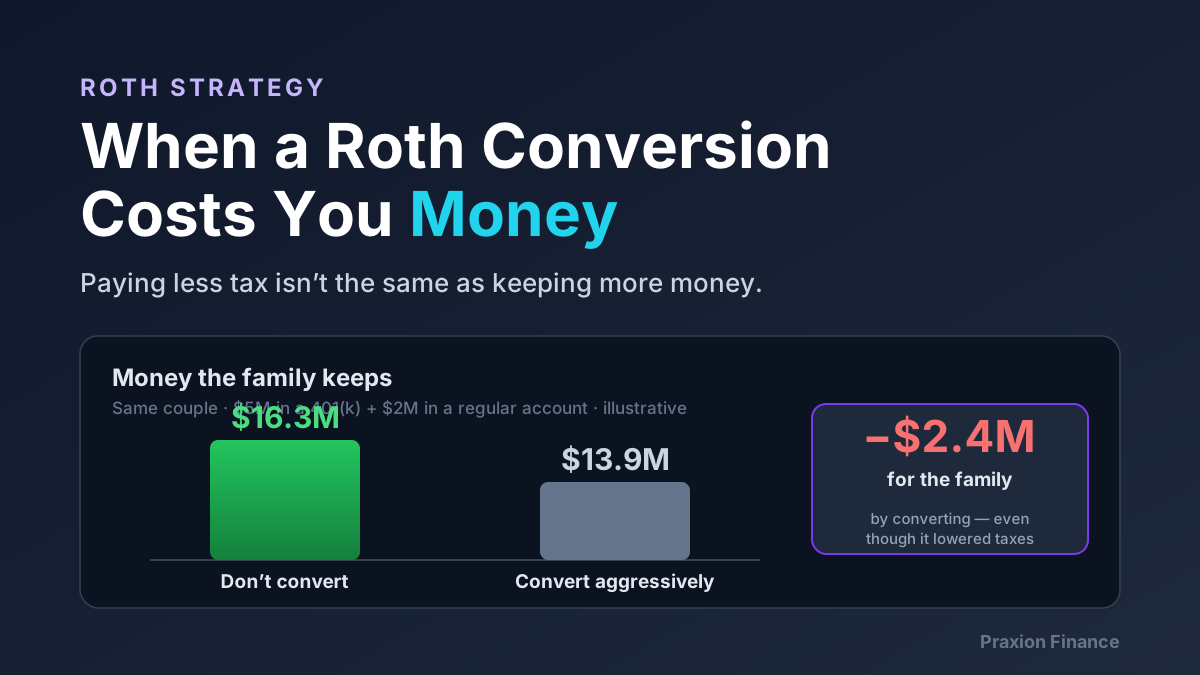
On paper, our couple looks like a textbook Roth conversion candidate — a large $5 million pre-tax 401(k) and years of low-income living before withdrawals are required. That is exactly why the result surprises people. Add $2 million in a regular investment account and modest spending, run their plan to the end of life two ways, and the tax scoreboard and the family scoreboard point in opposite directions.
Notice what happened: the aggressive-conversion plan really did lower their lifetime income tax. It won the tax scoreboard. But it lost the family scoreboard by millions — because it spent down the account that was going to reach the family tax-free. Paying less tax made them poorer.
When a Roth conversion is (and isn't) worth it
You do not need a spreadsheet to get the gist. Read down the two columns and see which one sounds more like you.
| Converting often HELPS when… | Converting can HURT when… |
|---|---|
| Most of your savings is in a 401(k) or IRA | You also hold a large regular investment account |
| You expect to spend most of your money yourself | You spend modestly and plan to leave money to family |
| You have cash on hand to pay the conversion tax | The only way to pay the tax is from savings meant for heirs |
| Your heirs are in high tax brackets | Your heirs are in low brackets — or you give to charity |
| You have many low-income years before RMDs begin | You are already near or past the age RMDs start |
If you land mostly in the left column, a Roth conversion — done in the right years and the right amounts — can save your family real money. If you land mostly on the right, going slow or not converting at all may be the better plan. Most people are a mix, which is exactly why it is worth checking rather than guessing.
How Praxion decides for your plan
This is exactly the question our tool is built to answer. Praxion does not assume converting is good or bad. It models your plan to the end of life both ways — convert and don't convert — and compares the family scoreboard, not just the tax scoreboard. It accounts for the forgiven tax on your regular accounts, future RMDs, the surviving-spouse brackets, and where the tax to convert would come from.
When the numbers say converting would leave your family with less, your dashboard's Roth Conversion Strategy card will say “Do not act” — and it means it. That is not the tool being cautious. It is the tool protecting money that is already headed to your family tax-free.
The bottom line: a Roth conversion is a tool, not a rule. Used at the right time it can save six figures in lifetime taxes. Used at the wrong time it quietly hands money back. The only way to know your answer is to look at both scoreboards — for your plan.
Roth conversion questions retirees ask
Is a Roth conversion always a good idea?
No. A Roth conversion often helps when most of your savings sits in a pre-tax 401(k) or IRA and you have cash to pay the tax. It can hurt when you also hold a large regular (brokerage) investment account, spend modestly, and plan to leave money to family — because that account can pass to heirs with the tax on its past growth erased, and paying conversion taxes early gives that break up.
When is a Roth conversion not worth it?
A Roth conversion is often not worth it when most of your growth sits in a taxable brokerage account, you spend modestly, and you plan to leave money to family. Those investments can pass to heirs with the tax on past growth erased (a step-up in basis), and paying conversion taxes early — especially from that same account — can give up more wealth than the conversion saves in tax. It is also usually less attractive once you are near or past the age required minimum distributions (RMDs) begin.
Why can paying less tax leave my family with less money?
Because taxes paid and money kept are two different scoreboards. A conversion can lower the taxes you pay over your lifetime while also shrinking the total after-tax value of your plan — usually when the tax to convert is paid from a regular investment account that would otherwise have passed to heirs tax-free.
What is a step-up in basis, in plain terms?
When you pass away, regular (non-retirement) investments you leave to family are re-valued to their worth on that day. The tax on all the past growth is wiped clean. Selling those investments early — for example, to pay Roth conversion taxes — gives up that benefit.
Should I do a Roth conversion if I have a large brokerage account?
Not automatically. A large taxable brokerage account changes the math, because it can pass to your heirs with a step-up in basis — the tax on its past growth erased at death. If the conversion tax is paid by selling from that account, you may give up more than you gain. Smaller conversions, or conversions in low-income years before RMDs, can still make sense; the right answer depends on your spending, your heirs, and where the tax comes from.
Does a Roth conversion help with required minimum distributions (RMDs)?
Yes — converting money to a Roth now reduces the pre-tax balance that later drives RMDs, which can lower forced withdrawals and the taxes stacked on top of Social Security and Medicare. But lower RMDs are only worth it if the after-tax value of your whole plan improves. For some households the RMD savings are real; for others they are outweighed by giving up the step-up on taxable investments.
At what age is a Roth conversion no longer worth it?
There is no hard cutoff, but conversions usually lose appeal as you approach and pass the age RMDs begin — 73 for most people today, 75 for those born in 1960 or later. The best years are typically the low-income window after you stop working and before RMDs and Social Security fill up your tax brackets. Converting in your late 60s can still help; converting in your 80s rarely does, because there is less time for the tax-free growth to outweigh the upfront tax.
Do Roth conversions raise my Medicare premiums (IRMAA)?
They can. A large conversion raises your income for that year, and Medicare looks back two years to set your Part B and Part D premiums — a surcharge called IRMAA. IRMAA is a flat dollar amount per income tier, not a percentage, so crossing a tier adds a fixed extra cost per person. Spreading conversions across several years, or keeping each year under the next IRMAA threshold, is a common way to manage it.
How much of my IRA should I convert?
Enough to use up low tax brackets in your low-income years — but not so much that you jump into a higher bracket, cross an IRMAA threshold, or drain the cash you need to pay the tax. The right amount is specific to your plan. Praxion models a range of conversion amounts and shows which one leaves your family with the most after-tax value, instead of applying a one-size-fits-all rule.
See your own two scoreboards
Praxion runs your plan both ways and shows you the family scoreboard — so you can see whether converting helps you or costs you, before you write the check.
Check my Roth conversion plan →Praxion Finance is a decision-support tool, not a registered investment adviser. Examples are illustrative and not a guarantee of future results. Consult a qualified tax or financial professional about your specific situation.