How Much Do I Need to Retire at 60?
Sixty is a pivot year: Medicare is only five years away, Social Security opens at 62, and the Rule of 55 may already have unlocked one employer plan — but pre-Medicare healthcare still dominates the budget.
The short answer
Retiring at 60 often comes down to a timing trade-off: stop working now and self-fund five pre-Medicare years, or work to 65 and eliminate that line item entirely while letting savings compound.
Social Security at 62 is available but permanently reduced versus waiting to Full Retirement Age (67 for those born 1960+). Each year of delay adds roughly 8% to benefits until 70 — but the portfolio must cover the gap.
Withdrawal sequencing matters at 60: taxable brokerage first preserves tax-deferred growth and can keep MAGI lower for ACA subsidies during the bridge years. The calculator models spending inflated to 60 and Social Security at your chosen claim age.
What makes 60 different
At 60 you are close enough to Medicare and Social Security to see the finish line — but still in the penalty window for most IRA withdrawals and still paying retail healthcare prices.
Compared with retiring earlier: Versus 55, you cut the pre-Medicare gap in half and may already be past 59½ on some accounts — but you give up five years of earnings and employer match if you stop now.
Compared with waiting longer: Versus 62, you avoid locking in a permanently reduced Social Security benefit — but you must fund two additional years before the earliest claim age.
When retiring at 60 tends to work — and when it gets harder
Favorable signals
- Bridge healthcare is partially subsidized through ACA credits at your expected MAGI
- You can delay Social Security to 67+ without depleting the portfolio
- Part-time or consulting income covers a slice of spending and improves subsidy math
- Rule of 55 or post-59½ status unlocks enough tax-deferred access for the plan
Challenging signals
- Must claim Social Security at 62 because the portfolio cannot bridge two years
- Unsubsidized ACA costs in a high-premium state with limited plan choice
- Large Traditional IRA balance with no Roth or taxable buffer for early withdrawals
- Spouse still working — coordination of coverage and household MAGI is complex
Industry benchmarks (sanity check)
Benchmark providers often cite ~8× salary saved by 60 for traditional retirement at 65–67. If you retire at 60 instead, treat 10–12× annual spending as a starting conversation — then add five years of healthcare bridge explicitly rather than folding it into a generic multiple.
Your numbers at 60
Adjust the inputs, then analyze for an illustrative readiness view. This public model is not Monte Carlo — it uses a constant withdrawal-rate heuristic plus modeled pre-Medicare healthcare bridge costs.
Must be 60 or younger on this page (you are planning a future retire-at-60 scenario).
Key variables at 60
Five-year healthcare bridge
Medicare at 65 still leaves five years of private coverage. Subsidy-eligible ACA plans may reduce premiums, but out-of-pocket caps still apply.
Social Security at 62 vs 67
Claiming at 62 reduces benefits roughly 30% versus Full Retirement Age at 67 (born 1960+). Each year of delay adds about 8% until 70.
Withdrawal sequencing
Spending from taxable brokerage first may preserve tax-deferred growth and enable Roth conversions in low-income years before RMDs.
Part-time work
Many 60-year-old retirees transition gradually — earned income reduces the portfolio withdrawal need and may improve ACA subsidy eligibility.
Sequence risk
The first decade of retirement remains the highest-risk window for portfolio depletion due to sequence-of-returns effects.
Worked example (reference scenario)
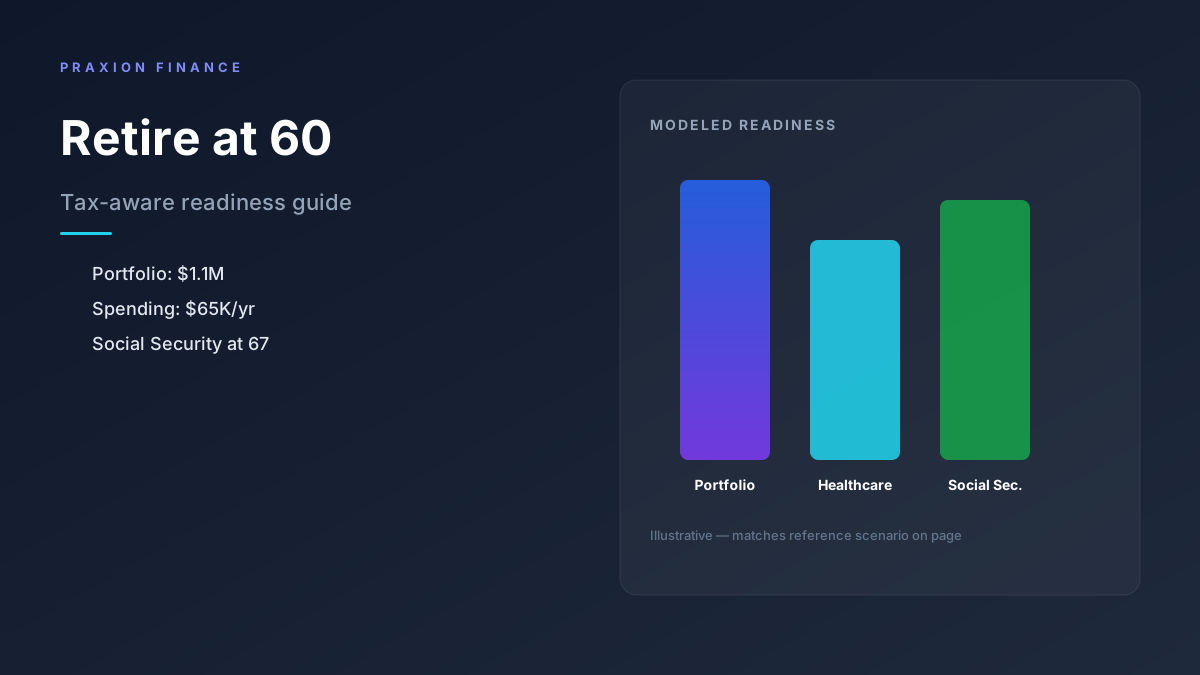
Defaults: age 57 → retire at 60, $1,100,000 portfolio, $65,000/yr spending today, Social Security at 67. Use the calculator above to see the illustrative band for these inputs.
Scenario comparison
Readiness bands use the same illustrative model as the calculator (today's spending inflated at 2.4%/yr to retirement age).
| Scenario | Portfolio | Spending | Illustrative band |
|---|---|---|---|
| Claim Social Security at 62 | $950,000 | $55,000/yr | Tight vs modeled need |
| Reference | $1,100,000 | $65,000/yr | Tight vs modeled need |
| Delay Social Security to 70 | $1,300,000 | $70,000/yr | Tight vs modeled need |
Frequently asked questions
Can I retire at 60 with $800,000?
$800,000 at a 3.5% withdrawal provides roughly $28,000/year before taxes — likely insufficient alone for $65,000 spending. Social Security at 62 or 67 and healthcare costs determine whether the gap is closable.
Should I wait until 65 instead of 60?
Working five more years reduces the planning horizon, eliminates the pre-Medicare healthcare gap, and allows five additional years of savings and compounding — often improving plan success materially.
What is the Rule of 55?
If you leave the employer sponsoring your 401(k) at age 55 or later, you may withdraw from that plan without the 10% early penalty. IRAs do not qualify — only the specific employer plan.
How much does healthcare cost from 60 to 65?
Varies widely by state and income. Unsubsidized ACA premiums for a 60-year-old often run $8,000–$15,000/year plus deductibles — lower with premium tax credits if MAGI is modest.
Is 60 a good age to retire if I have $1.5 million?
At 3.5% withdrawal, $1.5 million yields ~$52,500/year from the portfolio before taxes. Whether that is enough depends on spending, healthcare subsidies, Social Security claim age, and taxes — run the calculator with your numbers rather than comparing to a headline balance alone.
Ask Praxion AI
On a full plan, you can explore age-specific trade-offs in plain language — grounded in your numbers, not generic advice.
- Compare retiring at 60 vs working until 65 on my plan
- Should I claim Social Security at 62 if I retire at 60?
Opens QuickStart — no account required to begin.
Explore next
Other retirement ages in this cluster:
Related guides:
- Early Retirement Roth Conversion Windows — Bracket-fill strategy before RMDs
- The 4% Rule Explained — Withdrawal rate basics and limits
- Retirement Care Costs — Healthcare and LTC benchmarks
- When Is a Good Time to Retire? — Timing vs savings amount
Model your full retirement plan
Free QuickStart runs tax-aware projections, Monte Carlo success probability, and Roth conversion analysis on your numbers.
Praxion Finance is a decision-support tool, not a registered investment adviser.