How Much Do I Need to Retire at 62?
Sixty-two is the earliest Social Security claiming age — a permanent benefit reduction, three pre-Medicare years, and an earnings test if you still work part-time.
The short answer
Retiring at 62 lets you align last paycheck with first Social Security check — but claiming at 62 means roughly 70% of your Full Retirement Age benefit for life if FRA is 67 (born 1960+).
Medicare still starts at 65 regardless of when you claim Social Security. Budget three years of ACA or employer retiree coverage unless a spouse’s plan covers you.
If you continue working before FRA, the earnings test may temporarily withhold benefits above the annual limit ($23,400 in 2026 for years before FRA). Once you reach FRA, the earnings test no longer applies.
What makes 62 different
Sixty-two is the “earliest benefits” milestone — attractive for cash flow, expensive for lifetime Social Security income and still exposed to pre-Medicare healthcare costs.
Compared with retiring earlier: Versus 60, you can start Social Security immediately — reducing portfolio pressure — but you lock in the early-filing reduction two years sooner than if you waited to 64.
Compared with waiting longer: Versus 65, you trade three years of reduced Social Security benefits and pre-Medicare healthcare for two years of Medicare eligibility and the option to claim closer to full benefit.
When retiring at 62 tends to work — and when it gets harder
Favorable signals
- Spending is modest and Social Security at 62 covers a large share of baseline needs
- Healthcare is covered via spouse employer plan or retiree benefit until 65
- Longevity is a concern — starting income now provides earlier cash flow certainty
- Portfolio is primarily a supplement to Social Security, not the main income engine
Challenging signals
- High fixed spending requires portfolio withdrawals plus reduced Social Security to cover gaps
- Planning to delay Social Security but retiring at 62 — portfolio must bridge five years to 67
- Part-time work income triggers earnings-test withholding before FRA
- Single filer with unsubsidized ACA premiums for three years
Industry benchmarks (sanity check)
At 62, Social Security may cover 30–50% of pre-retirement income for median earners — the portfolio fills the rest plus healthcare until 65. A common planning mistake is counting full FRA benefits while retiring and claiming at 62; model ~70% of PIA instead.
Your numbers at 62
Adjust the inputs, then analyze for an illustrative readiness view. This public model is not Monte Carlo — it uses a constant withdrawal-rate heuristic plus modeled pre-Medicare healthcare bridge costs.
Must be 62 or younger on this page (you are planning a future retire-at-62 scenario).
Key variables at 62
Early Social Security reduction
Claiming at 62 vs 67 (FRA for born 1960+) reduces benefits by roughly 30%. For a $2,400/month FRA benefit, claiming at 62 might yield ~$1,680/month — permanently.
Healthcare until 65
Three years of private coverage remain. ACA subsidies depend on MAGI — Roth conversions and portfolio withdrawals can affect eligibility.
Spousal coordination
Married couples should model survivor benefits and spousal claiming strategies — the higher earner's delay often benefits the surviving spouse.
Withdrawal rate
A 33-year horizon may support 3.5% initial withdrawal; claiming Social Security at 62 reduces portfolio pressure but locks in a lower lifetime benefit.
Earnings test
If you claim Social Security before FRA and continue working, benefits may be temporarily withheld above the earnings limit ($23,400 in 2026 for years before FRA).
Worked example (reference scenario)
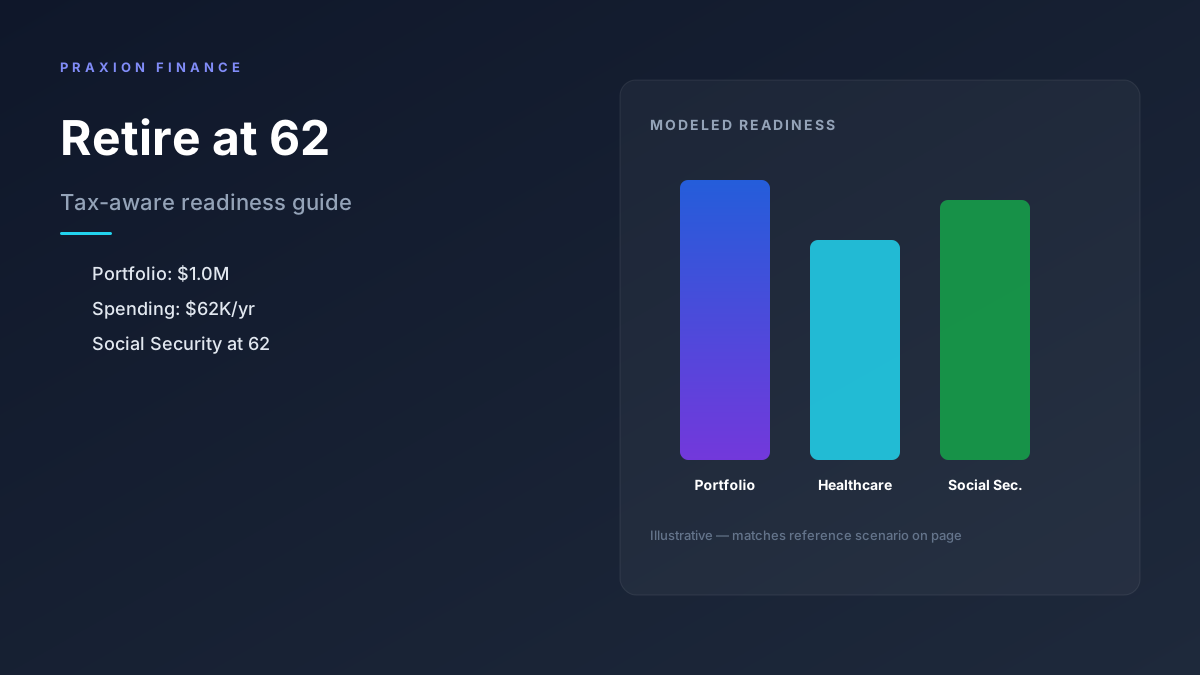
Defaults: age 60 → retire at 62, $1,000,000 portfolio, $62,000/yr spending today, Social Security at 62. Use the calculator above to see the illustrative band for these inputs.
Scenario comparison
Readiness bands use the same illustrative model as the calculator (today's spending inflated at 2.4%/yr to retirement age).
| Scenario | Portfolio | Spending | Illustrative band |
|---|---|---|---|
| Claim Social Security at 62 | $850,000 | $55,000/yr | Tight vs modeled need |
| Reference | $1,000,000 | $62,000/yr | Tight vs modeled need |
| Delay Social Security to 67 | $1,150,000 | $65,000/yr | Likely covers modeled need |
Frequently asked questions
Can I retire at 62 with $1 million saved?
$1 million at 3.5% withdrawal yields ~$35,000/year from the portfolio. Combined with Social Security at 62 (~$20,000/year for a median earner), total income may approach $55,000–$60,000 before taxes — potentially workable depending on spending and healthcare costs.
Should I take Social Security at 62 or wait?
Claiming at 62 provides income sooner but permanently reduces benefits. Break-even versus delaying to 67 is typically in your late 70s to early 80s depending on discount rate and longevity assumptions.
How much less is Social Security at 62?
For those with FRA of 67, claiming at 62 reduces benefits by about 30%. Each month you delay increases the benefit until age 70.
What about Medicare at 62?
Medicare eligibility begins at 65 regardless of when you claim Social Security. From 62 to 64, plan for ACA or employer retiree coverage.
What is the break-even age for claiming Social Security at 62 vs 67?
Break-even is typically late 70s to early 80s: earlier claims provide more years of payments at a lower amount; delaying provides fewer years at a higher amount. Health, spouse survivor benefits, and whether you need the income now matter more than the break-even math alone.
Ask Praxion AI
On a full plan, you can explore age-specific trade-offs in plain language — grounded in your numbers, not generic advice.
- Should I claim Social Security at 62 or 67 if I retire now?
- What is my break-even age for delaying Social Security?
Opens QuickStart — no account required to begin.
Explore next
Other retirement ages in this cluster:
Related guides:
- Early Retirement Roth Conversion Windows — Bracket-fill strategy before RMDs
- The 4% Rule Explained — Withdrawal rate basics and limits
- Retirement Care Costs — Healthcare and LTC benchmarks
- When Is a Good Time to Retire? — Timing vs savings amount
Model your full retirement plan
Free QuickStart runs tax-aware projections, Monte Carlo success probability, and Roth conversion analysis on your numbers.
Praxion Finance is a decision-support tool, not a registered investment adviser.