How Much Do I Need to Retire at 65?
Sixty-five is the traditional retirement anchor — Medicare eligibility, a 30-year planning horizon to 95, and a Social Security decision that still includes early-filing reductions if you claim before Full Retirement Age.
The short answer
Medicare at 65 removes the largest healthcare unknown for most retirees, but enrollment timing matters if you still have employer coverage. Part B standard premium is modeled around $2,220/year in 2026 before IRMAA surcharges.
The classic 4% rule targets a 30-year horizon — retiring at 65 with planning to 95 fits that window. Tax drag, allocation, and legacy goals may still argue for 3.5–4% rather than a blind 4%.
Social Security at 65 is two years before Full Retirement Age for the 1960+ cohort — claiming now permanently reduces benefits versus waiting to 67 or 70 for delayed credits.
What makes 65 different
Sixty-five is where “standard retirement” math begins — Medicare, a 30-year horizon, and RMDs still several years away — but Social Security timing can still swing the portfolio need by hundreds of thousands.
Compared with retiring earlier: Versus 62, Medicare eliminates the ACA bridge and you can claim Social Security without the steepest early-filing penalty — but you needed the portfolio to last three extra years to get here.
Compared with waiting longer: Versus 67, you may claim Social Security at a reduced rate if you start immediately — but you gain two years of retirement and must fund any delay to full benefit from the portfolio.
Retirement timing is a household decision
Age 65 is an important planning milestone, but partners do not always need to stop work at the same time. Compare coordinated and staggered retirement dates to see how the timing interacts with your plan’s income, saving years, and portfolio withdrawals.
Scenario Studio keeps the comparison tied to your saved plan. It is a planning aid, not a recommendation to retire at a particular age.
When retiring at 65 tends to work — and when it gets harder
Favorable signals
- Employer coverage ends cleanly into Medicare with no Part B penalty gap
- Spending aligns with 3.5–4% of portfolio plus Social Security at FRA or later
- Roth and taxable buckets allow tax-efficient withdrawals before RMDs at 73–75
- Mortgage paid off or housing costs are stable and predictable
Challenging signals
- Still working with complex Medicare/employer coordination rules
- Must claim Social Security early because portfolio cannot bridge to 67
- Large Traditional IRA that will drive high RMDs and IRMAA within a decade
- Spouse is younger and needs continued employer coverage — household budget stays elevated
Industry benchmarks (sanity check)
Fidelity and similar providers often cite 10× annual salary or 10–12× spending saved by retirement age. On $55,000 spending, $550,000–$660,000 is a floor benchmark — many comfortable retirees at 65 need more once travel, healthcare above Medicare, and taxes are included. Fidelity estimates ~$185,500/person in retiree healthcare from 65 onward (2026).
Your numbers at 65
Adjust the inputs, then analyze for an illustrative readiness view. This public model is not Monte Carlo — it uses a constant withdrawal-rate heuristic plus modeled pre-Medicare healthcare bridge costs.
Must be 65 or younger on this page (you are planning a future retire-at-65 scenario).
Key variables at 65
Medicare enrollment
Part A is premium-free for most with 10+ years of Medicare taxes. Part B standard premium is modeled around $203/month ($2,435/year) in 2026 — IRMAA surcharges apply at higher MAGI.
Social Security claiming
At 65 you are two years before FRA (67 for born 1960+). For a worker with FRA 67, the monthly worker benefit rises when claiming is delayed, up to age 70. The household lifetime outcome varies with longevity, survivor benefits, taxes, health, and portfolio context.
Tax-aware withdrawals
Withdrawal order (taxable → Traditional → Roth) affects marginal tax rate and IRMAA exposure. Roth conversions before RMDs may still be worthwhile.
RMD horizon
RMDs begin at 73 (born 1951–1959) or 75 (born 1960+). Pre-RMD years are the last window for aggressive Roth conversion without RMD-driven taxable income.
4% rule context
The Trinity Study 4% rule assumes 30 years and a stock-heavy portfolio. Tax drag and healthcare shocks may warrant 3.5–4% depending on allocation.
Worked example (reference scenario)
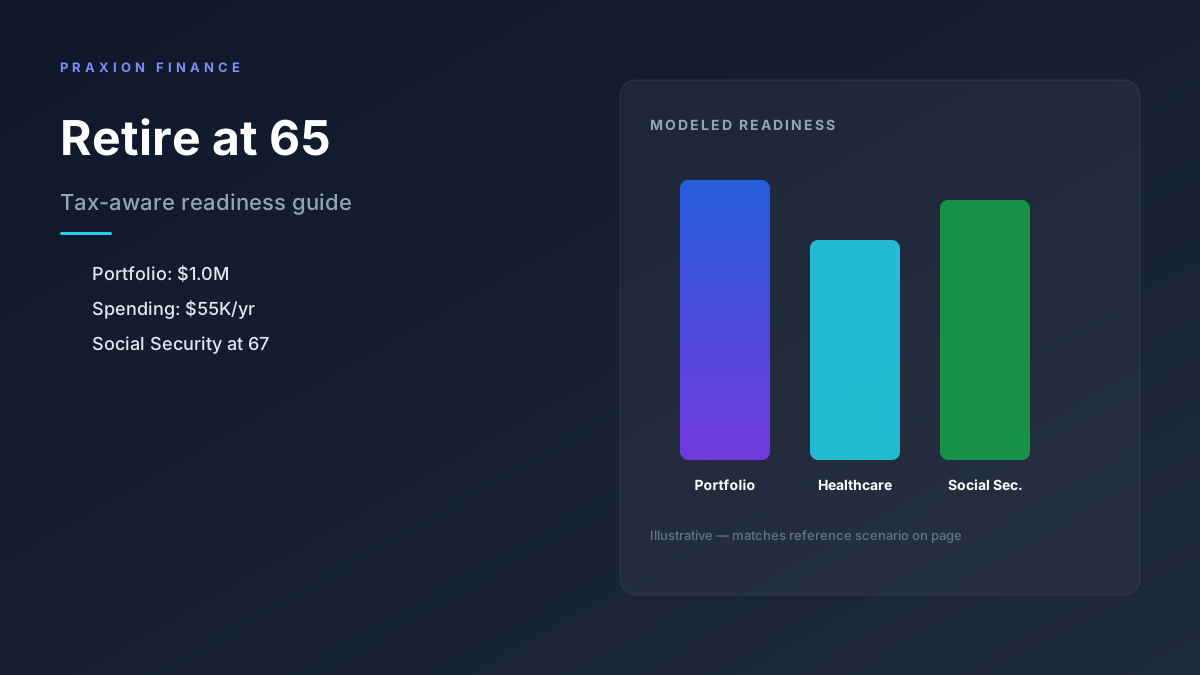
Defaults: age 63 → retire at 65, $1,000,000 portfolio, $55,000/yr spending today, Social Security at 67. Use the calculator above to see the illustrative band for these inputs.
Scenario comparison
Readiness bands use the same illustrative model as the calculator (today's spending inflated at 2.4%/yr to retirement age).
| Scenario | Portfolio | Spending | Illustrative band |
|---|---|---|---|
| Claim Social Security at 65 | $850,000 | $48,000/yr | Likely covers modeled need |
| Reference | $1,000,000 | $55,000/yr | Likely covers modeled need |
| Delay Social Security to 70 | $1,100,000 | $58,000/yr | Likely covers modeled need |
Frequently asked questions
Is $1 million enough to retire at 65?
At 4%, $1 million supports $40,000/year from the portfolio. Combined with Social Security ($20,000–$35,000/year depending on earnings history and claim age), that is $60,000–$75,000 of gross annual income before taxes; sustainable spending still depends on taxes, healthcare, and the plan horizon.
Should I sign up for Medicare at 65 if I am still working?
You may qualify to delay Part B without a late-enrollment penalty when you are covered by a group health plan based on your or your spouse’s current employment. COBRA and retiree coverage generally do not qualify for that Special Enrollment Period; confirm timing with Medicare or Social Security for your plan.
What is a good savings multiple at 65?
Fidelity and T. Rowe Price publish age-based benchmarks tied to final salary, often around 10–12× by retirement. Treat those as broad checkpoints, not a conversion from annual spending or a personalized retirement target.
Can I retire at 65 and delay Social Security?
Yes — some retirees use portfolio withdrawals from 65 to 67 (or 70) while allowing the monthly worker benefit to rise. Whether that produces a better household lifetime outcome depends on longevity, survivor benefits, taxes, health, and the portfolio used to cover the gap.
Should I retire at 65 or work two more years until 67?
Two more years adds savings, delays portfolio withdrawals, raises Social Security toward 100% of PIA, and shortens the planning horizon. If the portfolio is borderline, working to 67 often improves outcomes more than chasing higher returns — model both paths in the calculator and a full plan.
Ask Praxion AI
On a full plan, you can explore age-specific trade-offs in plain language — grounded in your numbers, not generic advice.
- Should I claim Social Security at 65 or wait until 70?
- How do IRMAA cliffs affect my Medicare premium if I do Roth conversions?
Opens QuickStart — no account required to begin.
Explore next
Other retirement ages in this cluster:
Related guides:
- Early Retirement Roth Conversion Windows — Bracket-fill strategy before RMDs
- The 4% Rule Explained — Withdrawal rate basics and limits
- Retirement Care Costs — Healthcare and LTC benchmarks
- When Is a Good Time to Retire? — Timing vs savings amount
Model your full retirement plan
Free QuickStart runs tax-aware projections, Monte Carlo success probability, and Roth conversion analysis on your numbers.
Praxion Finance is a decision-support tool, not a registered investment adviser.