How Much Do I Need to Retire at 70?
Seventy is the maximum Social Security claiming age — 124% of PIA for FRA 67 — with a shorter planning horizon and RMDs arriving within a few years.
The short answer
Retiring at 70 with delayed Social Security maximizes the lifetime benefit for many longevity scenarios — 124% of PIA when FRA is 67. That may reduce portfolio withdrawal pressure by $7,000–$12,000/year versus claiming at 67 for typical earners.
Planning to age 95 from 70 is a 25-year horizon — somewhat higher starting withdrawal rates may be sustainable than at 55, but sequence risk in the first decade still matters.
RMDs start at 73 (born 1951–1959) or 75 (born 1960+). Retiring at 70 leaves a short Roth conversion window before required distributions begin — tax planning urgency is higher than at 55.
What makes 70 different
Seventy shifts the balance toward Social Security as the primary income engine — the portfolio often funds discretionary spending, legacy, or the gap before benefits start.
Compared with retiring earlier: Versus 67, maximum Social Security reduces portfolio dependence — many households need less saved at 70 than at 62 for the same spending, despite three fewer working years.
When retiring at 70 tends to work — and when it gets harder
Favorable signals
- Social Security at 70 covers most or all baseline spending
- Continued work to 70 boosted earnings history and 401(k) balances
- Health supports longevity — delayed claiming has time to pay off
- Smaller portfolio needed because Social Security is the anchor income source
Challenging signals
- Health or job loss forced retirement before 70 — Social Security not yet at maximum
- RMDs within 3–5 years will spike taxable income despite recent retirement
- Spouse depends on survivor benefit — coordination if higher earner has health issues
- Legacy goals require portfolio preservation beyond what Social Security covers
Industry benchmarks (sanity check)
With maximum Social Security (~$35,000–$42,000/year for many earners at 70), the portfolio may only need to cover spending above Social Security — sometimes $300,000–$600,000 for $50,000 total spending before taxes. That is lower than early-retirement targets, not because the problem is easy, but because Social Security does more of the work.
Your numbers at 70
Adjust the inputs, then analyze for an illustrative readiness view. This public model is not Monte Carlo — it uses a constant withdrawal-rate heuristic plus modeled pre-Medicare healthcare bridge costs.
Must be 70 or younger on this page (you are planning a future retire-at-70 scenario).
Key variables at 70
Maximum Social Security
Delayed retirement credits add 8%/year from FRA to 70. A $2,400/month FRA benefit becomes ~$2,976/month at 70 — reducing portfolio withdrawal need by $7,000+/year.
Shorter horizon
Planning to 95 from age 70 is 25 years — a shorter window than retiring at 55. Higher initial withdrawal rates may be sustainable, but longevity risk remains.
Continued employment
Working to 70 often means maxing Social Security earnings history, additional 401(k) contributions, and fewer years of portfolio dependence.
RMDs approaching
RMDs begin at 73–75 — only 3–5 years after retiring at 70. Roth conversion windows are shorter but may still matter for tax planning.
Health and longevity
Health status affects whether delaying to 70 is optimal — those with shorter life expectancy may prefer earlier claiming despite the smaller benefit.
Worked example (reference scenario)
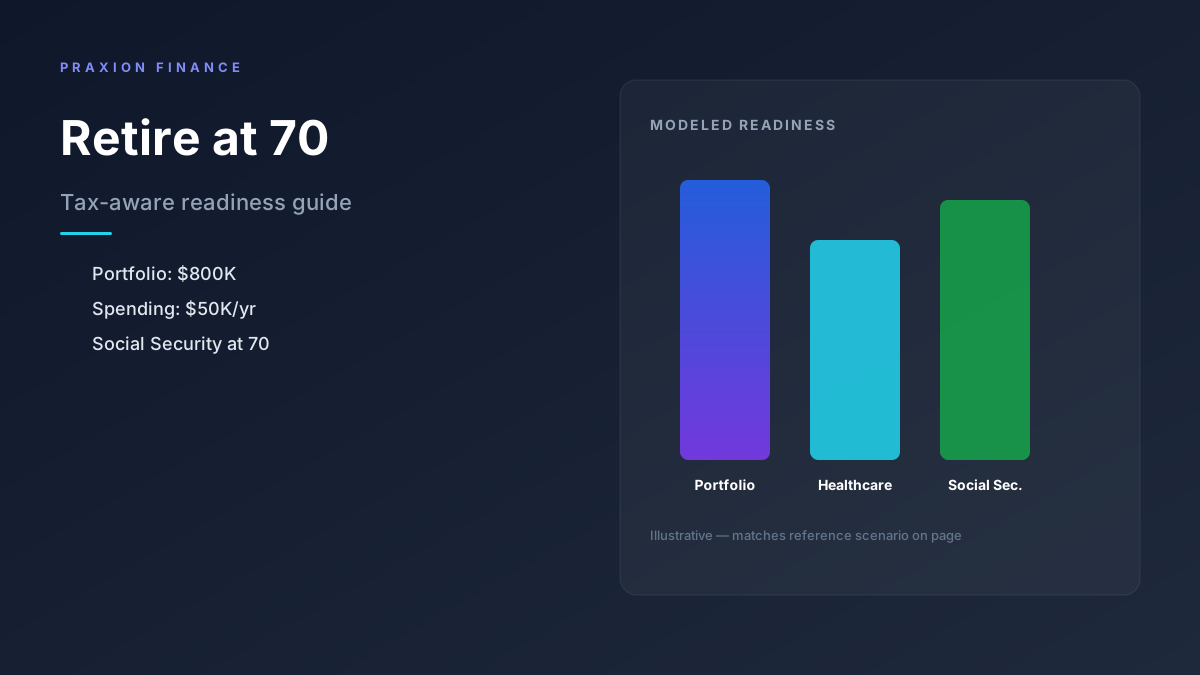
Defaults: age 68 → retire at 70, $800,000 portfolio, $50,000/yr spending today, Social Security at 70. Use the calculator above to see the illustrative band for these inputs.
Scenario comparison
Readiness bands use the same illustrative model as the calculator (today's spending inflated at 2.4%/yr to retirement age).
| Scenario | Portfolio | Spending | Illustrative band |
|---|---|---|---|
| Retire at 67, claim 67 | $750,000 | $48,000/yr | Likely covers modeled need |
| Reference (retire 70) | $800,000 | $50,000/yr | Likely covers modeled need |
| Retire 70, max Social Security | $850,000 | $52,000/yr | Likely covers modeled need |
Frequently asked questions
Is it worth working until 70 for Social Security?
Delaying from 67 to 70 increases benefits ~24%. Break-even versus claiming at 67 is typically early 80s. If longevity runs in your family or you can self-fund, delay often pays off.
How much do I need to retire at 70?
With maximum Social Security (~$35,000–$42,000/year for typical earners), the portfolio may only need to cover spending above Social Security — often $300,000–$600,000 for $50,000 total spending, depending on taxes and other income.
What about RMDs if I retire at 70?
RMDs begin at 73 (born 1951–1959) or 75 (born 1960+) — within 3–5 years of retiring at 70. Plan Roth conversions before RMDs if tax rates are favorable.
Can I retire at 70 with $500,000?
With Social Security at 70 covering $35,000+/year, $500,000 at 4% adds $20,000/year — potentially sufficient for $50,000–$55,000 total spending before taxes for many households.
Is retiring at 70 worth it for Social Security alone?
If you are healthy, can continue working, and do not hate the job — three years of delayed credits plus additional savings often improve lifetime income. If work is unsustainable, claiming earlier with a larger portfolio bridge may be the better trade-off. Model both in the calculator.
Ask Praxion AI
On a full plan, you can explore age-specific trade-offs in plain language — grounded in your numbers, not generic advice.
- Compare retiring at 67 vs 70 on my Social Security benefit
- How soon will RMDs affect my plan if I retire at 70?
Opens QuickStart — no account required to begin.
Explore next
Other retirement ages in this cluster:
Related guides:
- Early Retirement Roth Conversion Windows — Bracket-fill strategy before RMDs
- The 4% Rule Explained — Withdrawal rate basics and limits
- Retirement Care Costs — Healthcare and LTC benchmarks
- When Is a Good Time to Retire? — Timing vs savings amount
Model your full retirement plan
Free QuickStart runs tax-aware projections, Monte Carlo success probability, and Roth conversion analysis on your numbers.
Praxion Finance is a decision-support tool, not a registered investment adviser.