Introduction
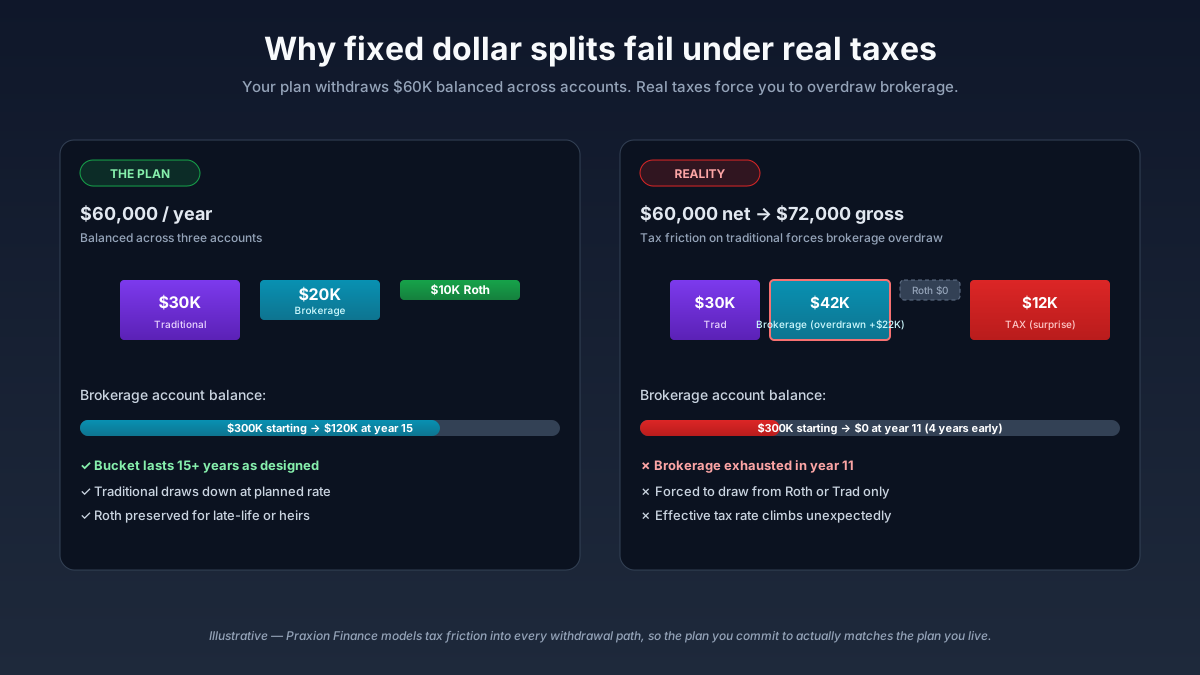
Fixed dollar withdrawal splits—for example, "$20k from brokerage, $60k from traditional, $15k from Roth"—are usually designed in a zero-tax world. Under real taxes, those same gross amounts deliver less spendable income. The plan has to pull the shortfall from the first bucket in order (usually brokerage). That overdraws brokerage every year, depletes it earlier, and eventually breaks the split, forcing a different draw order and outcomes that diverge from the original plan.
This isn't a bug. It's what happens when real tax friction meets rigid withdrawal rules. Below we show the math and real comparison data.
What a Fixed Split Assumes vs What Happens With Taxes
Many retirement plans use a fixed split: set dollar amounts from each account every year (all amounts below are in dollars). In a world with no taxes, every dollar withdrawn is a dollar you can spend:
- 20k brokerage + 60k traditional + 15k Roth + 5k cash = 95k spendable from bro/trad/Roth (100k total withdrawal; Profile A)
- 40k brokerage + 80k traditional + 30k Roth = 150k spendable
Once you add income tax on traditional (and possibly cap gains on brokerage), the same gross amounts no longer equal the same net spendable. Traditional withdrawals are taxed; only the after-tax portion is spendable. So the fixed split underdelivers net income, and something has to fill the gap—usually brokerage.
Total Portfolio Balance Over Time
Static (0% tax) vs Praxion Finance (real tax). Tax friction bends the curve and shifts depletion earlier.
Two Real Profiles: Conventional Retirement Calculator (Static Model) vs Real Taxes
We use two gold profiles (deterministic, 0% return, 0% inflation). The Conventional Retirement Calculator (Static Model) column is the design: fixed amounts, no tax. The "Under real taxes" column is what happens when the same split is run in an engine that withholds income tax on traditional withdrawals.
| Profile | Fixed split (design) | Total need (net) | Static Model (0% tax) | Under real taxes |
|---|---|---|---|---|
| Profile A | 20k brokerage + 60k traditional + 15k Roth + 5k cash | $95,000 | 95k net | 86.6k net → 8.4k shortfall |
| Profile B | 40k brokerage + 80k traditional + 30k Roth | $150,000 | 150k net | 138.25k net → 11.75k shortfall |
Roth and cash are tax-free. In these runs, brokerage had 0% cap gains. Traditional is taxed at the marginal rate, so net = gross × (1 − tax rate).
The Math: Why the Split Under-Delivers
Take a 95k spending target with a split of 20k brokerage, 60k traditional, 15k Roth, 5k cash.
In a 0% tax model:
20 + 60 + 15 = 95k from brokerage, traditional, Roth; + 5k cash = 100k total. In 0% tax, 95k net spendable. No shortfall.
In a real-tax model (e.g. 24% on traditional):
- Traditional net = 60 × (1 − 0.24) = 45.6k
- Total net = 20 + 45.6 + 15 + 5 = 86.6k
- Shortfall = 95 − 86.6 = 8.4k
If the engine must deliver 95k spendable (expense-based planning), it fills that 8.4k from the next bucket in order—here, brokerage. So brokerage withdrawal becomes 20 + 8.4 = 28.4k instead of 20k. The split is already broken in practice.
Net from the same fixed split (95k need):
| Scenario | Brokerage | Traditional | Roth | Cash | Total net | Shortfall | Filled from brokerage |
|---|---|---|---|---|---|---|---|
| Static Model (0% tax) | 20k | 60k | 15k | 5k | 95k | 0 | 0 |
| Real tax (24% on traditional) | 20k | 60k | 15k | 5k | 86.6k | 8.4k | Brokerage → 28.4k |
| Real tax (24% trad + 15% cap gains) | 20k | 60k | 15k | 5k | 82.6k | 12.4k | Brokerage → ~34k |
Why This Happens: Use It or Lose It
Fixed splits ignore a basic reality: your standard deduction is use-it-or-lose-it every year. If you don't have enough taxable income (e.g. from Traditional IRA or 401(k) withdrawals), you don't "use" that deduction—you get no tax benefit from it. For 2024, the standard deduction is about $14,600 (single) or $29,200 (married filing jointly). Withdrawing at least enough from tax-deferred accounts to fill that space, at 0% or 10% rates, is often modeled as favorable in tax-aware projections. Fixed splits don't do that; they lock you into arbitrary dollar amounts from each bucket regardless of your current bracket.
Observed Results: Conventional Retirement Calculator (Static Model) vs Tax-Aware Engine
These numbers come from a direct comparison: same withdrawal splits, 0% return, 0% inflation. One side assumes 0% tax (Conventional Retirement Calculator / Static Model); the other applies real income tax (Praxion Finance). Net spendable is the same in both; only the source of the money changes.
Profile A — $95k need (20/60/15/5)
| Metric | Static Model (0% tax) | Tax-aware engine | Difference |
|---|---|---|---|
| Brokerage withdrawal (per year) | $20,000 | $28,375 | +$8,375 |
| Traditional withdrawal | $60,000 | $60,000 | 0 |
| Roth withdrawal | $15,000 | $15,000 | 0 |
| Net spendable | $95,000 | $95,000 | 0 |
| Extra from brokerage (per year) | — | $8,375 | Tax shortfall |
| Cumulative extra (15 years) | — | ~$125,000 | Brokerage drains faster |
| By age 75 | Split still 20/60/15 | Brokerage exhausted; split breaks | Plan diverges |
Profile B — $150k need (40/80/30)
| Metric | Static Model (0% tax) | Tax-aware engine | Difference |
|---|---|---|---|
| Brokerage withdrawal (per year) | $40,000 | $51,750 | +$11,750 |
| Traditional withdrawal | $80,000 | $80,000 | 0 |
| Roth withdrawal | $30,000 | $30,000 | 0 |
| Net spendable | $150,000 | $150,000 | 0 |
| Extra from brokerage (per year) | — | $11,750 | Tax shortfall |
| Cumulative extra (25 years) | — | ~$294,000 | Brokerage exhausted by ~75 |
| By age 75 | Split still 40/80/30 | Brokerage = 0; split fails | Balances diverge |
At age 75, the zero-tax plan still had about $381k in brokerage. The tax-aware run had zero—brokerage was exhausted earlier because it absorbed the tax shortfall every year.
Brokerage Balance Over Time
Praxion Finance depletes brokerage earlier (tax shortfall); once it hits zero, withdrawal strategy must change.
Traditional (IRA/401k) Balance Over Time
Praxion Finance draws less from traditional early (brokerage covers shortfall), then more once brokerage is depleted; RMD can steepen the curve later.
How the Brokerage Gap Grows Over Time
With the same fixed split each year, real taxes pull extra from brokerage every year. The gap between the two plans grows linearly.
$95k need (20/60/15/5):
| Year | Extra from brokerage | Cumulative extra | Brokerage balance gap (tax-aware lower) |
|---|---|---|---|
| 1 | 8,375 | 8,375 | −8,375 |
| 5 | 8,375 | 41,875 | −41,875 |
| 10 | 8,375 | 83,750 | −83,750 |
| 15 | 8,375 | 125,625 | −125,625 |
| 20 | 8,375 | 167,500 | −167,500 |
$150k need (40/80/30):
| Year | Extra from brokerage | Cumulative extra | Brokerage balance gap |
|---|---|---|---|
| 1 | 11,750 | 11,750 | −11,750 |
| 10 | 11,750 | 117,500 | −117,500 |
| 20 | 11,750 | 235,000 | −235,000 |
| 25 | 11,750 | 293,750 | −293,750 |
Once the gap is large enough, the tax-aware plan cannot keep the fixed split—brokerage runs out first. Withdrawals then come from traditional (and Roth) in different proportions, and the plan diverges from the original design.
Withdrawal Composition by Year — Praxion Finance ($150k need)
Brokerage share falls to zero when depleted; traditional (and Roth) share rises. Static model would show constant 40/80/30.
An Alternative Approach: Tax-Efficient Sequencing
Research and practice often use a standard withdrawal sequence as the baseline: Taxable (brokerage) → Tax-Deferred (Traditional IRA/401k) → Tax-Free (Roth). The idea is to spend taxable first (often at favorable cap-gains rates), then use tax-deferred to "fill" low brackets, and preserve Roth for last. Many modeled plans emphasize bracket filling: withdraw from Traditional accounts up to the top of the 12% or 22% bracket (or whatever your target bracket is), rather than sticking to a fixed percentage or dollar split. One way to implement this is a waterfall method: cover spending first from taxable, then from Traditional up to your bracket cap, then from Roth as needed. That adapts to tax brackets instead of ignoring them.
The RMD Warning
Fixed splits can be a ticking tax bomb for Required Minimum Distributions (RMDs). If you take only a small portion from your Traditional account early in retirement (because the split says so), that account keeps growing. By age 73+, RMDs can become very large and push you into much higher tax brackets—the "RMD cliff." Tax-efficient sequencing, by contrast, deliberately draws down Traditional in earlier years within low brackets, reducing the balance that later gets hit by RMDs. Planning with real taxes and RMDs in mind avoids that cliff.
Why Fixed Withdrawal Splits Fail: Five Reasons
| # | Reason |
|---|---|
| 1 | Fixed splits are in gross dollars. With 0% tax, gross = net. With real taxes, traditional (and sometimes brokerage) give less net per dollar withdrawn. |
| 2 | The same gross split underdelivers spendable income. To hit the spending target, the engine has to take extra from the next bucket in order (here, brokerage). |
| 3 | Brokerage is overdrawn every year. So brokerage depletes faster than in the zero-tax design. |
| 4 | When brokerage is exhausted, the fixed split can't be maintained. The plan must pull from traditional and Roth in different proportions; balances and path diverge. |
| 5 | Roth and cash don't fix it. They're already tax-free. The shortfall comes from tax on traditional (and sometimes brokerage). The split fails because taxable buckets deliver less net than the zero-tax plan assumes. |
The failure is structural: tax friction plus rigid rules, not market randomness.
Estate Planning Caveat
One case where the "standard" order can be reversed: step-up in basis. If you hold highly appreciated stocks in a brokerage account, those assets get a tax-free basis reset at your death when left to heirs. In that situation, it may be modeled as favorable to spend from Traditional or Roth first and leave the appreciated taxable account to heirs—the opposite of the usual taxable-first sequence. Your goals (prioritize modeled lifetime spend vs. leave a tax-efficient legacy) help determine the order; fixed splits don't adapt to either.
What This Means for Retirement Planning
A simple way to see the impact is to compare ending wealth under a fixed split vs. a tax-analyzed withdrawal strategy (same spending, same market assumptions). In many scenarios, the tax-analyzed approach leaves more money at the end of the plan because it pays less in lifetime taxes.
| Strategy | Illustrative ending balance (25-year plan) | Why |
|---|---|---|
| Fixed split (e.g. 33% / 33% / 33%) | ~$1.2M | Brokerage overdrawn; Traditional under-drawn early, then large RMDs later; higher lifetime tax. |
| Tax-analyzed (bracket filling, sequence) | ~$1.5M | Fills low brackets with Traditional early; avoids RMD cliff; lower lifetime tax, more wealth preserved. |
Numbers are illustrative. Your result depends on balances, spending, brackets, and horizon. The point: the math of tax-bracket management favors adaptive withdrawal order over fixed splits.
Fixed withdrawal splits work in:
- Academic models
- Zero-tax illustrations
- Simple spreadsheet backtests
They break in:
- Real-world tax environments
- Multi-account retirement plans
- Long-horizon, cash-constrained planning
Under real taxes, the plan has to adapt—or it will diverge. That's why tax-aware, cash-constrained modeling matters, and why retirement analysis can't be done in a zero-tax vacuum.
Data and Assumptions
- Profiles: Gold profiles (deterministic, 0% return, 0% inflation): one with $95k need and split $20k/$60k/$15k/$5k ($100k gross), one with $150k need and split $40k/$80k/$30k ($150k gross). All split numbers are dollar amounts.
- Tax-aware engine: Same profiles run with expense-based need, default marginal rate on traditional (e.g. 24% or effective ~14.7% in one run), 0% cap gains in the comparison, Roth conversion tax paid from outside.
- Comparison: Praxion Finance tax-aware engine vs Conventional Retirement Calculator (Static Model), under identical withdrawal targets and assumptions.
Model Your Withdrawal Strategy With Real Taxes
Use Praxion Finance to run tax-aware projections and see how your plan holds up under real tax friction.
Related Articles & Tools
Disclaimer: Praxion Finance provides educational tools and is not a registered investment advisor (RIA). The information in this article is for illustrative and educational purposes only and does not constitute financial, tax, or legal advice. Consult a qualified professional for advice tailored to your situation.