How Much Do I Need to Retire at 50?
Retiring at 50 means funding 15 years before Medicare, 12+ years before Social Security, and navigating 59½ withdrawal rules — the savings multiple is often well above the classic 25× rule.
The short answer
Most “how much do I need” articles stop at 25× annual spending. At 50, that shortcut usually understates the problem: you may need the portfolio to cover 15 years of pre-Medicare healthcare, a decade of spending before penalty-free 401(k)/IRA access, and a 45-year planning horizon if you model to age 95.
A workable target depends on four inputs: annual spending (in today’s dollars), how much sits in taxable versus tax-deferred accounts, when you plan to claim Social Security, and whether a spouse’s income or employer coverage changes the healthcare line item.
The calculator below inflates spending to your retirement year, models pre-Medicare healthcare for bridge years only, and applies a horizon-based starting withdrawal rate. It is illustrative — not a substitute for Monte Carlo, account-level tax modeling, or your actual Social Security record.
What makes 50 different
Age 50 is the hardest early-retirement milestone in this cluster: the longest gap to Medicare, the strictest access rules on tax-deferred accounts, and the longest period your portfolio must survive market downturns.
Compared with waiting longer: Compared with retiring at 55, you add five more pre-Medicare years and five fewer years of catch-up contributions. Compared with 65, you roughly double the healthcare bridge and lose Medicare entirely from the base budget.
When retiring at 50 tends to work — and when it gets harder
Favorable signals
- Large taxable brokerage or Roth basis to fund ages 50–59½ without penalties
- Employer-sponsored retiree health coverage or a spouse’s plan that covers you until 65
- Pension or rental income that covers a meaningful share of baseline spending
- Flexible spending — you can trim discretionary costs if markets turn early in retirement
Challenging signals
- Most of the nest egg is in Traditional 401(k)/IRA with little taxable buffer
- High fixed spending with limited ability to cut healthcare or housing costs
- Planning to claim Social Security at 62 — portfolio must bridge 12 years with no Social Security income
- Single-income household with no employer coverage alternative before Medicare
Industry benchmarks (sanity check)
Industry savings-multiple guides (Fidelity, T. Rowe Price) rarely target “retire today at 50.” A more realistic framing: 12–15× annual spending as a floor, plus explicit budget lines for ~$15,000–$25,000/year pre-Medicare healthcare per person and a lower starting withdrawal rate (~3.0%) for a 45-year horizon. Post-65 healthcare still averages ~$185,500/person lifetime per Fidelity’s 2026 estimate — on top of anything you spend before 65.
Your numbers at 50
Adjust the inputs, then analyze for an illustrative readiness view. This public model is not Monte Carlo — it uses a constant withdrawal-rate heuristic plus modeled pre-Medicare healthcare bridge costs.
Must be 50 or younger on this page (you are planning a future retire-at-50 scenario).
Key variables at 50
Healthcare before Medicare
Medicare eligibility begins at 65. Retiring at 50 means 15 years of private coverage. Fidelity estimates lifetime retiree healthcare near $185,500 per person from 65 onward (2026) — pre-65 costs are additional.
59½ withdrawal rules
Most 401(k) and Traditional IRA withdrawals before 59½ face a 10% penalty unless you qualify for a SEPP (72(t)) schedule or Roth basis. Taxable brokerage and Roth contributions are more flexible for early-year cash flow.
Social Security timing
You cannot claim Social Security until 62 at the earliest. Retiring at 50 means the portfolio must bridge all spending for at least 12 years before any Social Security income — often longer if you delay claiming to grow benefits.
Roth conversion window
Low-income years between retirement and RMD age may create a Roth conversion window — converting Traditional balances at lower marginal rates before RMDs and IRMAA pressure rise.
Sequence-of-returns risk
Poor market returns in the first 5–10 years of retirement can permanently impair portfolio longevity. Monte Carlo simulation tests hundreds of market paths; a single withdrawal-rate rule cannot.
Worked example (reference scenario)
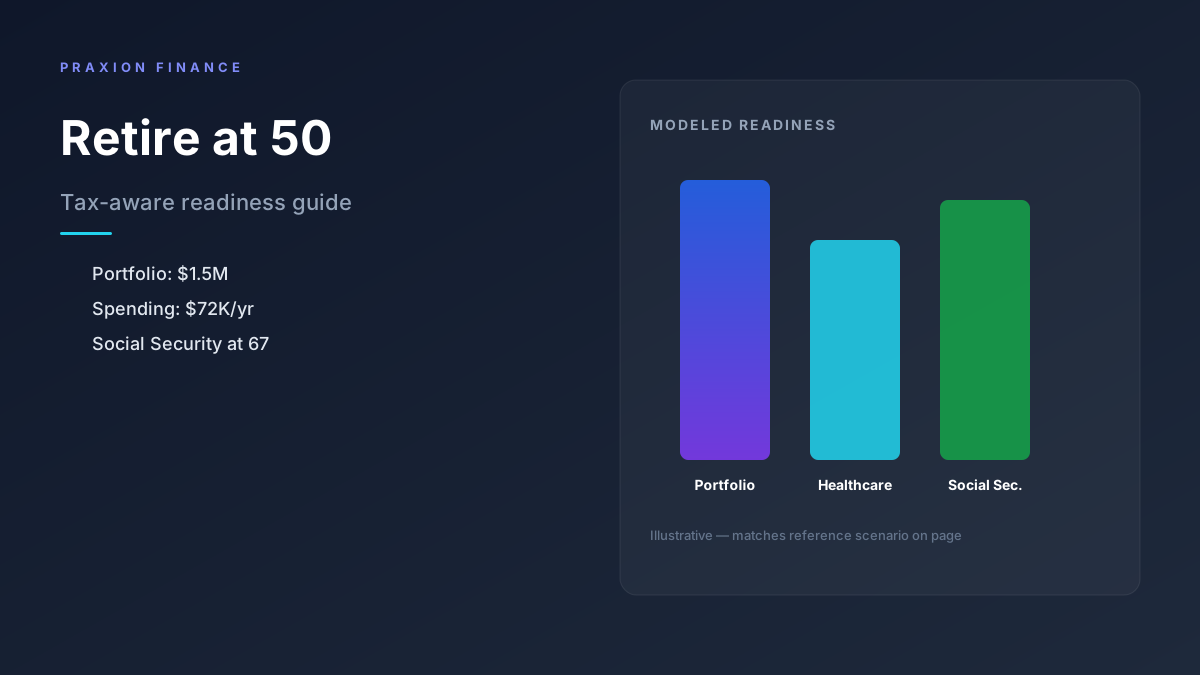
Defaults: age 47 → retire at 50, $1,500,000 portfolio, $72,000/yr spending today, Social Security at 67. Use the calculator above to see the illustrative band for these inputs.
Scenario comparison
Readiness bands use the same illustrative model as the calculator (today's spending inflated at 2.4%/yr to retirement age).
| Scenario | Portfolio | Spending | Illustrative band |
|---|---|---|---|
| Lean FIRE | $1,100,000 | $58,000/yr | Gap vs modeled need |
| Reference | $1,500,000 | $72,000/yr | Gap vs modeled need |
| Comfortable | $2,200,000 | $90,000/yr | Tight vs modeled need |
Frequently asked questions
Is $2 million enough to retire at 50?
$2 million at 50 may support roughly $60,000–$66,000/year using a 3–3.3% starting withdrawal before taxes and healthcare — but pre-Medicare healthcare and a 45-year horizon mean many households need more conservative assumptions. Run your specific spending and account mix through a full plan.
How much should I have saved by 50 to retire at 50?
Rules of thumb suggest 12–15× annual spending for a 50-year-old targeting immediate retirement, versus 10× for a traditional 65 retirement. The exact target depends on pension income, spouse benefits, and how much sits in taxable versus tax-deferred accounts.
What about healthcare if I retire at 50?
Medicare starts at 65. From 50 to 65, most retirees purchase ACA marketplace coverage or COBRA. Modeled pre-Medicare costs often run $15,000–$25,000 per year for an individual — a line item that a 25× expenses rule ignores entirely.
Can I access my 401(k) at 50?
Generally not without penalty before 59½, unless you use SEPP (72(t)) distributions, retire from the employer at 55+ with that plan (Rule of 55), or withdraw Roth contributions. Many early retirees lean on taxable brokerage and cash reserves first.
How does retiring at 50 compare to the FIRE 25× rule?
The 25× (4%) rule assumes a 30-year horizon and often ignores pre-Medicare healthcare and early withdrawal penalties. Many planners modeling to age 95 from 50 use 28–33× spending or a 3–3.3% starting rate instead — before taxes and healthcare.
Ask Praxion AI
On a full plan, you can explore age-specific trade-offs in plain language — grounded in your numbers, not generic advice.
- What if I retire at 50 but claim Social Security at 62?
- How much Roth conversion room do I have between 50 and 65?
Opens QuickStart — no account required to begin.
Explore next
This page models a fixed retirement age of 50. For variable FIRE age, FIRE number, and poor-market stress bands, use the FIRE calculator.
Pre-Medicare healthcare bridge: Can you afford healthcare before Medicare?
Other retirement ages in this cluster:
Related guides:
- Early Retirement Roth Conversion Windows — Bracket-fill strategy before RMDs
- The 4% Rule Explained — Withdrawal rate basics and limits
- Retirement Care Costs — Healthcare and LTC benchmarks
- When Is a Good Time to Retire? — Timing vs savings amount
Model your full retirement plan
Free QuickStart runs tax-aware projections, Monte Carlo success probability, and Roth conversion analysis on your numbers.
Praxion Finance is a decision-support tool, not a registered investment adviser.